
A complete family guide to Halifax, Nova Scotia. The best things to do with kids, where to stay and eat, day trips to Peggy’s Cove, and how long to stay.

Somebody, somewhere, at some point decided that Halifax was “the Vancouver of the East.” I have been to both cities this year, and I can tell you with A great deal of confidence that whoever coined that phrase hadn’t looked very closely at either city.
It is a lazy comparison, and it does Halifax a disservice twice over. It implies that one of Canada’s oldest and most character-heavy capitals needs to be measured against a sprawling metropolis the better part of a continent away. And it implies that Halifax has to live up to its much larger sibling on Canada’s west coast.
It does not. Halifax proudly stands on its own, and not just for the reasons the local travel brochures like to lay out in their pretty pages. Here is what you actually need to know about travel to Halifax before you book your trip.
About Halifax
Halifax is the capital of Nova Scotia; it is built around one of the largest natural harbors on Earth, and the downtown core is small enough that a family can walk most of it in an afternoon. Halifax Stanfield International Airport sits about 35 km (22 miles) north of downtown, roughly a 35-minute drive. From that compact little downtown, you are 45 minutes from a legitimate North Atlantic surf beach, an hour from the most photographed lighthouse in Canada, and about 90 minutes from a UNESCO World Heritage town.
Halifax is a city that doesn’t make you choose between culture and wild, adventure and comfort. It hands you both sides of the travel experience in the same day, and you don’t even need to drive for hours to experience them both.
My family has been traveling to Halifax for years. We’ve done the full tourist circuit: the Citadel, the ferry, George’s Island, a seafood dinner in a haunted restaurant, those unforgettable sunsets at Peggy’s Cove followed by wiping donair sauce off our chins because we couldn’t wait to sit down and eat them. This past summer I came back on a father-son trip with my twelve-year-old son Dylan with the goal of seeing a completely different side of Halifax from what the travel brochures show you. We treated the city as a basecamp instead of a cruise ship port. Both trips showed that there are two sides to Halifax. There’s the Halifax that everyone else does, and then there’s the Halifax that gives you stories that no one else is talking about.
This is the guide I wish someone had handed me the first time that I traveled to Nova Scotia. Every attraction, neighborhood, restaurant, and day trip below is here because it earns a spot on a family itinerary, not because it fills out a list.
Framily Travel To Halifax: Quick Planner
Where: Halifax, Nova Scotia, on Canada’s Atlantic Coast.
Getting there: Halifax Stanfield International Airport (YHZ) sits about 35 km (22 miles) north of downtown. Rent a car if you’re planning on exploring outside of downtown Halifax.
How long: Three days for the city of Halifax. Five if you want to include the Eastern Shore, Peggy’s Cove, or the Nova Scotia lighthouse route.
Best time to visit: Late June through early October. July and August are best for beach weather; September is ideal for warm water and smaller crowds.
Top picks: Maritime Museum of the Atlantic, Halifax Citadel, the Dartmouth Ferry, Georges Island, Mezza or King of Donair.
Plan ahead: Georges Island runs a limited ferry season and cancels trips in rough weather. Book it the moment you have a firm date.
Don’t miss: Walking the waterfront boardwalk to see what boats tied up overnight.
Why Halifax Works So Well for Families

Most cities make you pick a side. You get the museums, or you get the coastline. The good restaurants or the wilderness. You choose one, and then you spend half a day in a car getting to the other.
Halifax is a choose-your-own-adventure kind of location. From adventure to museums, great food, to cultural experiences, everything is nearby. That alone is the single best argument for bringing kids here. You can spend a morning inside a museum ogling at the complexity of lighthouse beacons, and in the afternoon, you’re getting flattened by North Atlantic surf as you try to ride the waves. You can climb through a star-shaped fortress before lunch and be standing on the deck of a visiting tall ship by three. The adventure is not a day trip from Halifax. Everything you want is in the city’s backyard.
The truth is that visiting downtown Halifax is easy. The city core is compact, walkable, and built on a hill that slopes down to the water, which means almost everything worth seeing is within a reasonable stroll of the boardwalk. Kids can burn energy outdoors between indoor stops. The waterfront has playgrounds, benches, ice cream, and enough boats coming and going that even a bored nine-year-old finds something to watch.
And the weather, which I will return to more than once in this guide, is an active participant in your trip whether you invite it or not. Maritime weather changes its mind constantly. That sounds like a warning. It is actually the reason this city has so many excellent indoor options, and the reason a rained-out day here is rarely a wasted one.
And, hey, if the weather changes in Halifax. Just wait five minutes. It’ll probably change again.
Kjipuktuk: The Name That Came First
Long before the colonization of Halifax, and the crowded ports of1749, the Halifax harbor was known to the local Mi’kmaq as Kjipuktuk, which translates to “the Great Harbor.” It was a gathering place, and the rivers flowing into the basin functioned as traditional highways across Mi’kma’ki. Halifax sits on unceded Mi’kmaw territory. These territories expand well beyond what is now the city of Halifax, southwest to the Acadian Shores, northeast to Cape Breton Island, and up through neighboring New Brunswick regions including Moncton and Fredericton. Those routes continue on into what is now Quebec.
Discover Halifax maintains a good guide to Mi’kmaw culture in Kjipuktuk that is worth reading with older kids before you arrive, and the Halifax Citadel now includes Mi’kmaw interpretation among its exhibits. Teaching a child that a place had a name, and a people, and a purpose long before a British fort turned up on the hill is one of the more valuable things you can do with a travel day.
A City That Keeps Getting Back Up
Halifax was founded in 1749 as a British military town, and the Citadel fortress on the hill was built to defend a harbor that nobody ever managed to attack. The Citadel has never fired a shot in anger, which gives it a certain smugness when you look up at it from the waterfront.
The sea, on the other hand, has hit this city repeatedly. In 1912, Halifax became the recovery port for the Titanic, and the bodies pulled from the North Atlantic were brought here. Three cemeteries in the city hold the graves of many of those who were lost. In 1917, another maritime disaster occurred when two ships collided in the harbor and produced the largest human-made explosion the world had ever seen, a record that stood until the atomic age. The north end of the city was flattened. Thousands died.
You cannot understand Halifax without understanding that this city and its people have been knocked down and stood back up more times than most countries. That resilience runs through the museums, the neighborhoods, and honestly through the people serving you dinner. It also gives a family visit here real substance. There are places you take kids to have fun. Halifax is a place you take kids to have fun and come home with a great understanding of the strength of Atlantic Canadians.
Getting to Halifax and Getting Around

Halifax Stanfield International Airport (YHZ) is the main gateway to Atlantic Canada, with direct flights from across Canada, several US cities, and seasonal service from Europe. It sits about 35 km (22 miles) north of downtown along Highway 102, which is a 30 to 40 minute drive depending on traffic.
If you hope to explore beyond the center of town, I highly recommend that you rent a car. I know that a compact, walkable downtown sounds like an argument against it, and for the city core alone you could get by without one. But some of the best things to do in Halifax with kids lie outside the peninsula, and none of it is well served by transit. Peggy’s Cove, the Eastern Shore, Lunenburg, the surf beaches- all of it needs wheels or an organized tour to get there. Every rental agency operates out of the airport terminal, or you can book ahead here.
Once you are downtown, park the car and leave it at the hotel or on one of the city’s central lots. Halifax’s core is highly walkable, though you should know that everything is on a hill and the hill runs down to the water. That makes for a delightful stroll in the morning, and a quad-burning climb at the end of a long day depending on where your hotel is. Plan your route so the uphill happens when everyone still has fuel.
For crossing the harbor, use the Halifax Transit ferry to Dartmouth. It is the oldest continuously operating saltwater ferry service in North America, running since 1752, and it costs the price of a regular city transit fare. It is also, by a wide margin, the cheapest harbor cruise you will ever take. Sit on the top deck facing back toward the city and let your kids think they have gotten away with something.
The Best Things To Do in Halifax With Kids
This is the core of this family guide to Halifax. To help you plan your trip, I’ve grouped these experiences roughly by where they sit rather than ranking them from best to worst, because that’s all conjecture and what’s incredible for me may not hit the spot for you. Start on the waterfront, work uphill, then spread outward.
Walk the Halifax Waterfront Boardwalk
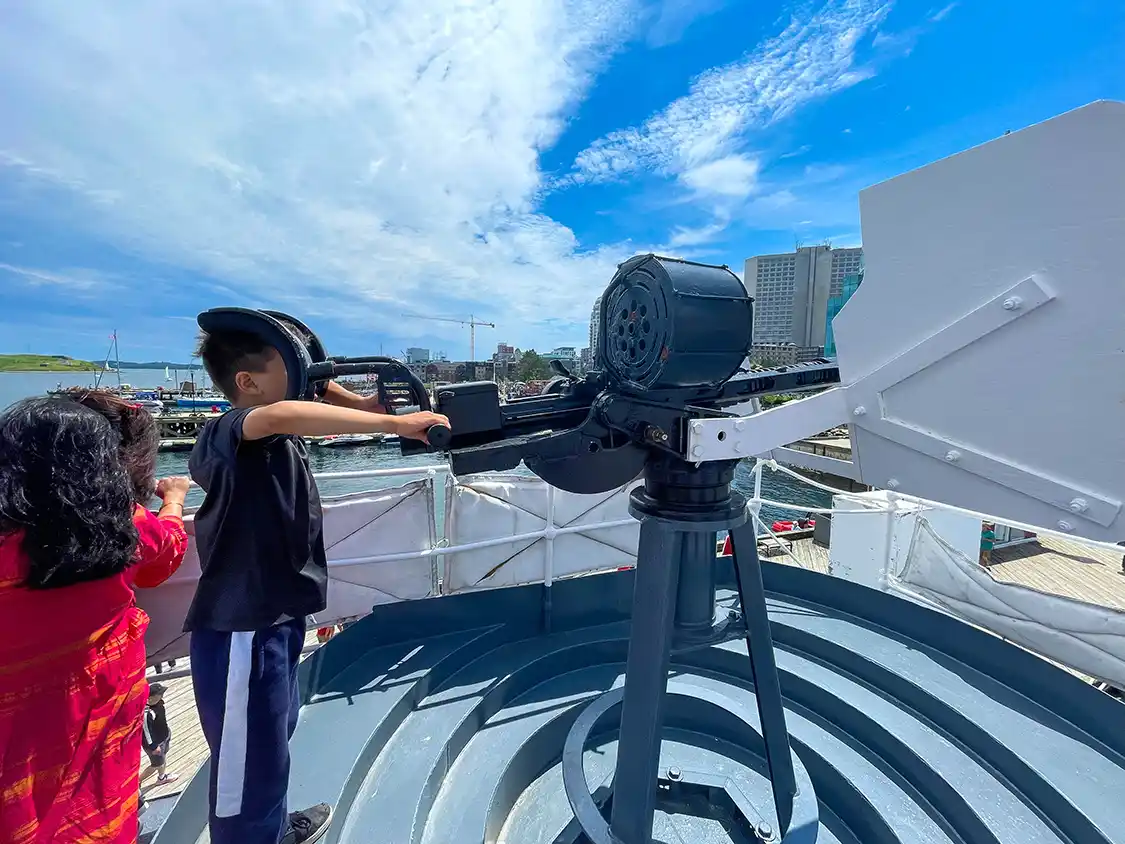
The Halifax boardwalk runs for a little over 2 miles (3.2 km) along the harbor, and it is the spine of any family visit to this city. It is also the single best free thing to do in Halifax, and I want to make an argument for setting aside some time to do it with no agenda whatsoever.
Here is why. On our last trip to Halifax, Dylan and I came out of a museum into a nearly empty, rain-soaked waterfront and found a three-masted tall ship tied up a short walk down the boardwalk. Steel hull, sailors on deck in the drizzle. It turned out to be the Mircea, a sail training vessel of the Romanian Navy and one of the last great working sail training ships on Earth. The crew waved us over and asked if we would like to come aboard and have a look around.
These are the kind of Halifax experiences that you can’t plan around. You can only be there at the right time and see how the adventure unfolds. On any given day, the Halifax boardwalk might have the iconic Bluenose II in port or a naval vessel, or a cruise ship that blocks out the sky, or nothing at all except the wave sculpture that every kid in Nova Scotia has climbed on and every parent in Nova Scotia has photographed them either sliding down, or in Dylan’s case, jumping off. An unstructured hour to stroll the boardwalk lets Halifax unfold the way it wants to, and that’s the best way to experience it.
Can’t-miss spots on the Halifax boardwalk for families
- The Wave, a large curved concrete sculpture kids will immediately climb, with predictable results in wet weather.
- Several playgrounds and splash areas scattered along the route.
- Food stalls, ice cream, and the Halifax Seaport Farmers’ Market at the southern end.
- Benches positioned so that adults can sit while children run out their batteries. Whoever designed this understood parents.
- Waterfront artwork like the drunken lampposts, which you can read more about here.
The Maritime Museum of the Atlantic
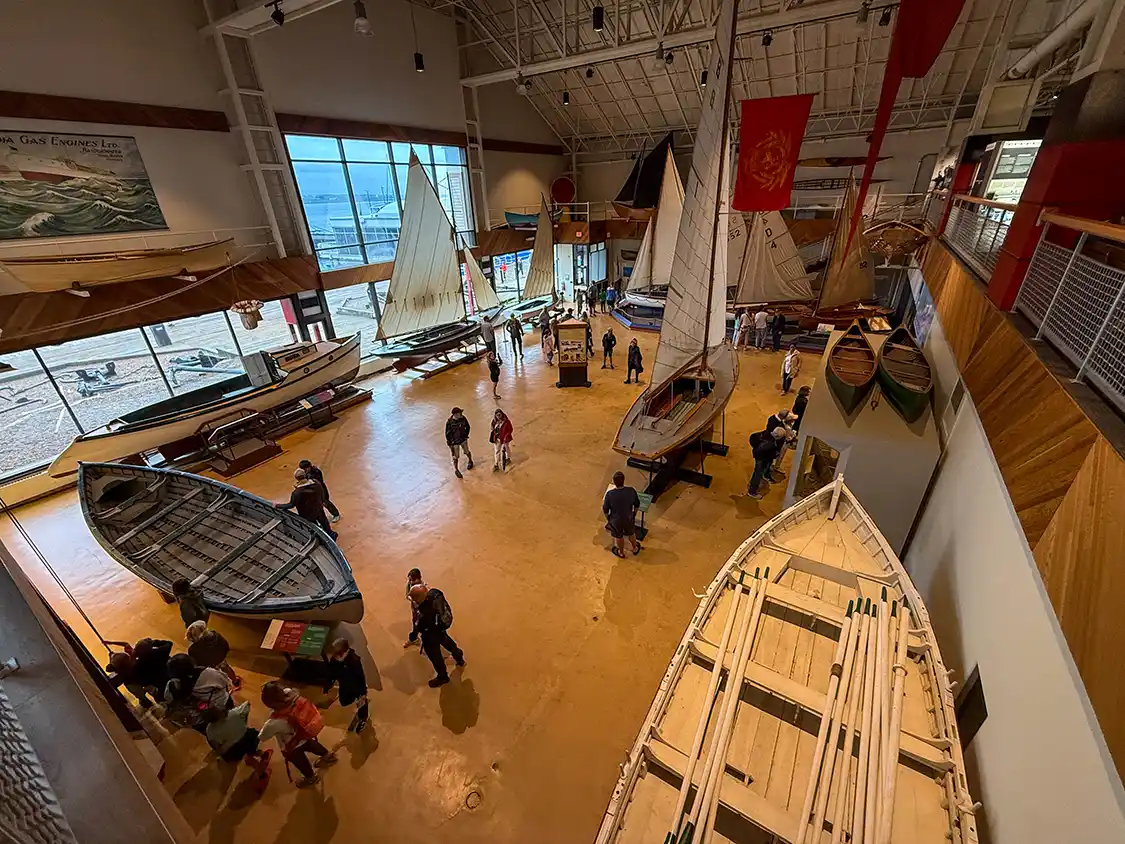
The Maritime Museum of the Atlantic is the single best rainy day stop in Halifax, and it was one of the genuine surprises of my recent father-son trip with Dylan. I came in expecting an hour of model ships and historic photographs. I left having spent 15 minutes alone just staring in awe at the complexity of lighthouse lamps.
Here is what got me. I had always assumed that a lighthouse was, functionally, a lamp in a tower. Then you stand in front of one of the museum’s lighthouse lenses and realize the lens is the entire point. Hundreds of hand-ground glass prisms, arranged with absurd precision, bend scattered light into one beam that a ship can find from 20 miles (32 km) out at sea. It is one of the most beautiful pieces of engineering I have ever looked at, and I stood in front of it far longer than I expected to.
The museum also holds the world’s largest collection of wooden artifacts recovered from the Titanic, including a deck chair. Halifax was the recovery port, and the museum tells that story without sensationalizing it. The Titanic gallery includes a pair of small leather shoes belonging to a child whose body was recovered from the water and who went unidentified for nearly a century. Know that going in. For most kids over about nine, it lands the right way, quietly and seriously. For younger ones, it is worth walking through first yourself.
The Halifax Explosion gallery covers 1917 with the same steadiness, and the CSS Acadia, a survey ship that lived through both world wars and the Explosion itself, is moored alongside and open to board in season. Kids get to go below deck on a real ship that has actually been somewhere. That never fails.
Planning note: budget more time than you think. We planned an hour and a half and used nearly three, and Dylan is not a museum kid.
Halifax Citadel National Historic Site

The Halifax Citadel is the star-shaped fortress sitting on top of the tallest hill in town, glaring down at the harbor it was built to protect and never once had to. It is the most recognizable landmark in the city. The Halifax Citadel is run by Parks Canada, and it is one of the greatest natural historic sites in Canada for families.
The reason is the 78th Highlanders. Costumed interpreters drill, march, play the bagpipes, and fire rifles on the parade square throughout the day, and there is a Royal Artillery detachment that fires the noon gun. If you are anywhere on the peninsula at midday, you will hear it. Being inside the fortress when it goes off is a different experience entirely, and I recommend timing your visit for it. Bring ear protection for toddlers.
Beyond the ceremony, kids can walk the ramparts, explore the defensive ditch, and go through the Army Museum in the cavalier building. Parks Canada also runs family programming and, for older kids with a taste for the macabre, evening ghost tours.
The grounds are open year-round, and the views over the harbor from the ramparts are the best in the city. Check current hours, programming, and admission on the Parks Canada site before you go, because the interpretive season does not run all twelve months and Parks Canada occasionally runs free admission promotions that are worth knowing about in advance.
Canadian Museum of Immigration at Pier 21

Between 1928 and 1971, nearly one million immigrants entered Canada through this building; my one-year-old Nana and her family were among them. The Canadian Museum of Immigration at Pier 21 now occupies the shed they walked through, at the southern end of the waterfront next to the Seaport Farmers’ Market.
What makes this a great stop for families, whether they’re descended from immigrants or are immigrants themselves, is that it is built around the stories of the people who walked through its halls rather than the date when they did it. It’s easier to connect with stories that follow individuals. You’ll learn what a family was allowed to bring, what happened in the examination line, what it felt like to step off a ship into a country you had only heard about. There is a historic rail car on site, because for most arrivals the shed was only the first stop before a long train ride west.
If anyone in your family arrived in Canada by sea in the twentieth century, the museum’s research center can look them up in the passenger records. Doing that with a kid, and putting a great-grandparent’s name on a screen in the building they actually walked through, is the kind of travel moment that sticks.
For me, this opened up the chance for me to share the story of my Nan, a woman that they never met, with my kids. The struggles her family endured, the reason they transited across the Atlantic to a new home, the strength required to become new Canadians
The Discovery Center
The Discovery Center on Lower Water Street is the straightforward, unapologetic, hands-on science center experience in Halifax. It’s a fantastic wet weather option, especially for families visiting Halifax with you kids. You’ll find four floors of interactive galleries, a health and energy focus, Atlantic Canada’s only dome theatre, and a dedicated area for the under-sevens.
Older kids will move through the museum fast; set aside an hour or so for them. Under-tens will need to be physically extracted. Know which you have before you plan your day around it.
Georges Island National Historic Site

That green humped island sitting in the middle of Halifax Harbor is Georges Island, and for most of its history you could step on its shores. It opened to visitors relatively recently, and it remains one of the most rewarding half-day excursions in the harbor.
The island holds Fort Charlotte, a Martello tower and fortification complex with a system of underground tunnels beneath it. Parks Canada runs interpretation on the island; there are trails, beaches, picnic areas, and a set of red chairs positioned so you are looking back at the Halifax skyline from the water. Plan on one to two hours.
Here is the critical part, and I am putting it in bold because I do not want this to ruin someone’s day: the island is accessible by sea only, the season is short, the ferry does not run every day, and it is canceled outright in heavy rain or rough water. Ferry service is run by Ambassatours. Book as soon as you have a firm date, and confirm before you drive downtown.
Ride the Dartmouth Ferry
I mentioned this under getting around, but it deserves its own entry because it is the highest value-to-effort ratio activity in the entire city.
The Halifax to Dartmouth ferry has been crossing this water since 1752, making it the oldest continuously operating saltwater ferry service in North America. The crossing takes about twelve minutes. You pay a standard transit fare. You get the definitive Halifax skyline view, the Citadel on the hill behind it, container ships and naval vessels sliding past, and a kid who is convinced they are on a boat adventure.
Once you land at Alderney Landing in downtown Dartmouth, you are in a neighborhood that has quietly become one of the better places to eat and browse in the region, with its own farmers’ market, a walkable main street, and a completely different feel from the Halifax side. We have spent whole afternoons over there. Ride back at golden hour.
The Harbour Hopper

The Harbour Hopper is a bus that is also a boat. It drives you around the city, then drives directly into the harbor and keeps going. It sounds ridiculous. I knew that when I booked it. It is unapologetically touristy, and I am telling you right now that it is a great time.
The land portion covers the Citadel, the Public Gardens, the historic properties, and the neighborhoods, with commentary that has improved considerably in recent years to include Mi’kmaw and African Nova Scotian history rather than just British military anecdotes. Then the vehicle rolls down a ramp and into Halifax Harbor, which produces a reliable and excellent reaction from everyone aboard under the age of fifteen.
A word of honesty, because the playbook here is that you get the real version. Our Harbour Hopper went out in fog. Not light fog. The kind that rolled in fast and thick enough that word came over the radio that harbor boat tours were being canceled across the board. Our captain took us into the water anyway, turned a slow circle in the grey, and brought us back. I saw almost nothing. I still enjoyed it, and Dylan enjoyed it more than I did, but if you have one shot and the forecast is socked in, consider moving it.
Rent a Sea-Doo on Halifax Harbor

This is the fastest possible way to understand the scale of what Halifax is built around. We rented from Harbour Watercraft on our last afternoon, when the sky finally broke after two days of rain, and it reframed the entire city for me.
Halifax Harbor is deep, ice-free, and one of the largest natural harbors on the planet, which is the reason the city exists at all. From a boardwalk, it is scenery. From the water, it is a working port, and the scale is startling. We ran out past Georges Island, past schooners under sail, past a cruise ship that blotted out the sky, and past a yacht so absurd that Dylan and I spent ten solid minutes theorizing about who could possibly own it.
This one has an age floor and a licensing requirement, so it skews toward families with tweens and teens rather than younger kids. Check the operator’s minimum age and operator card requirements when you book. For a twelve-year-old on a father-and-son trip, it was the highlight of five days.
Halifax Public Gardens
The Halifax Public Gardens are a formal Victorian garden in the middle of the city, a National Historic Site, and one of the finest surviving examples of the form in North America. There is a bandstand, a duck pond, serpentine paths, and in summer a small concession where you can get an ice cream and let everyone slow down for half an hour.
This is not a thrilling stop. That is the point. Somewhere in the middle of a packed family itinerary, there needs to be a place where nobody is learning anything, and nobody has to be anywhere, and the Public Gardens are the best one in Halifax. It is a short walk from the Citadel, which makes the pairing obvious: fortress in the morning, gardens after, nap optional.
Point Pleasant Park
At the southern tip of the peninsula, Point Pleasant Park covers 185 acres of forest, shoreline, and eighteenth century military ruins, with the Prince of Wales Tower, the oldest Martello tower in North America, sitting in the middle of it.
The trails are wide, well-maintained, and gentle enough for small legs, and they lead past gun batteries and fortifications half swallowed by trees, which is far more interesting to an eight-year-old than a plaque ever will be. Black Rock Beach gives you shoreline access and a view of ships coming into the harbor. Container vessels pass close enough that kids can read the lettering.
One fun fact that your kids will enjoy, and you will end up repeating at dinner parties: the land is still technically leased from Britain for one shilling a year, and the lease runs to the year 2865. The Halifax Trails guide to Point Pleasant has good trail maps if you want to plan a specific loop.
The Africville Museum
The Africville Museum sits on the shore of the Bedford Basin in the north end, in a replica of the Seaview United Baptist Church. It tells the story of Africville, a Black Nova Scotian community that lived on this land for more than 150 years, was denied basic municipal services the rest of the city received, and was demolished by the City of Halifax in the 1960s. Residents were relocated, some in city dump trucks.
Africville has since been recognized by UNESCO as a Place of History and Memory Linked to Enslavement and the Slave Trade. The museum is small, and it is run by the community, which is exactly why it works. There is a guided tour and a self-guided walking audio tour of the site accessible by QR code.
I want to be direct about why this belongs in a family guide. It is uncomfortable. It is supposed to be. Canada teaches its children a fairly flattering version of itself, and an hour here complicates that in a way that is appropriate for kids from roughly age ten upward. If you are going to bring your family to a city and take its history seriously, you do not get to only take the parts with cannons and lighthouses.
Fairview Lawn Cemetery and the Titanic Graves
When the Titanic went down in April 1912, Halifax was the closest major port, and the ships sent to recover bodies sailed from here. One hundred and twenty-one of the victims are buried at Fairview Lawn Cemetery, in three curving rows laid out to echo the shape of a ship’s hull.
It is free, it is quiet, and it takes about half an hour. The headstones carry the same date, and for a lot of kids that single repeated line does more than any documentary. One grave, marked only as an unknown child for decades, became one of the most visited. Another belongs to a man named J. Dawson, which has resulted in an enormous amount of misplaced movie-related pilgrimage and a small sign from the cemetery gently explaining the situation.
Pair this with the Titanic gallery at the Maritime Museum, in that order if you can. The museum gives the story, the cemetery gives it weight.
Halifax Seaport Farmers’ Market
The Halifax Seaport Farmers’ Market sits at the southern end of the boardwalk next to Pier 21. It descends from a market founded in 1750, which makes it one of the longest continuously operating farmers’ markets in North America, and it is at its fullest on weekends.
For a family, it is a good breakfast plan and a better rainy morning plan. Local producers, prepared food from a wide range of cuisines, crafts, and a rooftop with harbor views. Give each kid a small budget and let them choose their own lunch. It goes better than you would expect.
Halifax Central Library
It’s pretty rare that I put a library in one of my family travel guides, but trust me on this one. The Halifax Central Library on Spring Garden Road is an architectural landmark that looks like a stack of books shoved slightly out of alignment, and the top floor has a rooftop terrace with one of the best free views in the city.
Inside, there is a substantial children’s section, comfortable seating, washrooms, and a fifth-floor cafe. On a cold or wet afternoon when everyone has run out of patience, it is a warm, free, no-pressure place to reset for an hour. Every parent traveling with kids needs a building like this in their back pocket, and most cities do not have one this good.
Sir Sandford Fleming Park and the Dingle Tower
The Dingle, as locals call it, is a wooded park on the Northwest Arm with a stone memorial tower you can climb for views over the water, a small beach, walking trails, and a duck pond. It sits well outside the tourist circuit, which is exactly its appeal. This is where local Halifax families actually go on a Saturday, and half an hour here tells your kids more about the city than a bus tour will.
The Hydrostone District
After the 1917 Halifax Explosion flattened the north end, a section of it was rebuilt using poured concrete blocks, giving the neighborhood its name and a look you will not find anywhere else in Canada. The Hydrostone Market is a short, tree-lined commercial strip with independent shops, bakeries, and restaurants, and the residential streets around it have wide central boulevards that were a deliberate part of the reconstruction.
There is no admission and no attraction here. It is a neighborhood built out of a catastrophe, and walking it after visiting the Explosion gallery at the Maritime Museum closes a loop that most visitors never complete.
Shubie Park, Dartmouth
Across the harbor in Dartmouth, Shubie Park follows a section of the historic Shubenacadie Canal through woods and along lakeshore, with easy flat trails, a beach, and a campground. The canal system itself follows a route the Mi’kmaq used for generations to travel between the Atlantic and the Bay of Fundy. Pair it with the ferry crossing and a meal in downtown Dartmouth for a very easy, very pleasant half-day that costs almost nothing.
Day Trips From Halifax: Top Things To Do Near The City
Halifax’s greatest asset is the incredible towns, beaches, and historic spots that surround the city. Three directions, three completely different adventures. Here is how to think about them.
Peggy’s Cove


Peggy’s Cove lies 45 km (28 miles) southwest of Halifax, about a 45-minute drive, and it is the most photographed lighthouse in Canada for a reason. Granite slabs running down into the Atlantic, a working fishing village, and a lighthouse that earns its reputation. I have seen it at sunset in clear air with waves detonating against the rock, and it absolutely belongs among the most beautiful lighthouses on Earth.
I have also seen it in thick fog and driving rain, and I want to tell you what happened, because it changed how I think about the place. The rocks were slick, and you could not see the water until you were nearly in it. It was still dramatic, but it was genuinely dangerous, so we turned our backs on the lighthouse and looked at the village instead. We visited every shop, cafe, and restaurant that was open. All of them.
Here is what I did not know about Peggy’s Cove. Underneath the most photographed lighthouse in Canada, there is a real working art community. Tom’s Lobster Shack, where Tom himself built us what I would argue is the perfect lobster roll. Amos Pewter, a working pewter studio where you watch molten metal poured and spun. Margaret’s Cafe, the best place in the village to get out of the rain with a coffee and a hot chocolate. And Hags on the Hill, a co-op market run by fourteen Nova Scotia artists who all live within a short drive of the village. Watercolor painters like Neil Depew. Pewtersmiths. Fourteen artists in one co-op alone.
This is not a fishing village with a gift shop. It is a fishing village that turned into an art colony, and almost nobody notices, because they are all looking at the lighthouse.
Important safety note about Peggy’s Cove: People die on the rocks at Peggy’s Cove every year. The black granite closest to the water is wet, and the waves are unpredictable and far stronger than they look. Stay on the light colored rock, hold your children’s hands, and tell them to do the same. Most of all, do not turn your back on the ocean for a photo. I have written a full guide to visiting Peggy’s Cove that I wrote for We Explore Canada here.
Nova Scotia’s Eastern Shore

Run your finger east along the map, past Dartmouth, and the coastline starts to fray into something wilder. Inlets, granite ridges, salt marshes, surf beaches, and tiny Acadian communities strung along single-lane roads with more potholes than houses. It is a 45-minute drive from downtown Halifax and about as far from a cruise ship port as you can get.
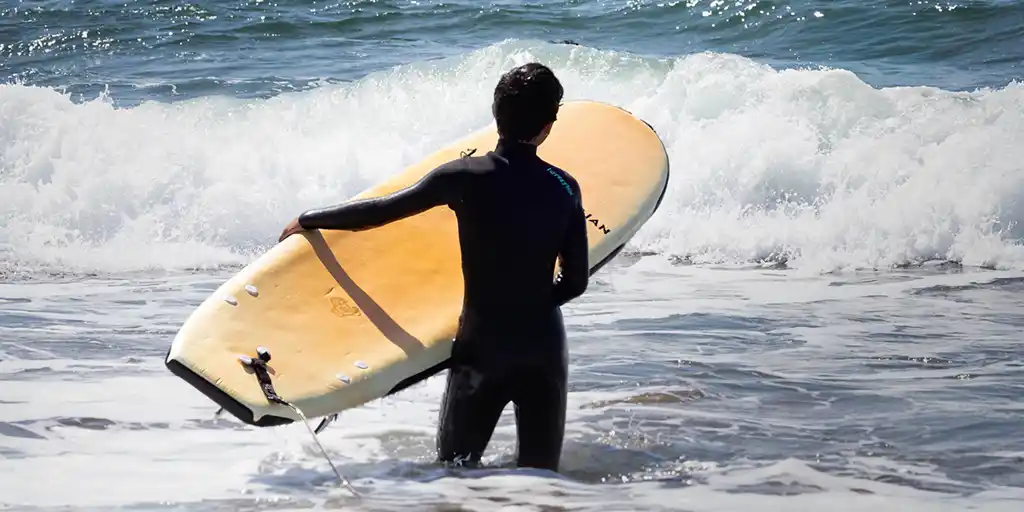
Dylan and I spent three nights out there in a geodesic dome above Porters Lake, and it was the best decision of the trip. Lawrencetown Beach is one of the best surf destinations in Canada, and the summer swell is friendly enough for first-timers, which I can confirm because I took a lesson there and spent ninety minutes being enthusiastically dismantled by the Atlantic while my twelve-year-old stood up inside thirty. The Musquodoboit Trailway runs fifteen kilometers along a former rail bed. Martinique Beach is the longest beach in Nova Scotia, and we had five kilometers of white sand nearly to ourselves at golden hour.
The Eastern Shore deserves more room than a day trip section can give it, so it has its own full guide. If you have five days in the region rather than three, this is where I would spend the extra two. Read the complete guide to Nova Scotia’s Eastern Shore with kids, including where to stay, where to surf, and how to find the trails nobody else is on.
And if you are visiting in winter, the same rail trail is superb on snowshoes. I have written about snowshoeing the Musquodoboit Trailway separately.
Lunenburg and the Lighthouse Route

Southwest of Peggy’s Cove, the coastal road strings together a series of fishing towns and lighthouses that ends at Lunenburg, a UNESCO World Heritage Site and one of the best preserved examples of a British colonial settlement in North America. The town is a grid of brightly painted wooden buildings stacked up a hillside above a working harbor, and it is roughly 100 km (62 miles) from Halifax, about 90 minutes.
Lunenburg is the home port of the Bluenose II, the replica of the racing schooner on the back of the Canadian dime. When she is in port, you can tour her deck, and on some sailings the public can book aboard. She also spends part of each season in Halifax, so check the schedule against your dates.
You can do Peggy’s Cove and Lunenburg in a single long day. I would not. Do Peggy’s Cove as a half day from Halifax and give Lunenburg its own full day, or stay the night. Rushing this coastline is the single most common mistake visitors make here.
Where to Stay in Halifax With Family

The short version: stay downtown, within walking distance of the waterfront, and accept that you will pay for the location. Halifax’s core is small enough that being able to walk back to your room mid-afternoon is worth more than any amount of square footage further out.
Halifax Marriott Harbourfront Hotel
This is where Dylan and I stayed on our most recent trip, and it is the one I would book again. The Halifax Marriott Harbourfront sits directly on the boardwalk at the north end of the waterfront, which means you step out the door and you are already where you want to be. Casino next door, Historic Properties a two-minute walk, the ferry terminal and the Maritime Museum a short stroll south.
For families, the specifics that matter: harbor view rooms that are actually worth the upgrade, an indoor pool, and a location that removes the single biggest friction point of a city trip with kids, which is transportation. We walked everywhere for five days. Ask for a harbor-facing room high up and let your kids watch the container ships come in before bed.
You can find their current rates and availability here.
The Prince George Hotel
On an earlier family trip, when it was Christina, Cohen, Dylan and me doing the full city circuit, we stayed at The Prince George Hotel. It is an independent property a couple of blocks uphill from the waterfront, near the Citadel and Spring Garden Road, with an indoor pool, larger-than-average rooms, and a distinctly less corporate feel than the chains around it.
The trade-off is honest: you are uphill from the harbor, so you walk down in the morning and back up at night. With two boys and a stroller era behind us, that was fine. With a toddler, think carefully about which direction your legs will be going at the end of the day. What you get in return is more space, a quieter building, and a location that is closer to the Citadel, the Public Gardens, and the Spring Garden shopping district than the waterfront hotels are.
You can find their current rates and availability here.
Other Options Worth Knowing
- Muir Hotel, in the Queen’s Marque development on the waterfront. This is the city’s top luxury option, with the best design in the city and a rooftop with harbor views. Worth it for a milestone trip.
- Sutton Place Hotel Halifax, connected to the Nova Centre downtown, with suites that suit larger families and an indoor pool.
- Delta Hotel Dartmouth waterfront, which sits across the harbor and offers significantly better value than the hotels on the Halifax side. You’ll need to trade a walkable downtown for a twelve-minute ferry ride, which is not much of a trade when the ferry ride is one of the best things in the city.
For anything outside the city, including the Eastern Shore glamping dome we stayed in, see the Eastern Shore guide. A quick note on that one: our dome was spectacular, and it worked beautifully for a father and son trip, but it is better suited to couples than to full families. Check capacity carefully before booking.
Where to Eat in Halifax With Kids
Halifax has quietly become one of the best food cities in Canada, and it has managed it without developing the attitude that usually arrives alongside that reputation. I hope that lasts. You can eat extremely well here without a reservation made three weeks out and without anyone raising an eyebrow at a twelve-year-old at the table.
Halifax Donair’s

The donair is the official food of Halifax. That is not a marketing line; it is an actual municipal designation, and understanding why tells you something very important about this city.
In the early 1970s, a Greek immigrant family in Halifax tried to sell gyros and found that nobody was buying. So they rebuilt the thing for local tastes: spiced ground beef on a vertical spit instead of lamb, and instead of tzatziki, a sweet white sauce made from evaporated or condensed milk, sugar, vinegar, and garlic. It should not work. It works completely. King of Donair has been serving them since 1973 and claims to be the original, and they have locations across the city.
The other one you want is Mezza Lebanese Kitchen, a homegrown Halifax chain that has grown across the Maritimes and does a donair alongside proper Lebanese food, which makes it the easier call with a family where not everyone wants the same thing. Both are casual, fast, and cheap enough to be a low-risk experiment.
My family’s version of this ritual is a donair after a sunset visit to Peggy’s Cove, eaten standing up in a parking lot because we could not wait long enough to sit down. Warn your kids about the sauce. Bring napkins. More napkins than you think.
Sea Smoke

On our last night, Dylan and I dried off after the Sea-Doos and grabbed a fireside table at Sea Smoke on the waterfront. It serves ribs and sushi, which is a combination that has no business working and absolutely does. Outdoor fire tables facing the harbor, a menu with enough range that a picky twelve-year-old and a father who wants to order properly can both be satisfied, and a location right on the boardwalk.
This was, food-wise, the best meal of the trip. Book ahead in summer, particularly if you want one of the fireside tables.
The Five Fishermen

On our earlier family trip, we had dinner at The Five Fishermen, which is a good seafood restaurant in a building with an unsettling history. It is one of the oldest buildings in Halifax, and it served as a funeral home. After the Titanic sank, this is where the bodies were brought and prepared. After the Halifax Explosion, it happened again.
The building is widely considered one of the most haunted in the city; staff have stories they are entirely willing to tell you, and the restaurant does not oversell it, which somehow makes it worse. Our kids loved this. Your mileage will depend entirely on the child. It is a real restaurant with real food, not a gimmick attraction, and the upstairs dining room is a proper night out.
The Other Big Names
- The Bicycle Thief, on the waterfront, North American food with an Italian soul, and the restaurant most Halifax locals name first when out-of-towners ask. Book well ahead.
- Salty’s, right on the boardwalk in Historic Properties, with the best harbor view of any dining room in the city. The upstairs is the proper restaurant; the downstairs is casual and works better with kids.
- The Stubborn Goat Gastropub, on Grafton Street, is dependable, loud in a good way, and visibly happy to have children in the room.
- The Halifax Seaport Farmers’ Market for a weekend breakfast or a build-your-own lunch, which solves the problem of four people wanting four different things.
- Water Polo is a popular waterfront stop serving up high-end plates that are as pretty as they are delicious. If the weather’s right, try to snag one of the patio spots.
And then there is the thing Halifax does better than almost anywhere: the roadside seafood shack. You will find them along every coastal road out of the city; they are usually a shed with a deep fryer and a line out the door, and a paper plate buckling under fried clams, haddock, scallops, and shrimp is the correct lunch. Follow the parking lot with the most local plates in it.
The Best Time to Visit Halifax With Family

Late June through early October is the best travel window for families visiting Halifax. Outside of that time, most of the seasonal attractions, ferries, tours, and coastal businesses close, and while the city itself carries on perfectly well, a family trip loses most of what makes this region special.
July and August
This is the Peak season. Warmest air, longest days, everything open, every festival running, and the Halifax waterfront at its liveliest. It is also busiest, accommodation is at its most expensive, and cruise ship days can make the boardwalk properly crowded. If you are tied to school holidays, this is your window and it is a good one. Book accommodation early.
September and Early October
This is my personal pick, if you have the flexibility. The ocean is at its warmest in September, which sounds counterintuitive until you understand that the North Atlantic takes all summer to give up its chill. Crowds thin out after Labor Day, accommodation softens, the light gets better for photography, and the fall color along the coastal routes starts coming in. Most attractions run through at least Thanksgiving weekend, though double-check individual seasons.
Late May and June
Shoulder season. Things are opening up, the Public Gardens are at their best in June, and prices are lower. The water is still cold enough to hurt. Some coastal operators do not start until late June, so confirm before building a trip around a specific tour.
Winter
Halifax in winter is a real city doing real things, and if you are coming for food, museums, and hockey it works fine. The Citadel grounds stay open, the ferry runs year-round, and the Eastern Shore rail trails are excellent on snowshoes. But Georges Island, most boat tours, and a good portion of the coastal businesses are closed. Come in winter on purpose, not by accident.
Important note about Halifax weather: The weather in the Maritimes will do whatever it wants regardless of the month. Fog can erase a harbor in ten minutes. Rain arrives sideways. Build at least one flexible indoor day into any Halifax itinerary and treat a washout as a redirection rather than a loss. Ours gave us the Maritime Museum, a Romanian tall ship, and a fishing village full of artists we would never have met in sunshine.
How Many Days Do You Need in Halifax? Here are my Halifax itinerary suggestions

Three days cover the city pretty well. Five lets you add the coast. Seven turns it into a proper Nova Scotia trip. Here is how I would build each one.
Three Days: The City
- Day 1: Waterfront boardwalk, Maritime Museum of the Atlantic, ferry to Dartmouth and back, dinner on the waterfront.
- Day 2: Halifax Citadel for the noon gun, Public Gardens after, Halifax Central Library rooftop, Spring Garden Road, donairs.
- Day 3: Georges Island in the morning if the ferry is running, Pier 21 or the Discovery Center if it is not, Point Pleasant Park in the afternoon.
Five Days: City Plus Coast
- Days 1 to 3 as above, with Fairview Lawn Cemetery and the Africville Museum slotted in where they fit.
- Day 4: Peggy’s Cove as a half day, with the afternoon in the village rather than only at the lighthouse.
- Day 5: Eastern Shore. Lawrencetown Beach, the Musquodoboit Trailway, and Martinique Beach at sunset.
Seven Days: The Proper Version
- Days 1 to 5 as above.
- Day 6: Lunenburg and the Lighthouse Route, ideally with an overnight.
- Day 7: Whatever the weather takes away from you earlier in the week. It will take something. Hold a day back for it.
Practical Tips for Visiting Halifax With Kids
- Rent a car. The city core is walkable, but everything that makes this region special is outside it, and transit does not go there.
- Pack layers and a real rain jacket in every season. A summer afternoon here can move from sun to fog to rain and back without warning.
- Book Georges Island the moment your dates are firm. Short season, limited sailings, canceled in rough water.
- Time your Citadel visit for the noon gun and bring ear protection for toddlers.
- Check the cruise ship schedule. On heavy cruise days, the waterfront and Peggy’s Cove are busy in a way they otherwise are not, and shifting your plan by a few hours fixes it.
- The ocean is cold. Even in August. Especially in June. Wetsuits are standard for surfing here and are included with lessons.
- Halifax is built on a hill. Plan routes so the uphill happens early in the day.
- Keep one indoor day in reserve. The Maritime Museum, the Discovery Center, Pier 21, and the Central Library will absorb a full rained-out day between them.
- On the rocks at Peggy’s Cove, stay on the light colored granite. The black rock is wet, and people have died there.
- Parking downtown is metered and enforced. Most hotels charge for parking. Factor it in.
Frequently Asked Questions About Family Travel In Halifax
Yes, and it is unusually good. Halifax combines a compact walkable downtown with world-class maritime museums, a historic fortress with costumed interpreters, and genuine wilderness within a 45-minute drive. Kids can go from a hands-on science center to a surf beach in the same day, which very few cities can offer.
Three days cover the city itself comfortably, including the Maritime Museum, the Citadel, the waterfront, and a harbor crossing. Five days lets you add Peggy’s Cove and the Eastern Shore. Seven days makes room for Lunenburg and the Lighthouse Route, plus a buffer day for the weather, which you will need.
Halifax is known for one of the largest natural harbors on Earth, its role as the recovery port after the Titanic sank in 1912, the catastrophic 1917 Halifax Explosion, the star-shaped Citadel fortress, and the donair, which is the city’s official food. It is also the cultural and culinary capital of Atlantic Canada.
Late June through early October. July and August bring the warmest air and the fullest calendar of events, but also the largest crowds. September is the sweet spot: the ocean is at its warmest after a full summer of heating, crowds thin after Labor Day, and most attractions are still running.
For downtown alone, no. The core is walkable, and the ferry handles the harbor crossing. For anything beyond the peninsula, yes. Peggy’s Cove, the Eastern Shore, Lunenburg, and the surf beaches all require a car, and those day trips are the strongest argument for visiting Nova Scotia in the first place.
A donair is spiced ground beef sliced from a vertical spit, served on a pita with tomatoes, onions, and a sweet white sauce made from condensed or evaporated milk, sugar, vinegar, and garlic. It was created in Halifax in the early 1970s when a Greek immigrant family adapted the gyro for local tastes, and the city made it official in 2015.
Yes, but only by boat and only in season, which runs roughly mid-June to mid-October on a limited schedule of days. Ferry service is operated by Ambassatours and departs from the Halifax waterfront. Sailings are canceled in heavy rain or rough water, so book early and confirm before heading downtown.
It is safe if you stay on the light colored granite and away from the black rock closest to the water. The black rock is wet, and waves on this stretch of coast are unpredictable and far more powerful than they look. People have been swept off and killed. Hold small hands, and never turn your back on the ocean for a photo.
Peggy’s Cove is about 45 km (28 miles) southwest of downtown Halifax, roughly a 45-minute drive along Highway 333. It works well as a half-day trip, and I would recommend leaving time for the village itself rather than only the lighthouse, because there is a working art community there that most visitors walk straight past.
The Maritime Museum of the Atlantic, the Discovery Center, the Canadian Museum of Immigration at Pier 21, the Halifax Central Library, and the Seaport Farmers’ Market will absorb an entire rained-out day between them. Rain in Halifax is common enough that the indoor options here are unusually strong, and our best day in the city was a washout.
Final Thoughts: Halifax Does Not Make You Choose

Most cities make you pick a side. You get the culture, or you get the wild. The restaurants or the ocean. History or adventure. You pick one, and you drive somewhere else for the other. Halifax does not make you choose. You can surf the North Atlantic in the morning and eat a proper seafood dinner that night. You can climb a boulder nobody has ever bothered to climb at noon and board a Romanian tall ship in the afternoon. The adventure is not a day trip from Halifax. It is the city’s backyard.
And the rain, which I would have told you at the time was ruining our trip, gave us the museum, the Mircea, and a fishing village full of artists we would never have met in sunshine. That is worth remembering when you look at a forecast and start rearranging everything. This is a city that has spent nearly three centuries getting pummeled by the Atlantic and refusing to budge. That toughness is in the water, in the people, and in the businesses here. And like the granite at Peggy’s Cove, all that weather has worn it smooth and welcoming.
Give it more than two days. That is the only real advice in this entire guide.
Have you taken your family to Halifax? Drop a comment below and tell me what you found, especially if it was something the brochures missed. I read every one of them.
You May Also Like To Read:
Disclosure: Some of the experiences described in this guide were supported by Discover Halifax. Every opinion, complaint, and enthusiastic overreaction below is my own, and I have flagged the things that did not work as honestly as the things that did.