
This complete guide to visiting Moncton with kids shows why it’s the smartest basecamp in New Brunswick for families who want to explore national parks, lobster dinners, epic adventures, and classic maritime experiences.
My youngest son, Dylan, and I were three days into exploring the wild, under-visited Eastern Shore near Halifax, when we made a decision that would completely change our visit to the Canadian Maritimes. Rather than flying home and ending our summer travels, we’d point the car northwest, cross into New Brunswick, and spend a few days digging into a city I thought we already knew.
I’ve been to Moncton more times than I can count. My dad was a musician who traveled Canada, the US, and Europe, playing East Coast Canadian folk music. The festivals in and around cities like Moncton, Saint John, and Fredericton were where I spent many of my childhood summers. As a Dad, I’ve returned several times, bringing the whole family here.
I love New Brunswick, yet I always find myself returning to Moncton, and I didn’t really love it … until now.
I’ve done the things you’re supposed to do in Moncton, and I’ve done many of them more than once. This time, Dylan and I wanted to do something different. We wanted to paint Moncton through a lens that showcases why this city is one of the perfect home bases for travel in the southern part of the province. Sure. I’ll talk about the big stuff, the things you’ll find in the brochure. But this guide aims to dive deeper than that. To show you that within an hour in any direction, your family can experience some of the best things to do in New Brunswick and still have a great place to sleep and an amazing restaurant to visit in the evening.
Here’s the thing about Moncton that took me years and many visits to fully understand: the city itself is only part of the story.
Moncton earned the nickname “Hub City” because it was a railway town. Cities like Moncton were where the Maritime cities connected to each other and to the rest of Canada. And more than a century later, it hasn’t shaken that reputation. It’s still a hub, just with a different cargo. Base yourself in Moncton, and within a 90-minute drive you can reach two national parks, the highest tides on the planet, an Acadian coastline with the warmest saltwater beaches north of Virginia, a UNESCO-worthy dune system, the best lobster in Canada, and skies dark enough to see the Milky Way with the naked eye.
Moncton’s most popular attraction, Magnetic Hill, is a hoot. It’s one of the wildest tourist attractions ever built around an optical illusion that I’ve ever seen. It’s 100% worth the visit. But look past it, and the travel story in Moncton will blow your mind.
This guide covers all of it: the city itself, the attractions that made Moncton famous, and every day trip worth building into your Moncton itinerary. Everything you need to plan a family trip here, in one place.
The Best Things To Do In Moncton
I want to be up front about something. Moncton isn’t one of the most beautiful cities in the Maritimes. It’s centered around a muddy river and has way too many strip malls per capita. This is a working city of just over 100,000 people (nearly 200,000 if you include the greater Moncton Area). The largest city in New Brunswick by quite a bit. Moncton was a powerhouse of shipbuilding. An industry that collapsed in the 1860s, causing Moncton to lose its city status entirely.
When the railway arrived, the city boomed once again for 100 years. That is, until the 1980s, when the train lines left Moncton, and the city nearly collapsed once again. But Moncton is resilient. The city’s motto is literally “Resurgo,” which means “Rise again.” I have tremendous respect for a place that’s honest enough to build itself around the concept of getting punched in the mouth and standing right back up again.
What Moncton lacks in postcard-perfect beauty, it makes up for in stubborn, unpretentious energy, a strong, bilingual Acadian culture, and a downtown core that has become one of the best places to eat and drink in the province. There are 14 golf courses in Moncton within a one-hour radius of the city. And for families, it has more than enough central experiences to build a city itinerary around.
The Tidal Bore (If You Can Time It Right)
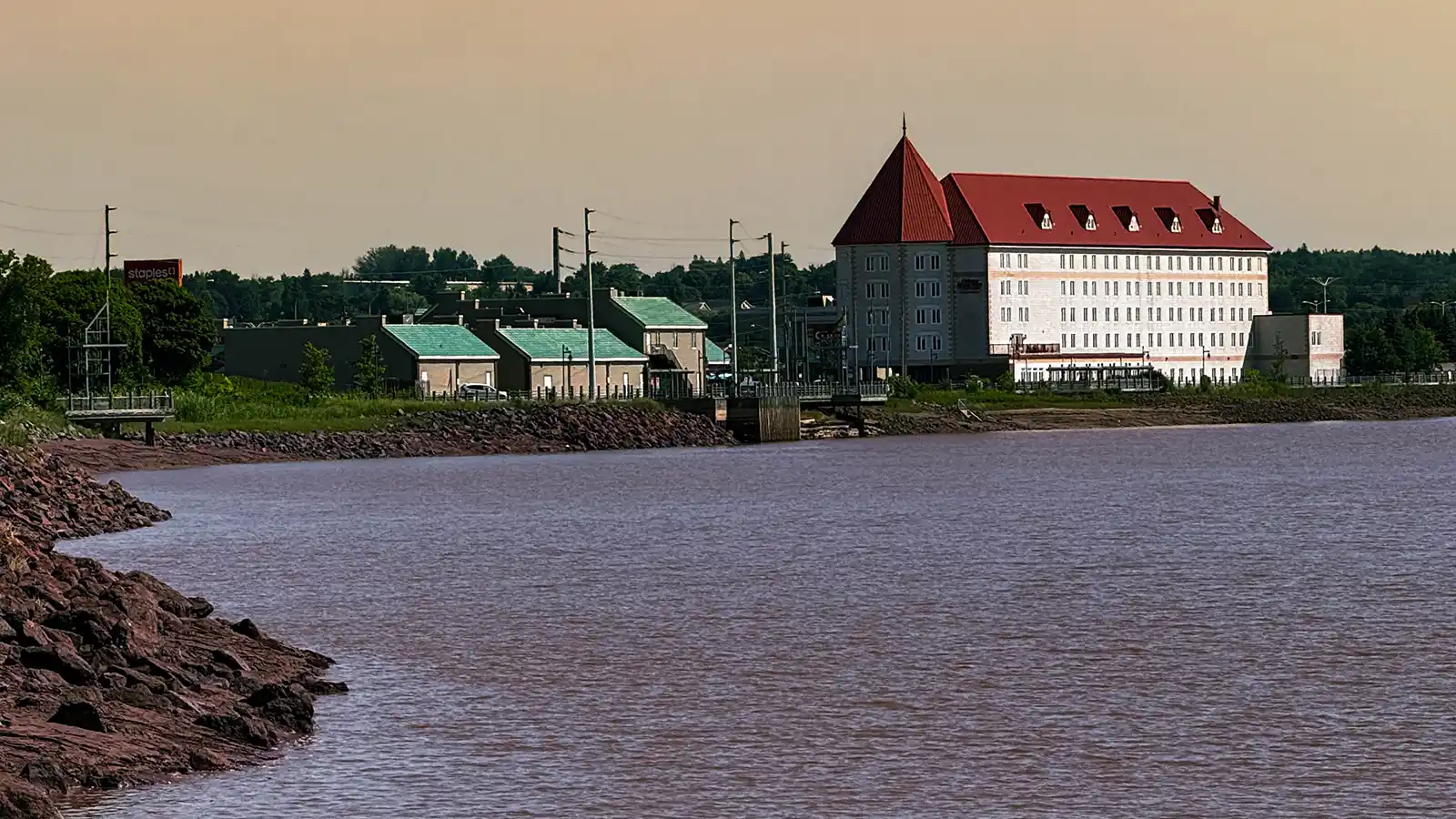
Twice a day, the Bay of Fundy pushes an absurd volume of water up the Petitcodiac River, and a wave rolls upstream against the river current. Dylan and I finally caught it on our very last morning in the city from the window of Chateau Moncton. This was after years of me somehow always being in the wrong place at the wrong time
Don’t expect a towering wall of water. On most days it’s a modest ripple, maybe a foot or two high, rolling up a chocolate-brown river. What makes it worth seeing is not the size but the physics of it, the fact that you’re watching a river, quite literally, run backward. The riverbed at Tidal Bore Park can go from a muddy trickle to over 20 feet (7.5 m) deep in about an hour, which can be a hard number to process while you’re standing there watching it happen. Kids get it immediately. Adults usually need a second.
The critical thing about catching the Moncton tidal bore is timing. The bore runs on the tides, not on your schedule, and if you show up two minutes late, you’ve missed it entirely. Check out this website, which lists the tidal bore times. It’s super useful. Tidal Bore Park in downtown Moncton has a tidal clock as well, if you happen to be in the area.
The Riverfront Trails and the Buskers
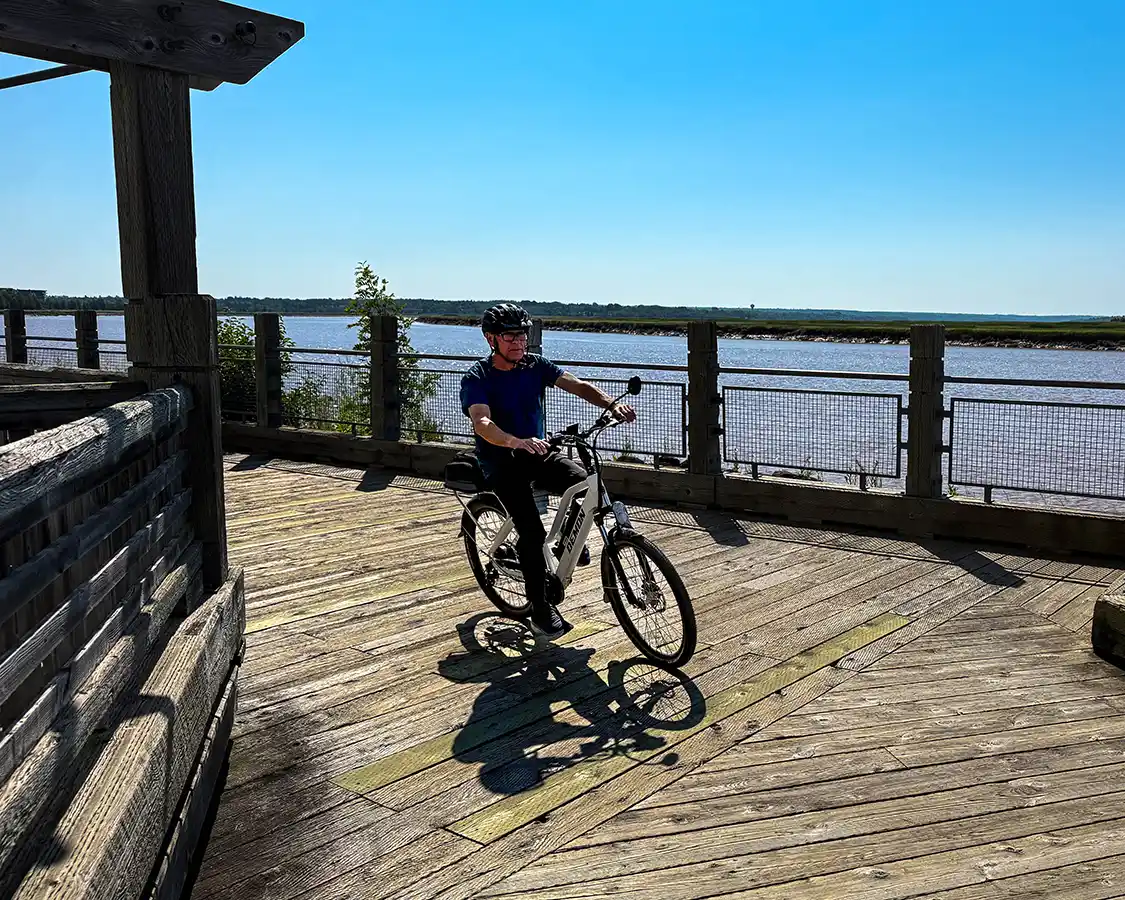
Moncton’s riverfront trail system is one of the city’s best features. Paved, flat, and running for miles along the Petitcodiac River through Riverfront Park and beyond, it’s ideal for families on bikes or on foot, with the salt marshes and mudflats on one side and the city on the other. Dylan and I rented bikes from La Bikery, a great little bike co-operative downtown, and rode a stretch of it on a warm afternoon.
Our timing on this trip was accidental but excellent. Moncton’s summer event calendar is busier than you’d expect, and we happened to roll into the waterfront during the Buskers Festival. We spent a good while watching a dance crew work a crowd on the boardwalk, the kind of unplanned, free, genuinely fun moment that makes a city feel alive.
I’ll admit this one landed with me. Standing on that boardwalk watching a crowd gather around performers, I was about eight years old again, running around the edges of a folk festival while my dad played his mandola somewhere on a stage in the distance. Whatever else has changed about the Maritimes in forty years, the region’s instinct for putting people in a field or on a boardwalk and making music happen has not. Check the city’s event schedule before you go. Moncton punches above its weight on festivals, and most of them are free.
Moncton Wildcats Hockey at the Avenir Centre
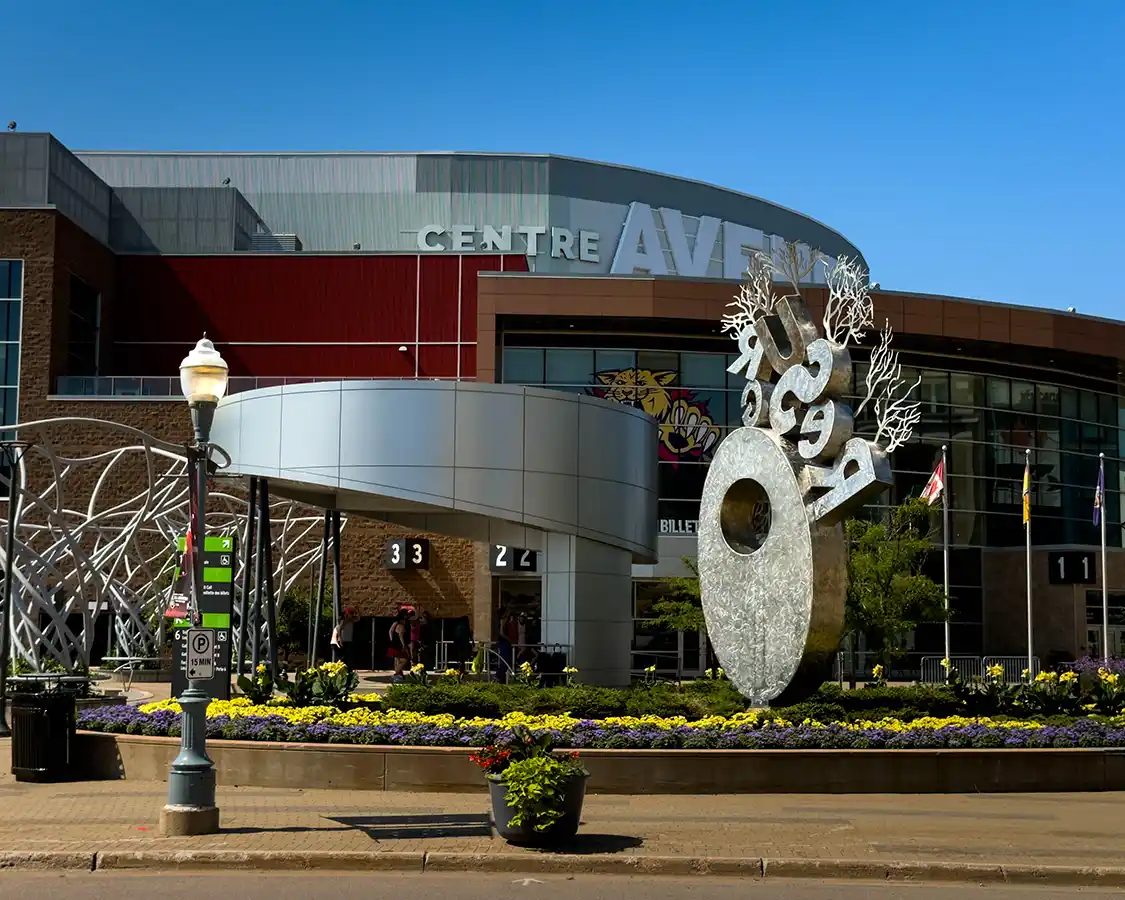
My family is a hockey family. If you are too, and you’re visiting between September and March, get tickets to a Moncton Wildcats game. The Wildcats play in the QMJHL out of the Avenir Centre, an 8,800-seat arena that opened downtown in 2018 and is a great place to watch a game.
This is not filler entertainment. The Wildcats won the QMJHL championship in 2025 and went back to the final again in 2026, and major junior hockey in the Maritimes is fast, physical, and played in front of crowds that are among the most passionate in the country. Tickets cost a fraction of an NHL game, the sightlines are excellent, and for kids who play the game, watching 17-year-olds who might be the next NHL phenom in a few years is more inspiring than watching millionaires from the 500 level.
The arena also hosted the World Juniors in 2023 and Hockey Day in Canada in 2026, which tells you what the city thinks of its team.
Historic Moncton Gives it Character
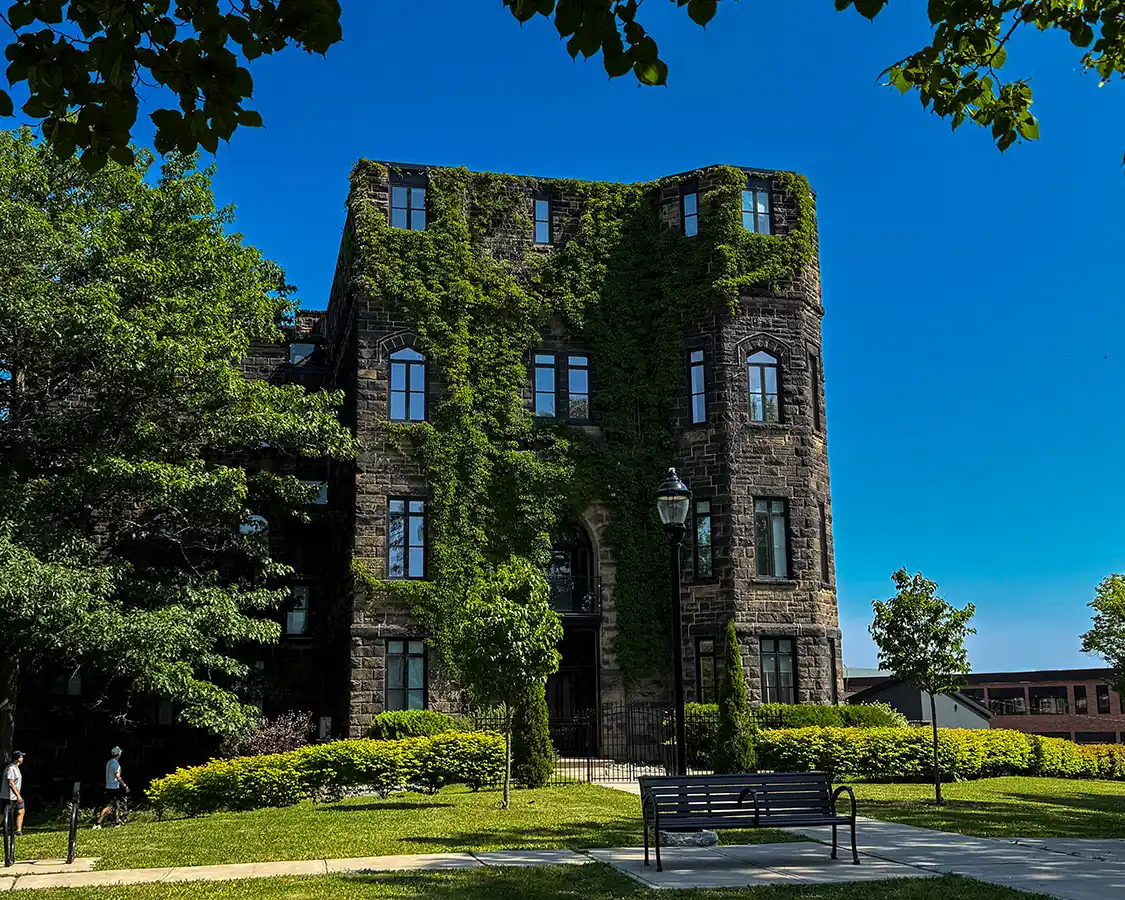
This sounds like a filler activity, but it isn’t. Moncton’s downtown has some seriously good architecture if you slow down enough to actually look at it.
The Dominion Public Building on Main Street just opposite the Avenir Center is the standout, a monumental Beaux-Arts pile built between 1934 and 1936 on a wedge-shaped lot, four stories of stone with two-story round-headed windows designed to make it look even taller than it is. It’s a Recognized Federal Heritage Building, and it was put up at the start of the Depression specifically to give people work. Standing in front of it, you get a clear sense of a country trying to convince itself it was going to be fine.
Then there’s the Gothic Revival castle at the corner of Archibald Street and Mountain Road, known locally as Castle Manor, and built between 1906 and 1908 as Mary’s Home, an orphanage. Four stories of actual castle, set back behind trees on a small hill in the middle of a Canadian city. Dylan’s reaction was roughly “wait, why is there a castle here,” which is the correct reaction. Swing around back, and you’ll find one of the coolest murals in Moncton.
Magnetic Hill: The Illusion, the Zoo, and the Waterpark
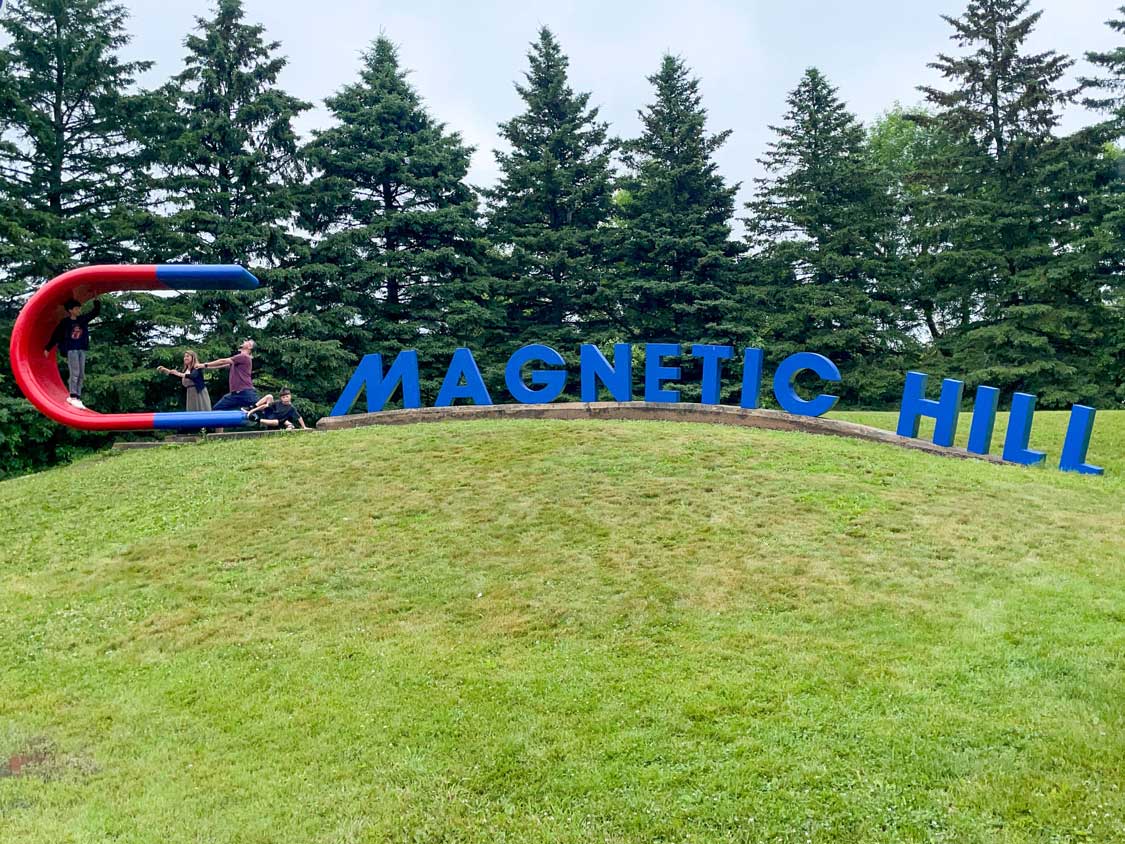
Magnetic Hill is the reason most people have heard of Moncton, and depending upon your interests, it can be a full day out or a ten-minute novelty stop.
The experience that became the biggest attraction in Moncton the original draw. Locals figured out in the 1800s that anything capable of rolling, such as wagons, barrels, and eventually cars, appeared to defy gravity on one short stretch of road. Muriel Lutes had the idea of turning it into an attraction in the 1930s, and by the 1950s it was the third most popular tourist destination in Canada. That tells you a lot about mid-century Canadian tourism.
In a nutshell, you put the car in neutral at the bottom, and it rolls backward uphill. It’s an optical illusion; everyone knows it’s an optical illusion, and it’s still weirdly satisfying. I’ve done it countless times, and I’ve never left without a smile on my face. Dylan spent the drive afterward arguing about the physics. I’ve written a full guide to Magnetic Hill if you want the deeper history and the practical details and all of the many things to do in and around the complete theme park that has arisen from those humble beginnings.
What makes the hill worth a full day is everything built around it. Magnetic Hill Park now contains a cluster of attractions within a couple of minutes of each other, and for families it’s the highest concentration of attractions in New Brunswick.
The Magnetic Hill Zoo is the standout. Opened in 1953 and spread across 40 acres (16 ha), it’s the largest zoo in Atlantic Canada, home to more than 400 animals across 70-plus species, and it’s accredited by the Canadian Association of Zoos and Aquariums, which matters if you care about how the animals are kept. Amur tigers, African lions, Arctic wolves, jaguars, lemurs, gibbons, Andean condors, plus a reptile house that is the single best bang for your buck at Magnetic Hill.
Budget at least 90 minutes and realistically closer to three hours for the whole zoo.
Magic Mountain sits next door and is the other half of the day. The SplashZone is the main event, with water slides ranging from toddler-safe to the genuinely alarming Kamikaze, plus a wave pool and a lazy river. There’s also a FunZone with carnival rides (carousel, Tilt-A-Whirl, Wave Swinger, Scrambler, Big Dipper, and a treehouse play structure for smaller kids), an arcade, and mini golf. It is unapologetically a waterpark, and on a hot Maritime day it’s exactly what you want.
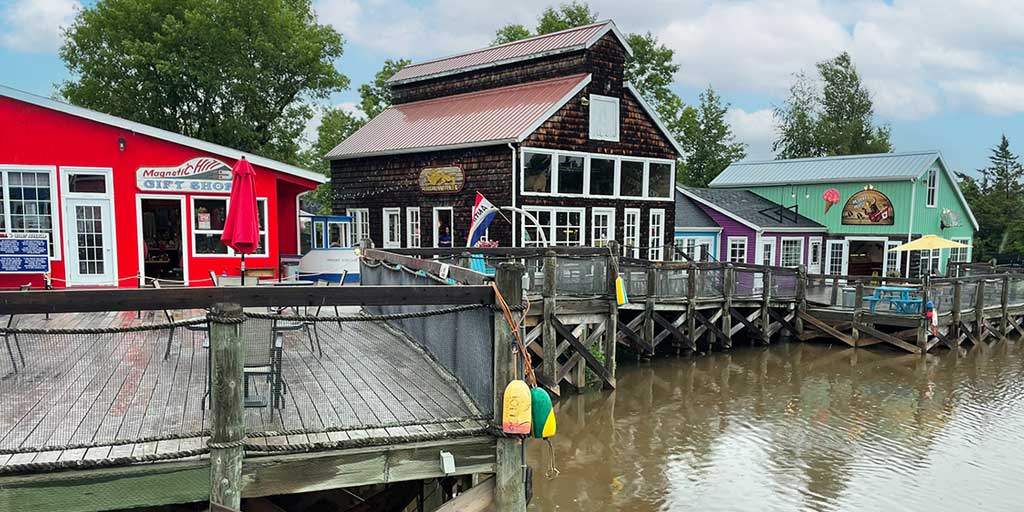
Wharf Village rounds out the complex with souvenir shops and snack bars built to look like a seaside village, which is cheesy in a way I’ve made peace with. There’s also a Nordic spa and a winery on the hill for parents who’ve earned a break, and a boardwalk with go-karts and batting cages across the road. You could burn two days here without trying. You can read my complete guide to Magnetic Hill here.
Magnetic Hill Winery and the USVA Spa
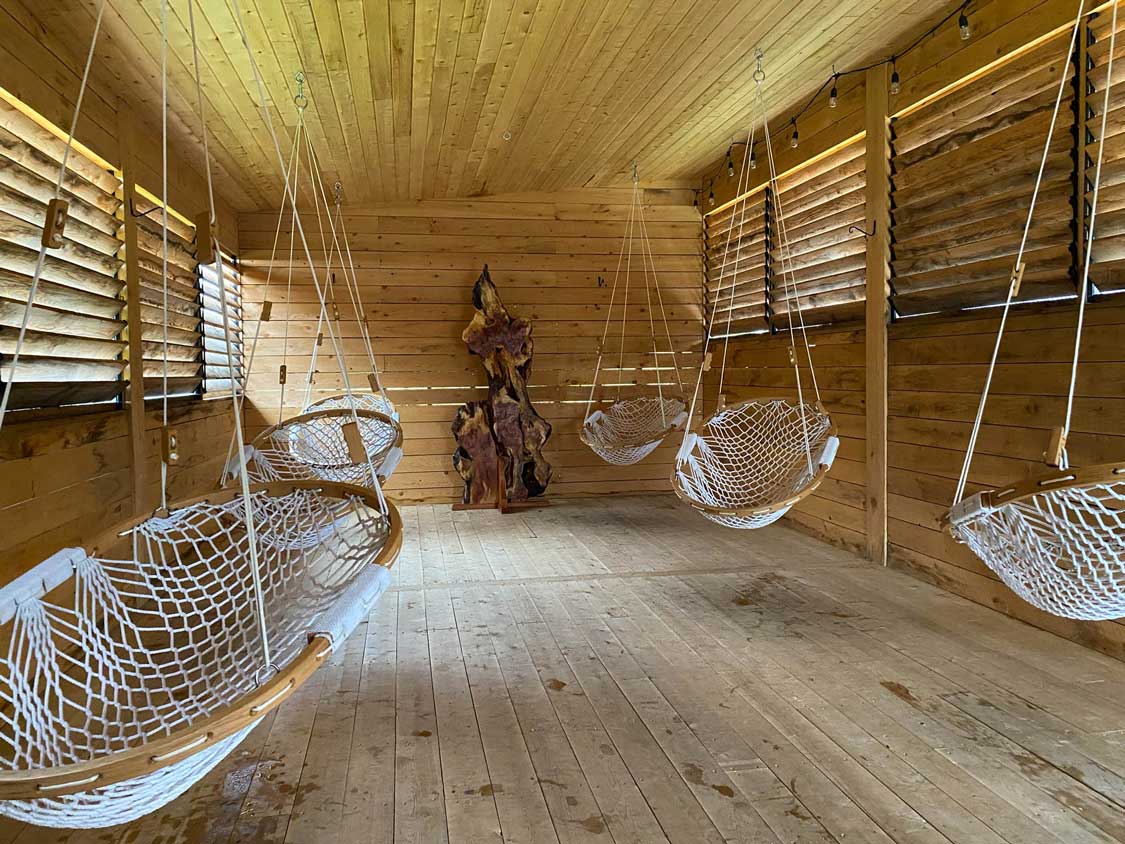
Magnetic Hill isn’t just kid-friendly attractions; there’s plenty for the adults to do as well. Magnetic Hill Winery is among the best wineries in all of New Brunswick, and it’s a short drive (or walk) away from the crowds.Sit on their patio and enjoy the view over the vineyards while sipping on their signature OC, or Osceola by the Sea, an award-winning signature off-dry white, or Marquette (a celebrated appassimento-style wine similar to a Pinot Noir.
Next door to the Magnetic Hill Winery is the USVA Spa, a Nordic-inspired spa combining alternating hot and cold treatments. Along with the traditional Nordic Spa offerings, USVA Spa in Moncton also offers massages, steam rooms, and a beautiful and relaxing experience for singles or couples to enjoy. I haven’t visited myself, but Christina spent nearly a full day here while I brought the kids through all of the Magnetic Hill attractions a few years back.
Resurgo Place: The Top Thing To Do On A Rainy Day
Every family trip needs a plan for the day the weather turns, and in Moncton that plan is Resurgo Place. It houses both the Moncton Museum and the Transportation Discovery Centre under one roof, and it’s built around interactive exhibits rather than glass cases and small print.
The transportation side is the hook for most kids, tracing how Moncton went from shipbuilding to railway hub, with hands-on stations throughout. The museum side tells the city’s story, including the repeated collapses and comebacks that gave Moncton its motto. It’s indoors, it’s engaging, and it’s the difference between a bad weather day and a good one.
Moncton Street Art
Moncton’s downtown has filled up with large-scale murals over the past decade, and wandering between them is one of the better free activities in the city. Give your kids a phone and turn it into a scavenger hunt: find the murals, photograph them, argue about which is best. It gets everyone walking through the downtown core, which is where the food and the shops are anyway.
Centennial Park and Irishtown Nature Park
If you need to burn off energy without spending money, Moncton has two large parks that do the job. Centennial Park sits in the middle of the city with a lake and beach area, playgrounds, walking trails, and an aerial ropes course in the trees.
Irishtown Nature Park, on the northern edge of town, is the wilder option, with trails around a reservoir and enough forest to feel properly out of the city. Both are free, both are easy, and both are useful for the day when nobody can agree on what to do.
The Acadian Museum
The Musée acadien at the Université de Moncton is small, but it does something important: it offers important context for everything you’re going to see on the Acadian Coast just outside of Moncton. The collection covers Acadian life from the earliest settlements through the Deportation of 1755 and into the present. For kids who are about to spend a day in Shediac and Bouctouche hearing French everywhere, an hour spent here makes the whole region click into place.
Day Trips from Moncton
Step outside of the city limits and the Moncton travel experience expands dramatically. Drive in any direction, and you’re going to hit something incredible. The Fundy Coastal Drive, Shediac, Bouctouche, National Parks, iconic Canadian landscapes, and small towns with stories to tell.
Moncton may be one of the best road trip home bases in the country. This is where the Hub City earns its name in modern times. Every one of these places can carry a half day or a full one depending on how your family travels. Pick the ones that suit you and build your own itinerary around them.
Shediac: The Lobster Capital of the World
25 minutes from Moncton
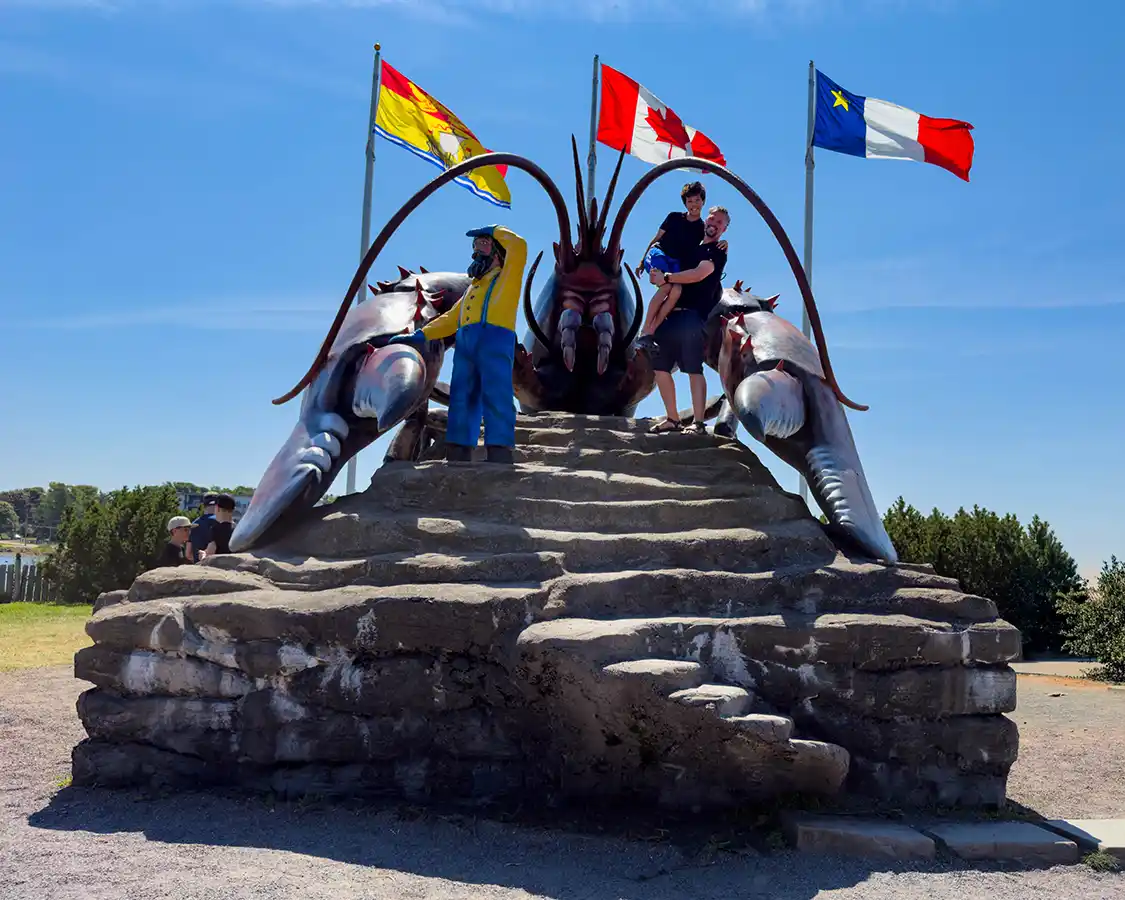
You can’t miss Shediac. A 90-ton concrete lobster on the side of Main Street will ensure that you don’t. Subtlety isn’t a big thing here, but with Shediac’s reputation as the lobster capital of the World, that’s something worth shouting from the rooftops. It’s a reputation the town has earned through 165 years of lobster harvesting, and there’s far more to do here than just photograph a giant crustacean (although you should, because it’s something EVERYONE does every time they visit).
If you can time your visit to match up with the Shediac Lobster Festival, you’re in for a treat. Some of the best lobster and seafood you can imagine, demonstrations, music, and fun right in the center of the city.
Homarus Centre
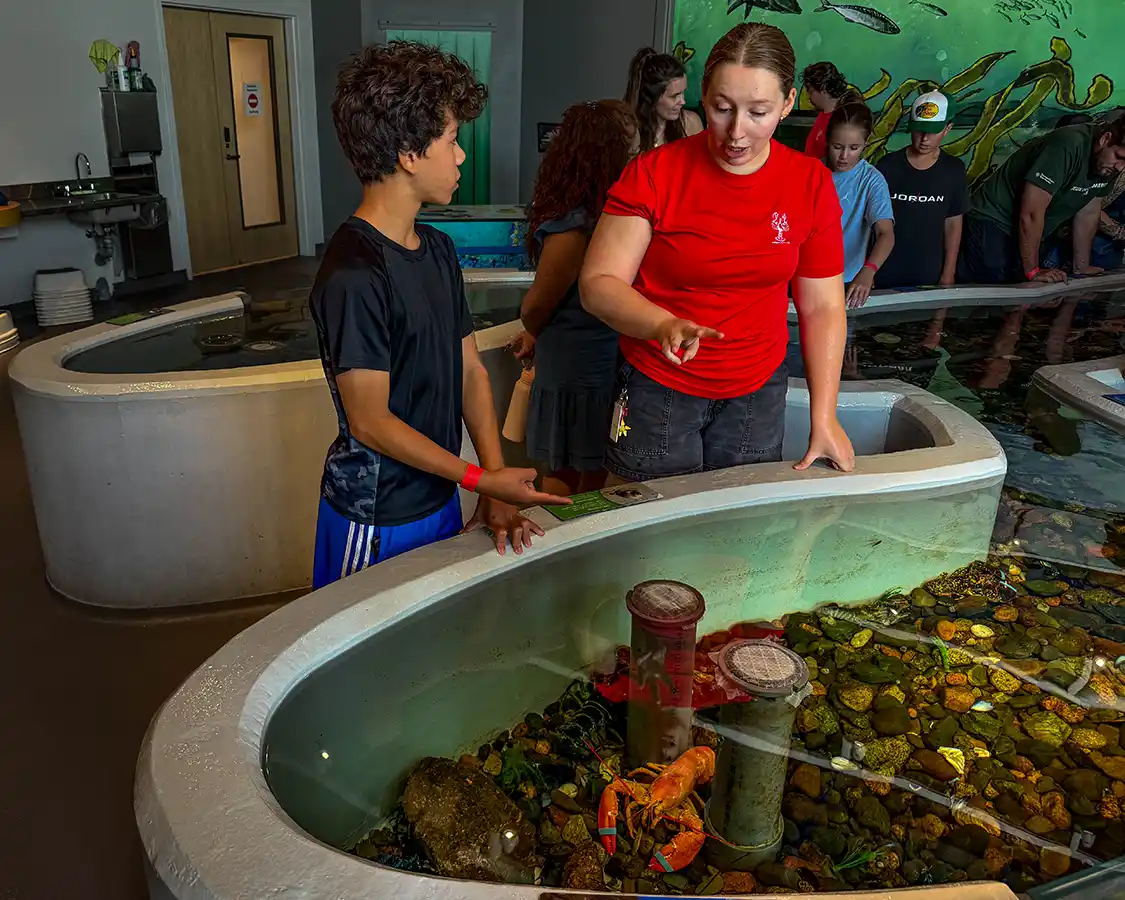
Visit the Homarus Eco-Centre if you want to dive into lobster fishing history, culture, and the science behind lobsters, hatcheries, and research. Kids can get up close and personal with live lobsters, learn how the fishery industry works, and come home with more than just lobster roll stains on their shirts. Mine and Dylan’s favorite experience was checking out the rare blue, orange, and calico lobsters in the touch tank.
Pointe-du-Chêne Wharf
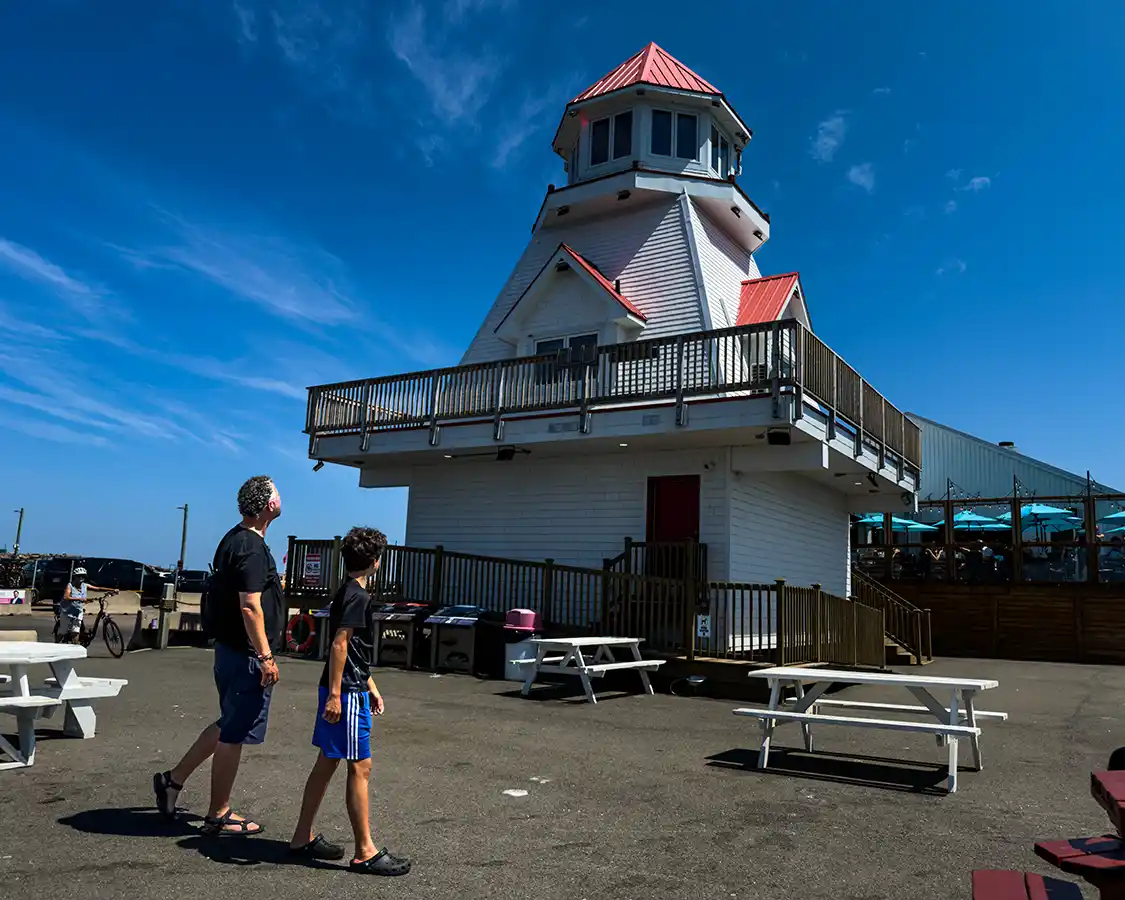
Pointe-du-Chêne Wharf sits at the end of a small peninsula just outside Shediac. It’s a working wharf, mostly filled with personal watercraft, that has become one of the best places on the Acadian Coast to spend an evening.
The wharf itself juts out into Shediac Bay, and it’s a spot where locals gather to fish off the pier, kids leap off the edge into the warm water below, and boats come and go throughout the day, including the lobster cruises that depart from here. The restaurants and patios clustered around the wharf are the other draw, and they’re at their best in the last hour before dark. The bay faces west, the water goes gold and then pink, and eating fresh seafood on a patio while the sun drops below the horizon is about as good a summer evening in New Brunswick as they come.
At Pointe-du-Chene Wharf, we boarded a Shediac Bay Cruises lobster dinner cruise and found one of the best value experiences in the province. You go out on the water, the crew hauls in a trap (it’s a demo, not proper fishing), they explain how lobster fishing works and how to tell a male from a female, and then they feed you a full lobster dinner while you’re still out cruising the bay. It’s touristy, but very relaxing, entertaining, educational, and fun.
Parlee Beach Provincial Park
Parlee Beach Provincial Park is the other big draw in Shediac, and it should also serve as a small warning if you’re planning a visit. The sand is beautiful, and the water is some of the warmest saltwater north of Virginia, which for Canadian kids on the Atlantic Coast is about as perfect as you can get.
It is also absolutely slammed on summer weekends. The parking lot fills to max capacity, the beach gets incredibly crowded, and the experience shifts from idyllic to overtouristy fast. Go on a weekday, go early, or go somewhere else. There are several great beaches within an easy drive of Moncton, including Bouctouche Dunes and Plage Aboiteau Beach in Cap-Pelé. That’s not a knock on Parlee; it’s just what happens when a great beach sits so close to a major city.
Bouctouche: Dunes, Lobster Rolls, and a Forest That Talks
50 minutes from Moncton
Bouctouche is a traditional Acadian fishing village and one of my favorite places in the whole region. It sits at the mouth of the Bouctouche River and draws crowds from Moncton and St. John to its Farmers’ Market, golf courses, sandy beaches, and charming lighthouses. Acadian heritage runs strong in Bouctouche, so expect French to be the language that you hear most here.
Bouctouche Dunes (Dunes de Bouctouche)
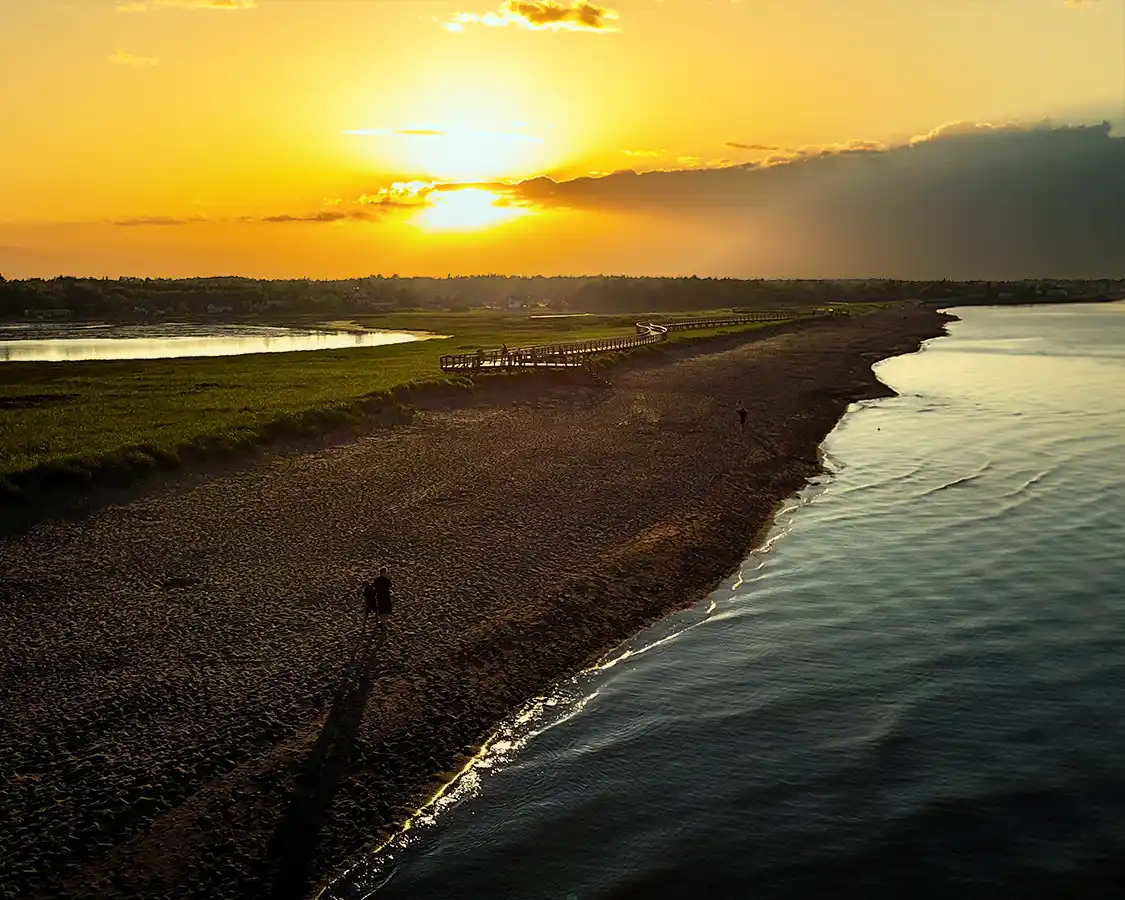
The Bouctouche Dunes are one of the most popular places to visit in the region. It’s a sandy spit stretching roughly 7.5 miles (12 km) across Bouctouche Bay. It’s one of the few remaining dune systems of its kind on the northeastern coast of North America, and the Irving Eco-Centre has laid a boardwalk out across it so you can walk the length of it without destroying the very nature that you came to experience. It’s flat, it’s easy, it’s stroller-friendly, and the views are enormous. There’s an interpretation center at the base with guided and self-guided options.
Akadi Lumina
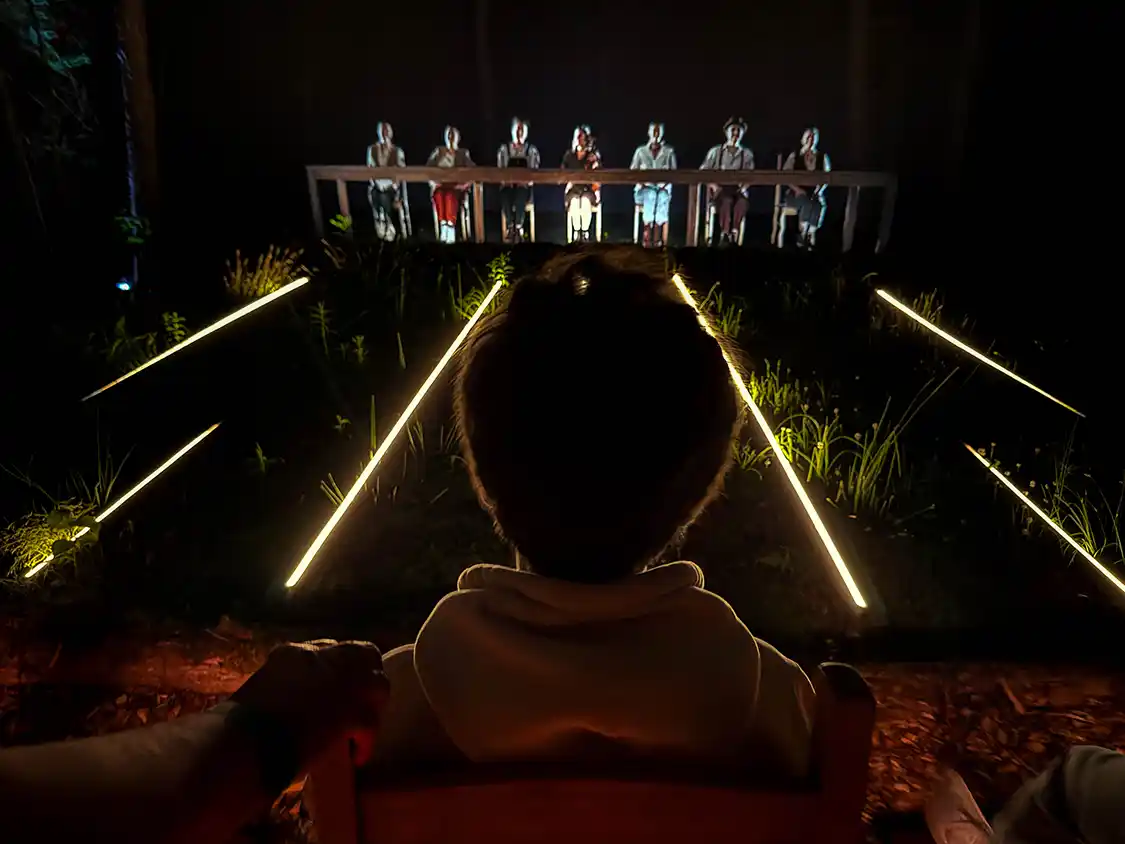
After dark, Bouctouche offers something completely different. Akadi Lumina is a multimedia night walk through the forest that tells the story of the Acadian people through light, sound, and projection. The Lumina series is something my family always looks out for when we travel. We’ve experienced them at Mont Tremblant and Coaticook, in Quebec, and one in Kingston, Ontario, that had a short run a while back.
The experience takes around an hour; it’s beautiful, and it carries real emotional weight because the Acadian story that is told throughout the walk includes the Great Expulsion of 1755 that saw French colonists uprooted from their homes in the Maritimes and arrested, deported, and expelled from their homes. For families with kids old enough to engage with the story, it’s a moving way to understand the culture that surrounds you while in the region.
Kouchibouguac National Park
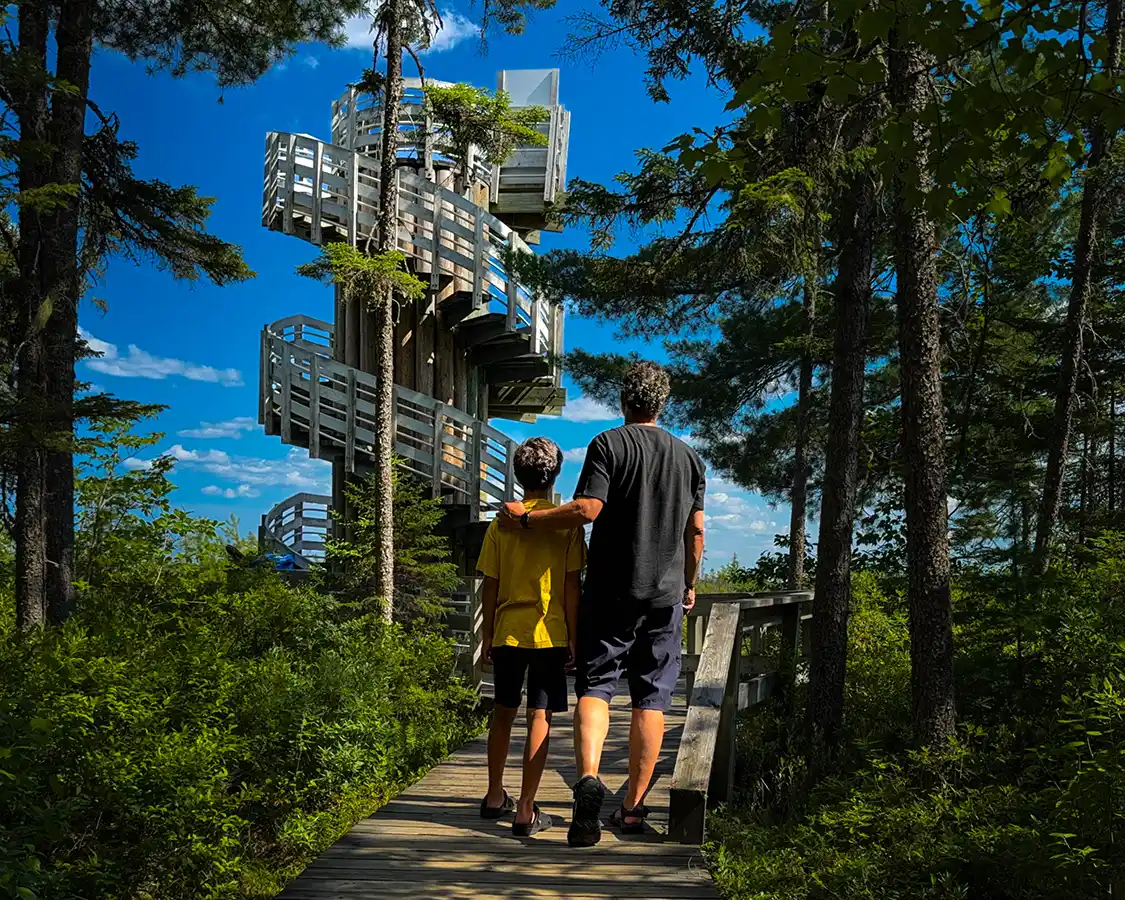
The first of the two national parks that make Moncton such a strong basecamp, Kouchibouguac protects a stretch of coastline that looks nothing like the rest of the Maritimes. This is a park packed with barrier islands, salt marshes, warm lagoons, bogs, and long sandy beaches with water that actually gets warm enough to swim in without a wetsuit.
Because of its location close to Moncton, many locals will head out here for their warm saltwater swimming rather than brave the crowds at Parlee Beach in Shediac. And honestly, I don’t blame them. Because there are far more things to explore at Kouchibouguac while you’re here. This is one of the quietest National Parks east of Ontario, and that alone makes it a gem.
For families, it’s close to ideal. The lagoons are shallow and calm, the bike trails are flat and forgiving, and the park is a designated Dark Sky Preserve. That’s a trend you’ll find a lot of in New Brunswick, and it’s something I’ll come back to later in this Moncton guide. Don’t miss the Bog Trail and Callanders Beach, my two favorite stops.
Hillsborough
25 minutes from Moncton
Hillsborough is a small village south of the city on the way to Fundy National Park, and it’s the kind of place most people blow straight through. Dylan and I stopped mostly to break up a drive and grab some lunch, and it turned into one of the best one-hour stops of our trip. That’s the thing about the Fundy coast. The plan is rarely the point.
We’d rolled into town on the day of the Hillsborough Days parade, which we had no idea was happening. Small-town Maritime parades are a unique and wonderful experience: fire trucks, farm equipment, kids on decorated bikes, candy thrown at the crowd, and a few people who seem to have just been sucked into the parade route while on their way to work. The entire population of the village was either marching in it or watching it. We stood on the sidewalk with everyone else, and it was the least touristy thirty minutes of our entire Moncton visit.
Then we went into the Hillsborough Market, and I met Brian Townsend.
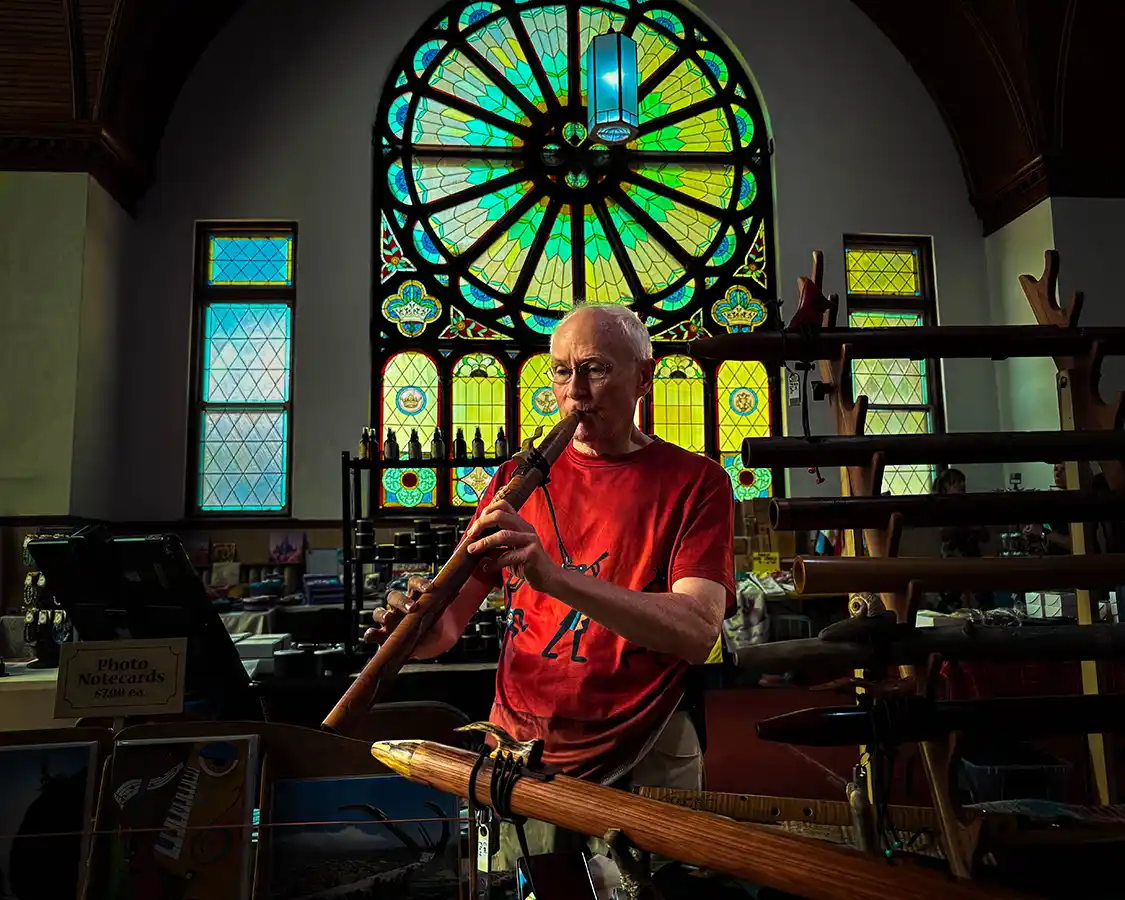
Brian runs a small operation called Fundy Flutes out of nearby Alma, and he makes First Nations-style flutes by hand from driftwood he collects along the Bay of Fundy shore. He walks the beaches constantly, and by his own estimate, only about one piece of driftwood in a hundred is usable, because the wood is usually too cracked or too warped to hold a true note. He told me about the history of the instrument, how the earliest ones go back more than 2,500 years and were often courting instruments, played by a young man near the home of the woman he was hoping to win over. He’s even started making them from alder, which most people around Alma consider a weed. He described the sound as meditative, and then he played one, and he was right. Global News did a piece on him a few years back that’s worth watching.
I got a photograph of Brian that I like more than almost anything else I shot on that trip. Talk to people at markets. That’s the whole point of a Maritimes road trip.
Cinnamon Soul Cafe in Hillsborough is the food stop, and it earns it. Good coffee, good baking, exactly what you want before or after a parade. Be warned, on a summer weekend it will be busy. We got our food to go because there were no more tables left.
Fundy National Park and Alma
60 minutes from Moncton
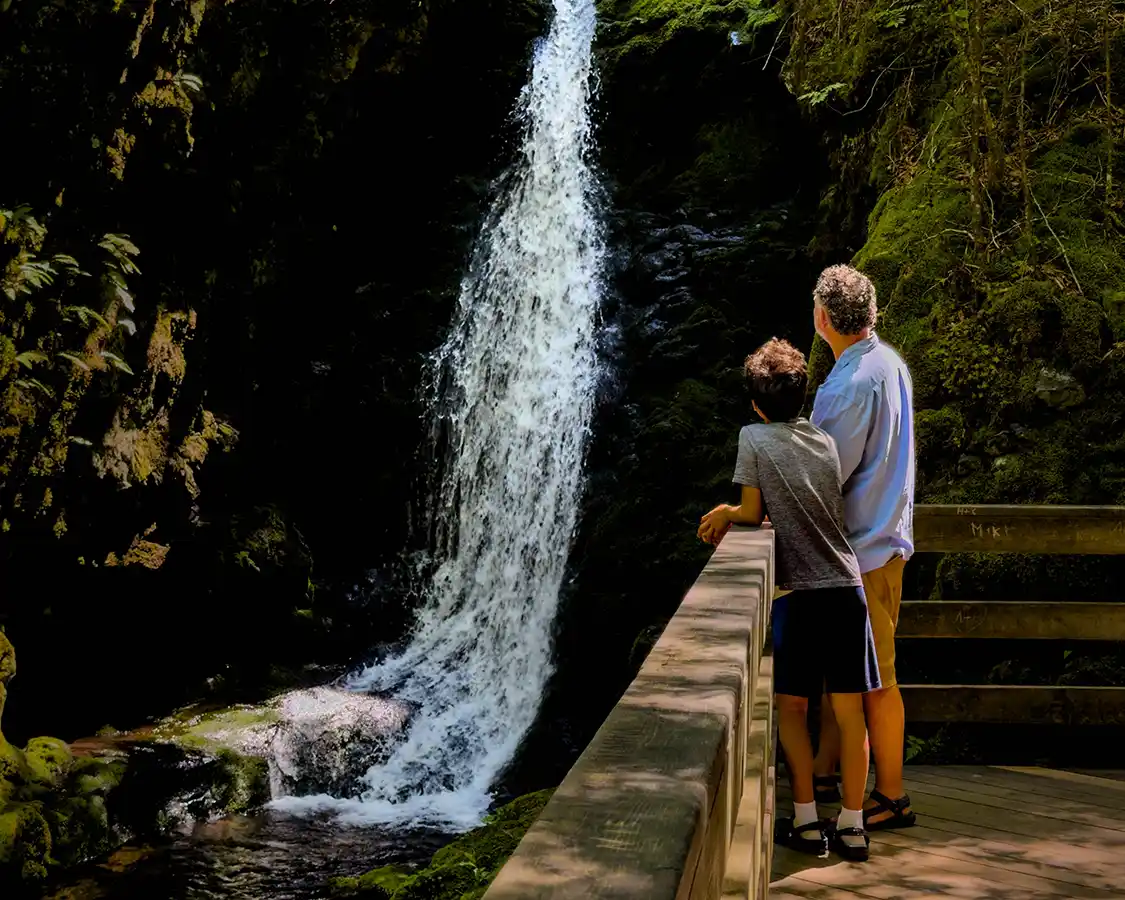
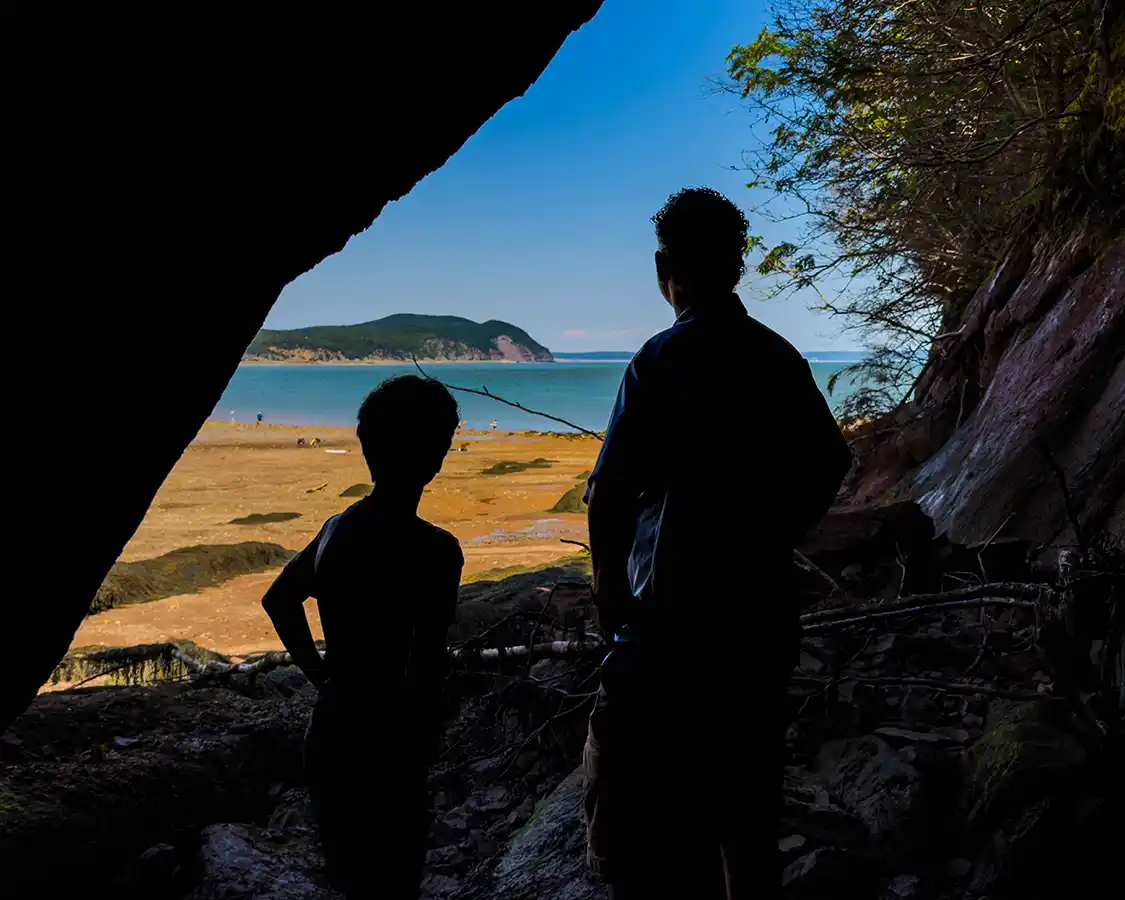
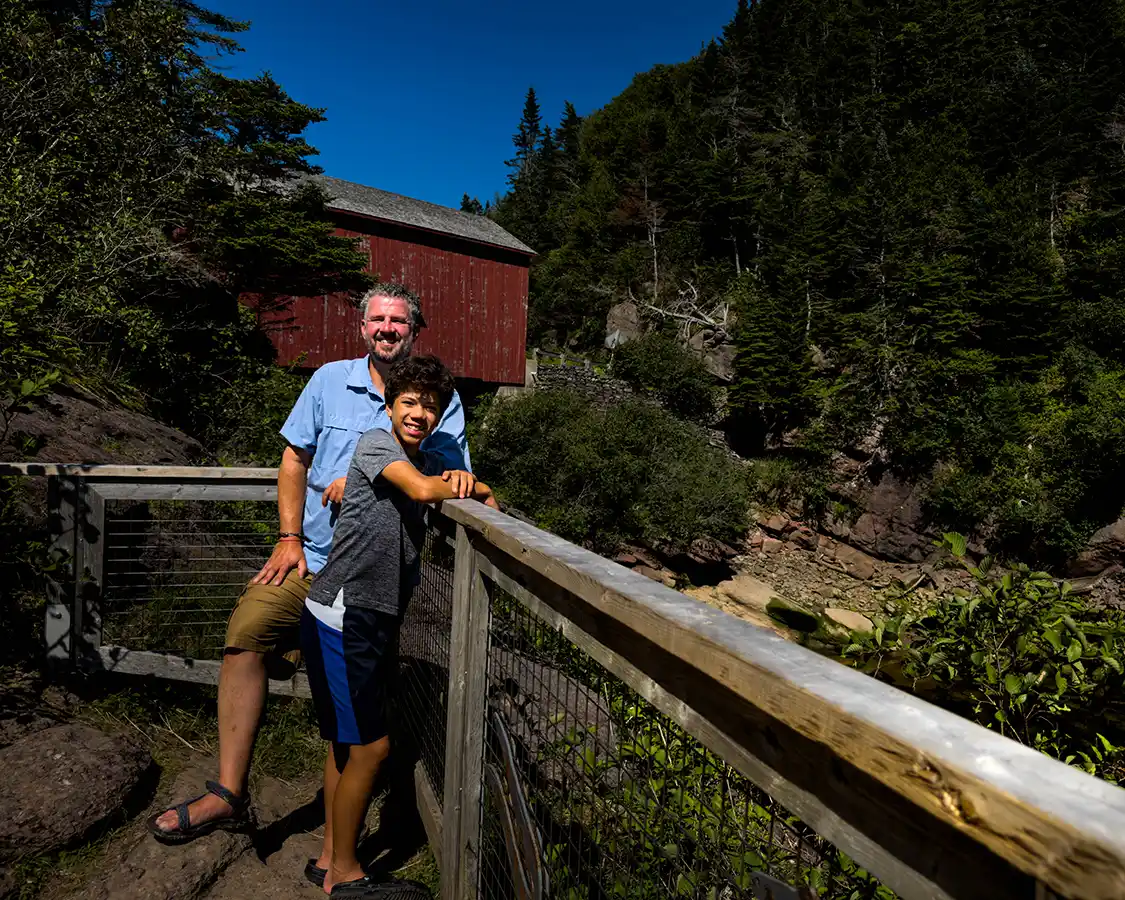
The second of Moncton’s two national parks is the most spectacular national park in New Brunswick. Picture small cascading waterfalls you can hike through without a full expedition, a network of trails ranging from easy boardwalk loops to real backcountry treks, a heated saltwater pool, and a coastline where you can walk on the ocean floor at low tide and watch the same spot disappear under 40 feet (12 m) of water six hours later. For Dylan and me, our favorite thing to do is wander the sea cave rocks at Herring Cove Beach.
The village of Alma sits right at the park gates, and it’s packed with restaurants serving up sunset views for those day-tripping to Fundy NP. This is a working fishing village; the boats sit on the mud at low tide looking stranded, and the seafood is about as fresh as it’s possible to get. It’s also, as it happens, where Brian Townsend makes his flutes.
My full guide to Fundy National Park is right here, because between the tides, the trails, and the dark skies, one section can’t cover it.
The Fundy Trail Parkway
1 hour from Moncton
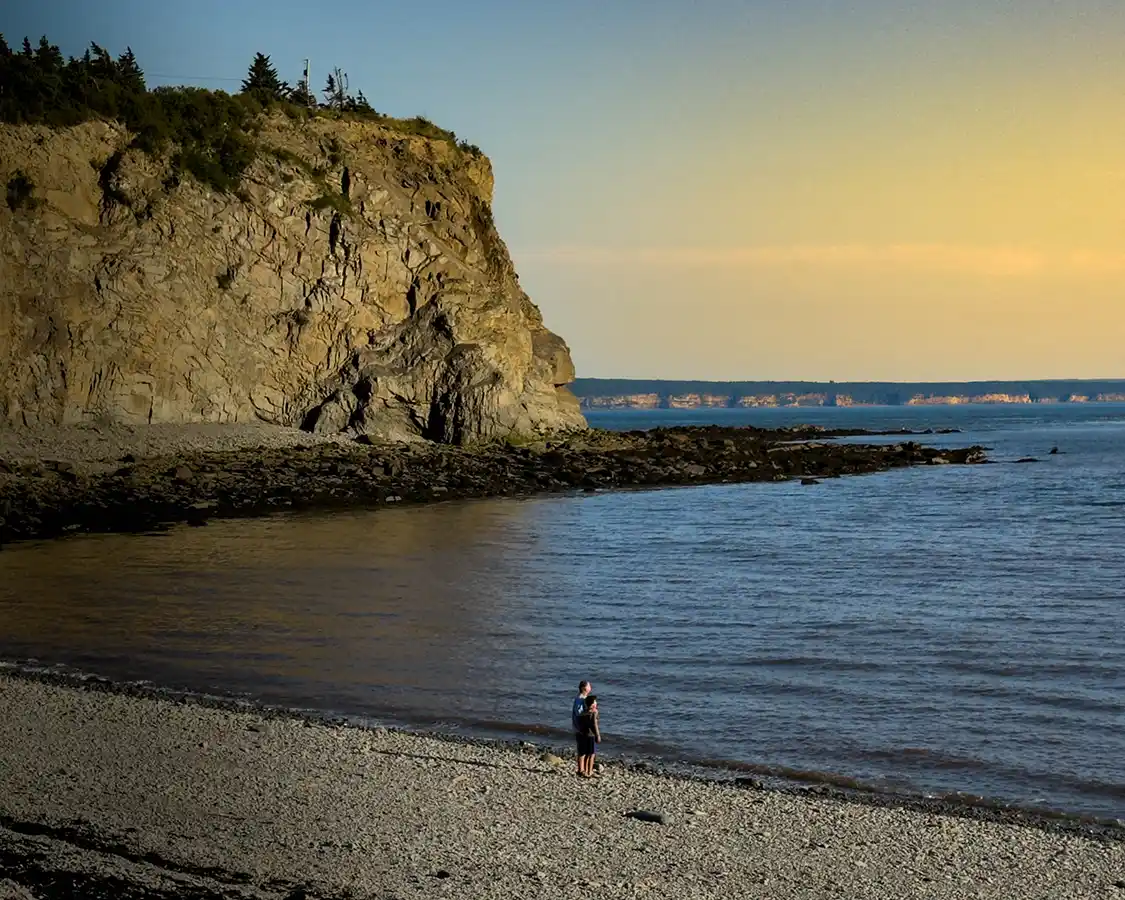
The single best road trip in New Brunswick is the Fundy Coast Drive, and part of that route is the Fundy Trail Parkway near Moncton. I’ve driven it several times now, and it remains one of my favorite drives in all of Canada. The Fundy Coastal Drive is a ribbon of pavement strung between clifftops, oceanside grassland, and bay lookouts, and features stops for waterfalls, suspension footbridges, and beaches all the way along. It’s windy and slow-going in the way that the best road trips can be, because you’ll want to stop often.
Swing off the route to Cape Enrage for a sunset stop (yes, I know, another sunset stop). This is a massive cliff jutting out into the Bay of Fundy and marks the narrowest point in the bay. The cliff is topped by a lighthouse that’s been operating since 1839. The name comes from the violent tides that churn the waters here at mid-tide. The shipwreck history here is grim, but fascinating to read about.
At the top of the cliff is an adventure park that features rappelling down the cliff face, a 600-foot (182 m) zipline, kayaking, and rock climbing, along with a restaurant with a view that alone makes the drive worth it. There’s a rocky beach down below where I like to spend most of my time. The kids can spend hours skipping and piling rocks, and the marsh-to-bay landscape with the cliffs on either side feels like a little protected space.
Hopewell Rocks Provincial Park
40 minutes from Moncton
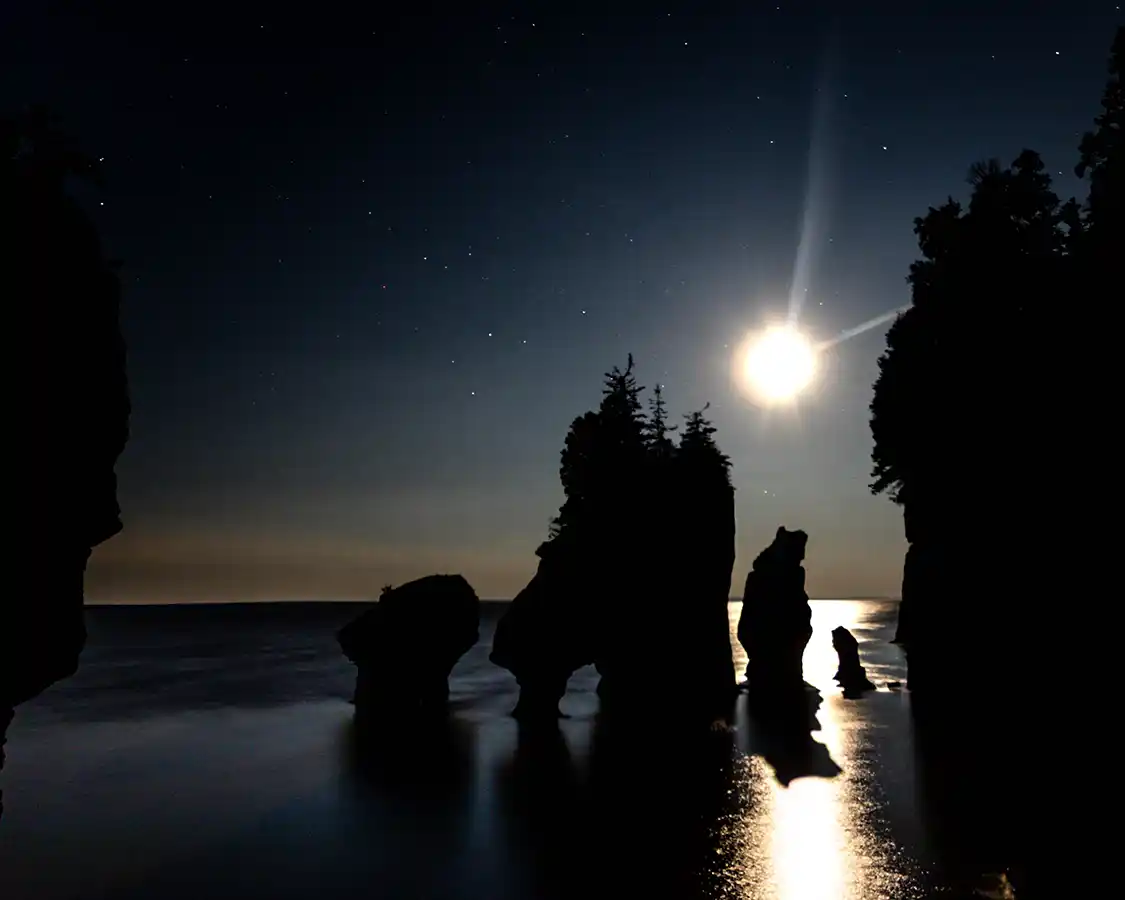
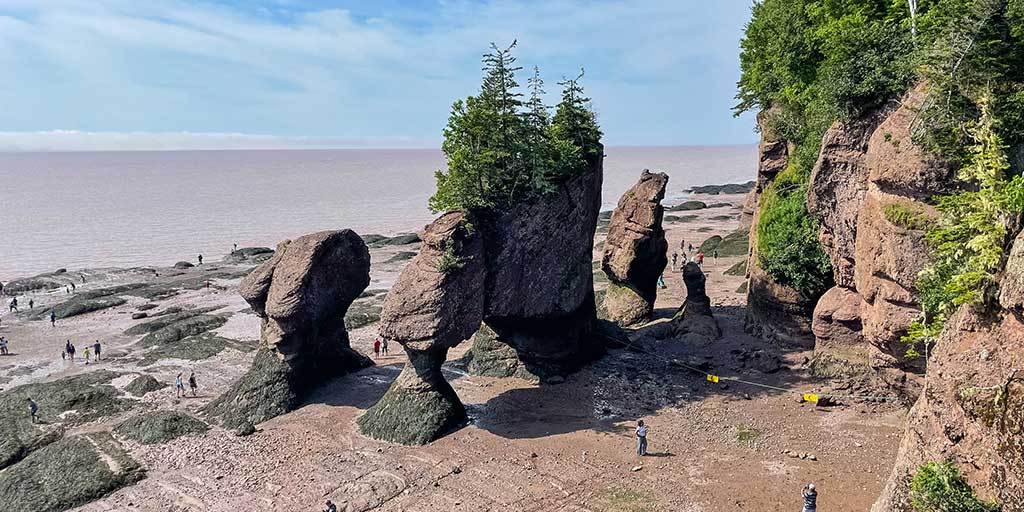
Hopewell Rocks Provincial Park is the reason that most families travel to Moncton. The iconic flowerpot rocks are the clearest demonstration anywhere of the power of the Fundy tides. It’s also the most dramatic place to see the sheer scale of the highest tides on the planet. At low tide, you walk on the ocean floor among 70-foot (21 m) sea stacks, and at high tide you can paddle a kayak through the same space, above ground you were standing on hours earlier. I’ve written a full guide to visiting Hopewell Rocks Provincial Park with everything on timing your visit around the tide tables.
The thing I’d add here is the night kayaking. I’ve paddled through Hopewell Rocks during the day with my son Cohen, and at night on my most recent trip with Dylan. Paddling among the flowerpot rocks after dark, with the water black and the moonlit cliffs looming over you and the guides pointing out the stars, is one of those experiences that recalibrates what a family vacation can be. Kids remember it forever. So do parents. Connect with Baymount Adventures, located right in the park, to book either one.
Moncton’s Dark Skies
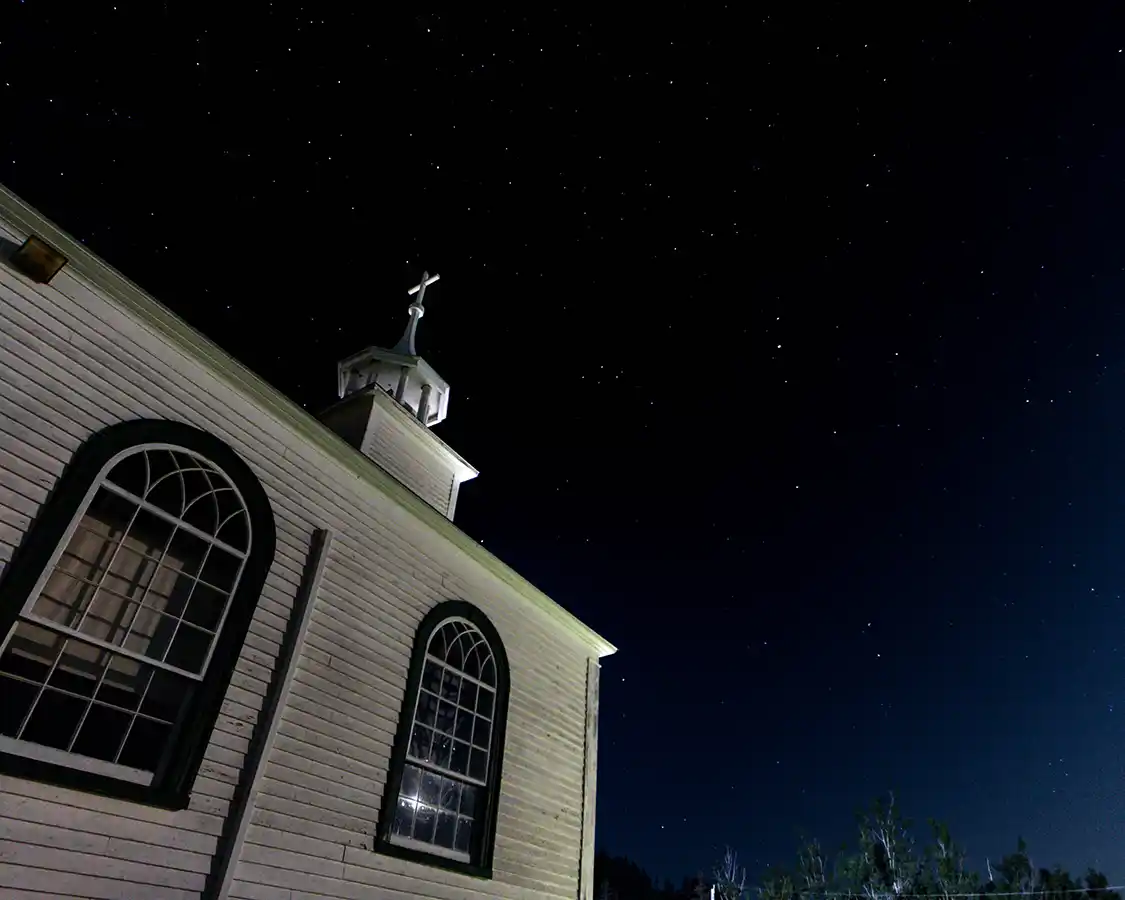
On our first night in the city, Dylan and I went out with Stéphane Picard of Cliff Valley Astronomy and set up on the banks of the Petitcodiac River. What followed was one of the more moving evenings of our trip.
Stéphane is not just an astronomy guide. He’s actively pushing to build and connect a network of dark sky preserves, experiences, and accommodations across New Brunswick and across Canada. Listening to him talk about it, you start to understand that dark skies are a resource in the same way that clean water is a resource, and that most of us have already lost ours without noticing. Urbanization has caused a catastrophe of light pollution. As a result, 80% of the world’s population now lives under light-polluted skies.
New Brunswick remains the wildest province in Canada. More than 80% of the province is forested, and because of that, much of it still has dark skies where the stars are plentiful. Kouchibouguac is a designated Dark Sky Preserve, Fundy National Park has its own dark sky programming, and Mount Carleton in the north is one of the darkest places in eastern North America.
For kids, getting the chance to look through a proper telescope at Saturn’s rings or the craters on the moon offers a type of connection that you could never have from looking at a photograph. Dylan actually went quiet when he saw the Ring Nebula. That’s something that has landed with him. A dedicated guide to stargazing and dark sky preserves across New Brunswick is coming in a few weeks.
Where to Stay in Moncton
Moncton has the widest hotel selection in southern New Brunswick, which is another reason that it works so well as a basecamp. You can find something at almost any price point, and because the city is compact, almost everything is within ten minutes of everything else. A few options worth looking at, depending on what your family needs.
Some of the links below are affiliate links. If you book through them, I may earn a small commission at no extra cost to you. Thank you for supporting our adventures. Thanks for helping to support my family.
Chateau Moncton
This is the hotel that Dylan and I stayed at and is the hotel that I’d point most families toward first. It sits right on the Petitcodiac Riverfront, which means you can walk out the door onto the Riverfront Trail and be at Tidal Bore Park in minutes. Breakfast is included, and being able to walk to the bore (or even see it from your hotel window) rather than drive and park is worth more than it sounds when you’re timing your morning around a tide chart.
Chateau Moncton is on the edge of town, so if you’re planning to use Moncton as a base for exploring the south of New Brunswick, you won’t have to struggle with traffic. You can check out their current rates and availability here.
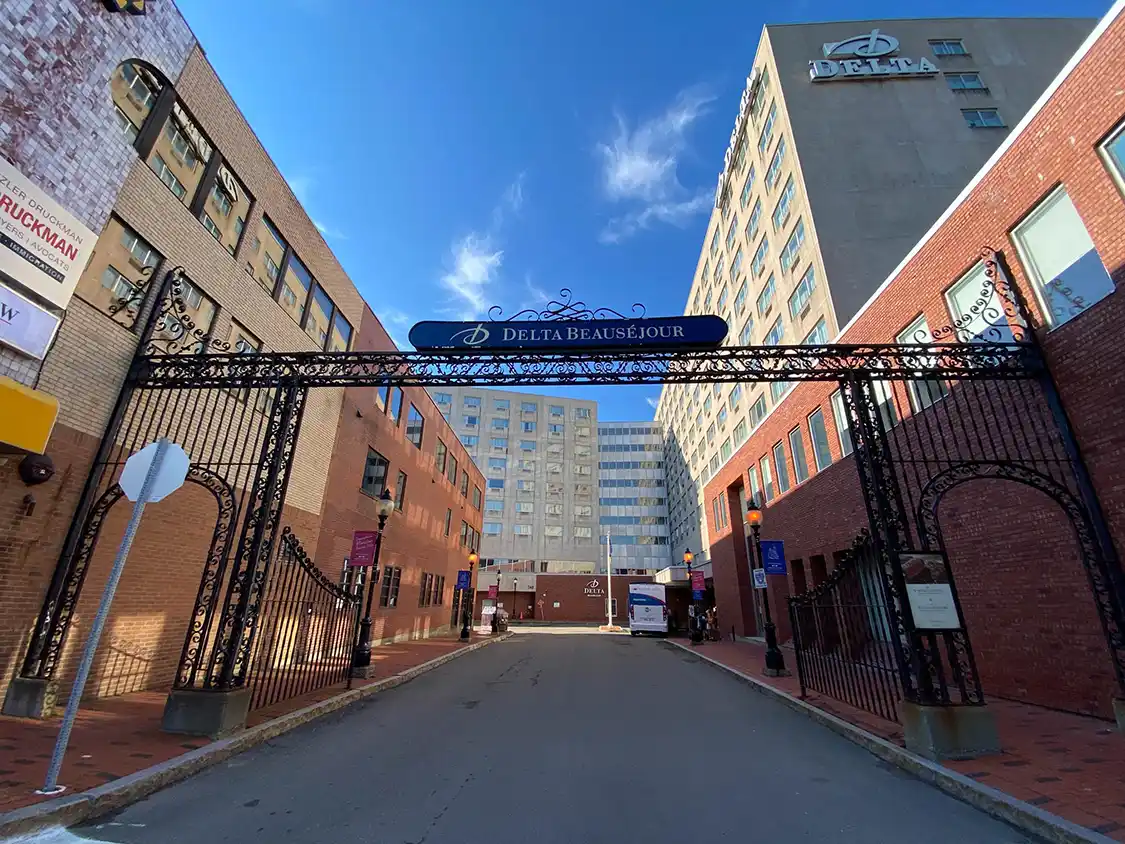
Delta Hotels by Marriott Beausejour
The Delta Beausejour is a great option for those who want to stay downtown. It’s in a great location where most of the restaurants, parks, and riverfront are within easy walking distance. is the downtown upscale option, within walking distance of Main Street’s restaurants and the Avenir Centre. If you’re catching a Wildcats game or want to be in the middle of the food scene without driving, this is the one I’d pick. You can check out their current rates and availability here.
Residence Inn by Marriott Moncton
The Residence Inn is great if you’d like a suite-style hotel. These have kitchenettes, so are excellent for those enjoying a longer stay. Having a kitchen and a separate bedroom changes the math considerably when you’re basing in one city for four or five days and doing your own breakfasts before early departures. You can check out their current rates and availability here.
Where to Eat in Moncton
Moncton’s food scene has come a long way in the past 10 years. The restaurant scene is now one of the top reasons to base yourself here rather than in a smaller town closer to the parks. You can spend the day on a mudflat or a dune and still eat properly that night. That being said, the locals have been paying attention to the culinary explosion in the city, and on Friday and Saturday nights it can be a real struggle to find parking downtown. Build in an extra 10 minutes to find a good parking spot before your reservation.

Tide & Boar Gastropub
700 Main St
Tide & Boar is Moncton’s best restaurant, hands down. The name is a play on the tidal bore, and the menu leans heavily into locally sourced ingredients and house-made everything, right down to their own ketchup. The Boar Poutine is the restaurant’s signature dish, and it’s as good as it sounds.
Tide & Boar has been named one of Canada’s top 50 restaurants by Maclean’s, turned up on You Gotta Eat Here, and been flagged by Air Canada’s enRoute as one of the country’s favorite bars. It manages the difficult trick of being genuinely good and still relaxed enough to bring the whole family. During the summer, they have a small patio on the side. Get a seat there if you’re able to.
The Pump House Brewery & Restaurant
5 Orange Ln
Pump House is where we ate on our most recent visit. This is a Moncton institution and one of the most famous brewpubs in the province. They have a proper wood-fired pizza oven, a long list of house beers including a blueberry ale that had me rethinking my opinion on fruit beers, and a menu broad enough that nobody in your family will go hungry. It’s casual, it’s busy, and it’s a comfortable spot after a long day of exploring southern New Brunswick.
Little Louis’ Oyster Bar & Fine Cuisine
245 Collishaw St
The name may sound as if it’s trying to confuse you, but Little Louis’ is a great place for a more upscale night out. It’s tucked into a corner of an industrial area, which does it no favors from the outside, and then you walk in and understand. This is the place for a proper dinner if you’ve got a sitter or kids who enjoy a slower-paced meal experience.
Other Restaurants in Moncton
Cactus on Church St. is a local vegetarian restaurant, and it’s a good one (although most restaurants in town do have vegetarian options). It’s a nice one to be aware of if anyone in your group doesn’t eat meat and needs a break from exploring lobster country.
Les Brumes du Coude on Botsford St. serves up the Acadian side of the city. It’s got a great patio as well, and Skipper Jacks on Mapleton Rd. handles the seafood in a casual setting. For a quick lunch downtown between the street art and Resurgo Place, Main Street has enough options that you can stumble into something decent without planning.
Practical Tips for Visiting Moncton With Kids
To help you plan your family travel in Moncton, here are a few things that make the difference between a smooth trip and a frustrating one.
- Base yourself in Moncton and day trip out. Everything above is within about a 90-minute drive of the city, and moving hotels every night with kids isn’t for everyone. Moncton has the widest hotel selection in the region and the best food scene, so stay put and drive.
- Pay attention to the tide tables. Hopewell Rocks, the tidal bore, the Fundy coastline, and the mudflats at Alma all run on the tide, not on you. Check the tables the night before and build the day around them. Getting this wrong means driving two hours to look at water where the thing you came for used to be.
- Pick up a Parks Canada Discovery Pass. If you’re planning on visiting both Fundy National Park and Kouchibouguac, you can save money by purchasing a Parks Canada Discovery Pass. It gives you access to all Parks Canada locations for an entire year, and usually pays for itself fast. You can buy it online or from any Parks Canada gates.
- New Brunswick is Canada’s only bilingual province. This is Acadian country, and in Shediac, Bouctouche, and many other areas of the province, French is often the first language you’ll hear. A “bonjour” and a “merci” go a long way, and it’s a good, low-stakes way to get kids used to the idea that Canada has two official languages.
- Book tickets and hotels ahead of time. Whether you’re doing the lobster dinner cruise, Akadi Lumina, night kayaking at Hopewell, or stargazing sessions, expect them to fill up during the summer high season.
Why Moncton Finally Won Me Over
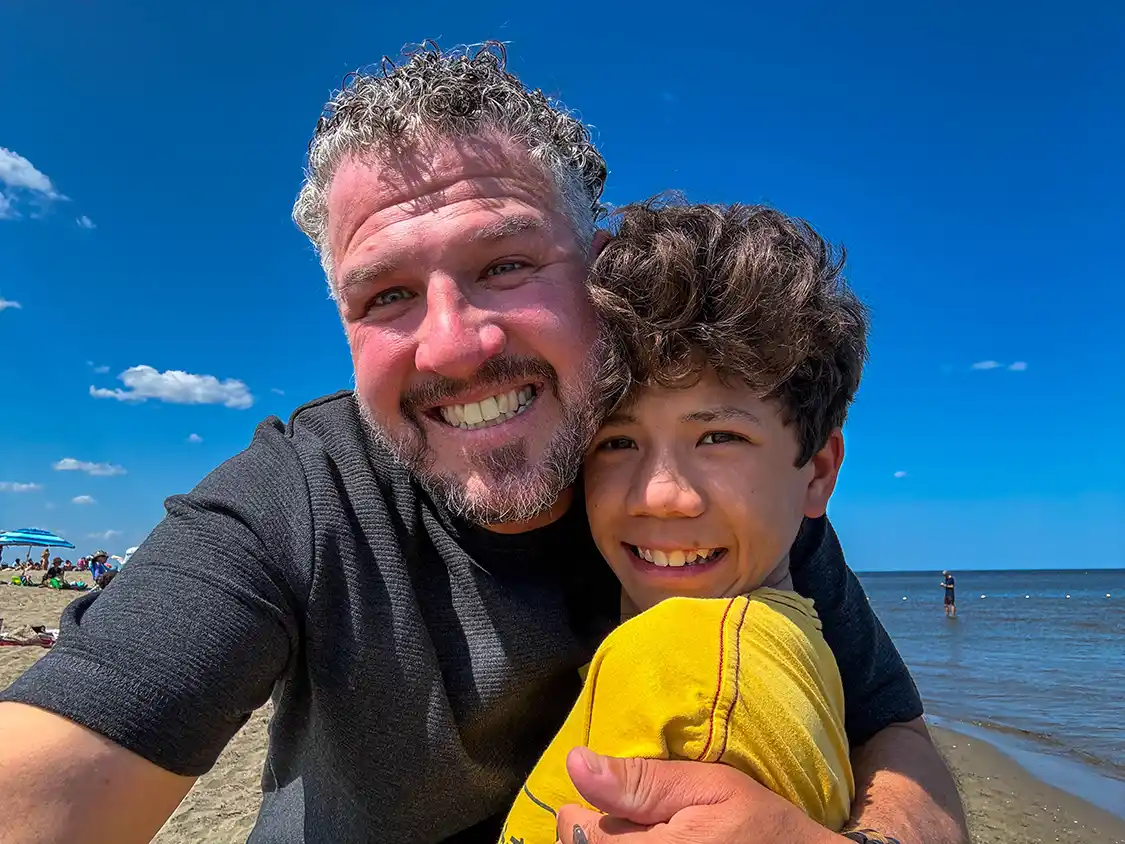
As I mentioned earlier, I wasn’t always a fan of Moncton. But I’ve learned a few things on my most recent visit, and I hope others can benefit from my experience. You see, Moncton doesn’t try to charm you. There’s no dramatic harbor, no quaint old town, no signature skyline. It’s a scrappy railway city that has been flattened repeatedly and keeps standing back up, and it wears that history out in the open for all to see. It’s proud to be standing, to be growing, and to be a home for so many New Brunswickers.
I’m proud to have learned to understand it. For most of my life, my whole read on the place was that it was somewhere you passed through. Somewhere to catch a festival, and then get out of town. What changed on this trip was that I finally stopped judging Moncton by what it looks like from the highway and started judging it by what it puts within reach.
Park yourself there for four or five days with your kids and you get the world’s highest tides, two national parks that could not be less alike, a warm-water Acadian coast, a dune you can walk the length of, a forest that tells you a story after dark, some of the darkest skies left in eastern Canada, and, if you time it right, a river that runs backwards twice a day. Then you drive back into the city at night and eat well and sleep in a real bed.
There isn’t another city in Atlantic Canada that does that as well as Moncton.
And the moments that stuck weren’t the famous ones. It was standing on a Hillsborough sidewalk watching a village parade go by. It was meeting a man who walks the Fundy shore looking for the one piece of driftwood in a hundred that will sing. It was a boardwalk crowd in downtown Moncton pulling me straight back to being a kid at a folk festival with my father’s music somewhere in the distance
That’s the Moncton region. The brochure stuff is worth your time. The stuff between the brochure stuff is what you’ll be talking about on the flight home. It took me nearly 50 years and a detour I almost didn’t make to work that out. I hope you don’t take as long as I did.
Planning a wider New Brunswick trip? Have a look at the best places to visit in New Brunswick and some fun facts about New Brunswick to get the kids excited before you go.
You May Also Like To Read:
Disclosure: Some of these experiences were done in partnership with Tourism New Brunswick and Visit Moncton-Dieppe. All opinions remain my own.