
The Denver to Estes Park drive is one of the most popular drives in Colorado. Discover the top three routes between Denver and Estes Park

I like to say there are two ways of making the Denver to Estes Park drive: the fast way and the right way. The fast way gets you to the mountains in about ninety minutes. The right way winds up into the high country along one of the oldest scenic byways in Colorado, past ghost towns and gold mines and a little stone chapel perched on a boulder, and takes as long as you’ll let it.
In all honesty, though, everyone’s road trip goals are different, and the best answer for most families is to do one route on the way up and the other on the way back. That’s exactly what we did, and I wouldn’t change a thing.
Denver and Estes Park are two very different sides of Colorado. Denver is the state capital and its cultural heart, with a thriving music scene, funky architecture, and a restaurant scene that loves to experiment. Estes Park is the opposite: a small, walkable mountain town of mom-and-pop diners and outdoor-gear shops that exists, more or less, as the eastern gateway to Rocky Mountain National Park.
Getting from one to the other is half the fun. This guide lays out every route, the best stops along each, how to handle the park’s reservation system, and where to stay and what to do once you arrive. For the wider trip, pair it with my guides to things to do in Denver with kids and the best things to do in Colorado with kids.
Quick Planner: The Denver To Estes Park Drive
The fast route: About 65 miles and 1.5 hours via US-36 through Boulder and Lyons.
The scenic route: The Peak to Peak Highway, roughly 2 to 3 hours depending on where you start and how often you stop.
Best strategy: Drive the fast route one way and the scenic route the other, so you get both.
Before you go: Rocky Mountain National Park requires a timed-entry reservation during the busy months. Book it on Recreation.gov well ahead, or plan to enter early or late to skip it.
Best time: Late spring through early fall for open mountain roads; September for the elk rut and golden aspens.
Don’t miss: The Chapel on the Rock near Allenspark, and a slow evening with the elk that wander right through Estes Park.

Why Make The Drive From Denver To Estes Park?
Table of Contents
Most people who make this drive are heading for Rocky Mountain National Park, and with good reason. It’s a sprawling wonderland for hikers, wildlife watchers, and anyone who just wants to stand slack-jawed in front of a mountain. Within its boundaries, you’ll find lowland meadows thick with elk, crystal-clear alpine lakes, and the towering peaks that give the park its name, all threaded by Trail Ridge Road, the highest continuous paved road in the United States.
Estes Park is where you’ll base yourself, sleep, and eat, and it’s a charming, kid-friendly little town in its own right. For everything to actually do once you’re inside the park, see my guide to Rocky Mountain National Park with kids, and for the bigger picture, my roundup of Colorado’s national parks.

The Fastest Drive From Denver To Estes Park
If you just want to get to the mountains, the quickest way covers about 65 miles and takes around an hour and a half without stops. From Denver, take I-25 north, then follow US-36 west through Boulder and on past Lyons, where the highway climbs the final stretch into Estes Park.
It’s mostly easy highway driving with only the last section winding into the foothills, which makes it the route I recommend for anyone nervous about mountain roads. One reader wrote in, worried about steep drop-offs for first-time mountain drivers, and this is the answer: US-36 keeps things gentle, with more highway and fewer white-knuckle switchbacks than the scenic alternatives.
Denver Airport To Estes Park
Flying in? From Denver International Airport, take Peña Boulevard to E-470, then connect to I-25 north and pick up US-36 west as above. It adds a little time on the front end but keeps you on straightforward, well-signed roads the whole way.
Denver to Estes Park Scenic Route Via The Peak To Peak Highway

Peak To Peak Highway Route From Denver To Estes Park
Now for the right way. The Peak to Peak Highway is the oldest scenic byway in Colorado, and it is spectacular, a ribbon of road that hugs the Continental Divide through pine forest and old mining country. Done straight through, it takes a little over two hours, but you’ll want to give it far longer, because the stops are the whole point.
From Boulder, head west and climb toward Nederland, then follow CO-72 north as it becomes CO-7, which drops you into Estes Park. Along the way, keep an eye out for these:
- The ghost towns and gold mines. This was some of the richest mining country in the American West, and the highway is dotted with the remains of that boom, including the weathered bones of old gold mines and ghost towns like Hesse and Apex. Kids who like a good “what happened here?” story eat this up.
- Golden Gate Canyon State Park. A gorgeous detour with more than 35 miles of hiking trails winding through aspen groves and up to panoramic overlooks, plus yurts and campsites if you want to linger. It’s a lovely leg-stretcher for restless kids partway through the drive.
- The Chapel on the Rock. Near Allenspark stands one of the most photographed little churches in Colorado, a stone chapel dramatically perched atop a huge boulder with the mountains rising behind it. It’s free to visit, quietly beautiful, and worth every minute of the stop. One reader shared a memory of visiting it with her grandmother years ago, and it clearly stays with people.
- Arapaho and Roosevelt National Forests. The highway rolls through these forests for much of its length, and the wildlife watching is superb. Scan the skies for hawks, falcons, and golden eagles, and the meadows and treeline for jackrabbits, red fox, mule deer, and elk.
The Clear Creek Canyon Route

If you have even more time and want to load up on mining history, you can reach the Peak to Peak from the south through Clear Creek Canyon. From Denver, take US-6 west through Golden and into Clear Creek Canyon, arguably the most dramatic leg of the whole trip, where sheer rock walls hug a rushing creek popular with climbers, cyclists, and anglers.
The canyon delivers you to CO-119 and the old mining towns of Black Hawk and Central City, once known as “the richest square mile on Earth” and now home to Colorado’s mountain casinos. From there, you join the Peak to Peak Highway north to Estes. Budget around three hours for this version.
The Clear Creek Canyon Route offers:
- One of the best cycling routes in Colorado
- Excellent stops for both hiking and rock climbing
- Stops in Black Hawk and Central City and the “Richest Square Mile on Earth”
The Big Thompson Canyon Route
There’s a third way in that splits the difference between fast and scenic. From the north, leave I-25 at Loveland and follow US-34 west up through Big Thompson Canyon, a stunning drive alongside the Big Thompson River as the canyon walls close in around you before opening onto Estes Park and the shore of Lake Estes. It’s nearly as quick as US-36 but far prettier, and it makes a great return route if you came in the other way.
Getting Around Estes Park And Rocky Mountain National Park
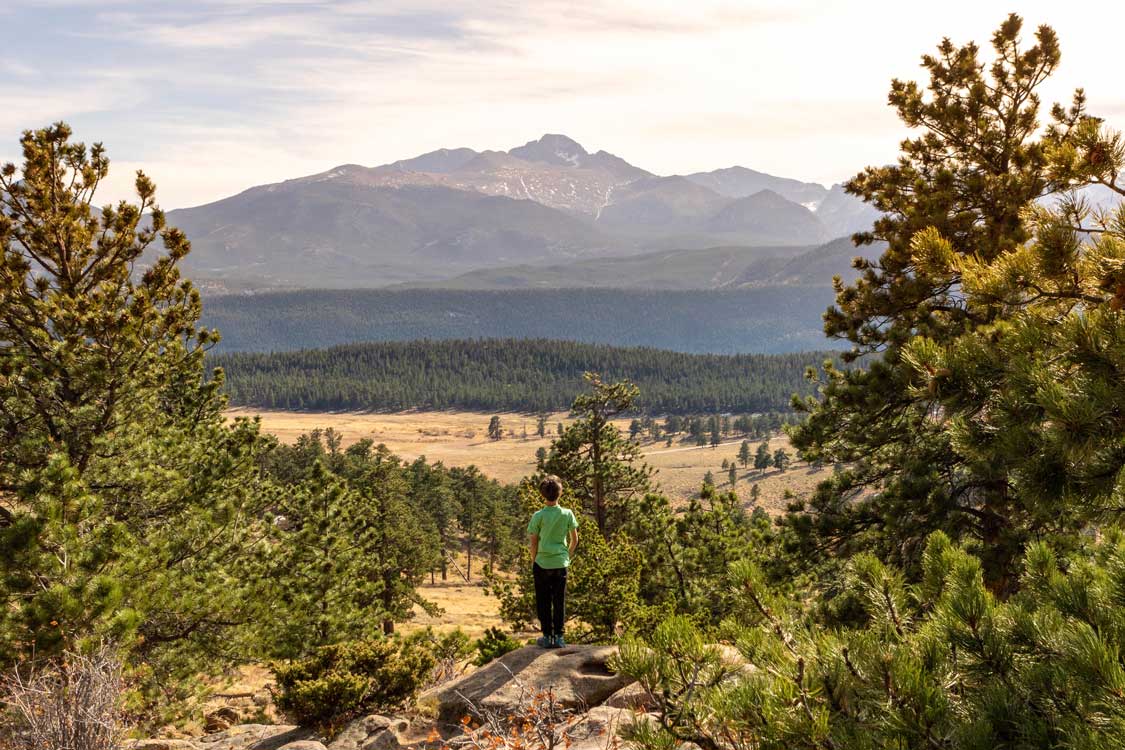
You do not have to drive everywhere once you arrive in Estes Park and Rocky Mountain National Park, and in summer you probably shouldn’t. Both Estes Park and the national park run free shuttle systems that connect the town, the visitor center, and the major trailheads inside the park, which spares you the misery of hunting for a parking spot at Bear Lake on a July morning. Start at the Estes Park Visitor Center to grab a map and get your bearings. If you’d rather skip the drive from Denver altogether, Colorado’s seasonal Bustang to Estes bus service runs from the city on summer weekends.
The Best Things To Do In Estes Park
Estes Park is more than a place to sleep before hitting the park. A few of our family’s favorites:
- Watch the elk. This is the one nobody expects. Herds of elk wander right through town, grazing on lawns and the golf course and stopping traffic like they own the place, and in the autumn rut you’ll hear the bulls bugling across the valley. It’s genuinely one of the coolest wildlife experiences you can have without leaving the sidewalk.
- Tour the Stanley Hotel. The grand, white, slightly spooky Stanley Hotel overlooking town is the hotel that inspired Stephen King’s The Shining after he stayed there, and even if you’re not bunking down, its history and ghost tours are a fun outing.
- Get creative at Patterson Glassworks and the Make and Take Studio. At Patterson Glassworks, you can watch local artists blow glass, and at the Make and Take Studio, kids can craft their own souvenir, like a drawstring backpack, to take home.
- Ride and climb. Sombrero Stables runs family horseback tours into the surrounding country, and the Open Air Adventure Park strings zip lines, tightropes, and obstacle courses through the trees for older kids and brave parents.
- Eat well. Estes Park punches above its weight for a small town. Mama Rose’s serves hearty Italian on the Riverwalk; its neighbor, Poppy’s Pizza and Grill, does crowd-pleasing pies; and Claire’s Restaurant and Bar is a solid pick for barbecue.
Where To Stay In Estes Park

Estes Park has beds for every budget, and it books up fast in summer, so reserve early. Two I’d point families toward:
- The Stanley Hotel. For a stay with a bit of history (and maybe a ghost or two) mixed in, the iconic Stanley is an experience in itself, with sweeping views over the town and mountains. You can check prices and availability for the Stanley Hotel here.
- The Landing at Estes Park. A more laid-back option with some of the best views in town and easy access to the park entrance. You can check prices and availability for the Landing here.
If you’d rather stay in the city on either end of your trip, my guide to where to stay in Denver has you covered.
The Best Time To Make The Drive from Denver to Estes Park
You can make this drive year-round, but the experience changes dramatically with the seasons. Summer brings warm days, wildflowers, and every trail and road open, along with the biggest crowds and the timed-entry reservations. Fall is my favorite: the aspens turn brilliant gold, the elk rut fills the valleys with bugling, and the crowds thin after Labor Day. Winter is quiet and beautiful but cold, and the high mountain roads close.
Important planning note: The Trail Ridge Road, the star drive inside the park, is only open from roughly late spring to early fall, so if crossing the Continental Divide is on your list, time your trip accordingly.
Tips For Driving From Denver To Estes Park
- Reserve your park entry. Sort out your Rocky Mountain National Park timed-entry reservation before anything else (see above), or plan to enter early or late.
- Take the altitude seriously. Estes Park sits above 7,500 feet, and Trail Ridge Road tops 12,000. Drink plenty of water, take your first day easy, and don’t be surprised if little ones tire quickly.
- Fill up before the mountains. Gas is easy to find in Denver, Boulder, and Lyons, but thins out fast on the Peak to Peak Highway. Top up before you climb.
- Watch the weather. Mountain weather turns on a dime, with afternoon thunderstorms common in summer and snow possible on the high roads well into spring and fall. Check conditions before you set out.
- Give wildlife room. Elk, bighorn sheep, and the occasional moose are part of the scenery. Enjoy them from a distance and never get between an animal and its young.
- Do both routes. Seriously. Fast one way, Peak to Peak the other. It’s the single best piece of advice in this guide.
Before You Drive: Understanding Changes To Rocky Mountain National Park Reservations
This is the part almost every other guide skips, and it’s the single most important thing to sort out before you make the drive to Estes Park. Through the busy season, roughly late spring into the middle of fall, Rocky Mountain National Park runs a timed-entry reservation system to control the crowds, and if you show up during the day without one, you will be turned away at the gate.
Here’s how it works in plain terms. There are two kinds of reservations. One covers the whole park except the Bear Lake Road corridor and is required through the middle of the day. The other adds the very popular Bear Lake Road corridor (Bear Lake, Sprague Lake, Moraine Park, Glacier Gorge) and is required across a longer daytime window. You book both on Recreation.gov, where they release in monthly blocks, with a second batch dropping the evening before each day. They go fast, so set a reminder and book the moment they open.
Two things worth knowing. First, the reservation is separate from the park entrance fee (or your national parks pass), so you’ll need both. Second, and this is the family hack, the reservation is only required during the daytime window. If you enter the park in the early morning or roll in during the late afternoon and evening, you can skip the reservation entirely, and you’ll dodge the worst of the crowds and score the best light and wildlife while you’re at it. I’ve put the current dates, times, and the booking link in the notes for this guide; confirm them on the park’s site close to your trip, since they shift a little year to year.
Frequently Asked Questions About Driving From Denver to Estes Park
The fast route via US-36 is about 65 miles and takes roughly an hour and a half without stops. The scenic Peak to Peak Highway runs two to three hours depending on your starting point and how often you stop.
Take US-36 through Boulder and Lyons. It’s mostly highway with only a short winding stretch at the end, and far gentler than the Peak to Peak Highway or the canyon routes.
The Peak to Peak Highway, Colorado’s oldest scenic byway, is the most beautiful, winding through mining country and national forest past ghost towns and the Chapel on the Rock. The Big Thompson Canyon route via US-34 from Loveland is a shorter scenic option.
Yes, during the busy season, the park requires a timed-entry reservation for daytime entry, booked on Recreation.gov and separate from the entrance fee. You can skip the reservation by entering in the early morning or the late afternoon and evening.
I’d do the fast route one way and the scenic route the other, so you experience both without doubling your driving time. The Peak to Peak is significantly longer, so it’s a lot to repeat in a single trip.
Late spring through early fall for open roads and full access, with September a standout for golden aspens and bugling elk. Trail Ridge Road inside the park is only open roughly late spring to early fall.
Yes. Colorado’s seasonal Bustang to Estes bus runs from Denver on summer weekends, and free shuttles connect Estes Park with the national park’s main trailheads once you’re there.
Ready For The Drive From Denver To Estes Park?
However you make it, the drive from Denver to Estes Park is one of the great little road trips in Colorado, and the payoff at the end, a charming mountain town at the doorstep of one of America’s most beautiful national parks, is hard to beat. Sort out your park reservation, pick your route (or better yet, both), and take your time. The mountains aren’t going anywhere.
For more of our Colorado adventures, explore my guides to Rocky Mountain National Park with kids, things to do in Colorado with kids, things to do in Denver with kids, and Colorado’s national parks.
This post may contain compensated links. Any purchases made may earn us a small commission at no extra cost to you. For more information, please read our disclaimer. Wandering Wagars is a participant in the Amazon Services LLC Associates Program, an affiliate advertising program designed to provide a means for sites to earn advertising fees by advertising and linking to amazon.com, amazon.co.uk, amazon.ca. Amazon and the Amazon logo are trademarks of Amazon.com, Inc. or its affiliates.
You May Also Like To Read:

Tommy
Wednesday 11th of June 2025
My Wife is going to make ride from Denver to Estes with daughter and is a little nervous . What would you consider the easiest route to travel . We are from east coast and she has not driven many mountain roads .
Tommy Boston , Ma
Kevin Wagar
Thursday 12th of June 2025
Hi Tommy, to be honest, none of the roads are what I would call difficult. There are quicker routes than the way that I describe in the article, but this is the most scenic. The easiest route would be to take 25 to 66 and then 36 to Estes Park. This route is a lot more highway driving and saves time as it doesn't go through small towns and villages.
Jennifer Davis
Friday 2nd of August 2024
Hi, thanks for the research. I was looking on Google Maps. I can't find where Baseline Rd connects to 119. Is there another road that connects the two? Thanks
Kevin Wagar
Wednesday 7th of August 2024
Hi Jennifer,
Make sure you're heading towards CO 119 and not HWY 119. They don't connect directly, you'll need to cross over via HWY 7.
Wayne
Sunday 1st of October 2023
Hi, Looking to do the denver-estes via the creek canyon park route that you highlight. Curious on your thoughts about getting back...come back the way we came or take the faster route back. Thank you
Kevin Wagar
Monday 2nd of October 2023
Hi Wayne,
Personally, I did the scenic route on the return. Whether you want to do it both ways is up to you. It's significantly longer, but doing it both there and back might give you a few more opportunities to explore the sites along the way.
Hilda
Tuesday 23rd of May 2023
Thank you for posting this. It is exactly what I was looking for.
Kevin Wagar
Wednesday 31st of May 2023
I'm happy to hear that Hilda! Safe travels.
Yvette Stone
Wednesday 22nd of March 2023
I used to go to the Chapel on the Rocks with my grandmother when she lived in Allenspark. It's a very beautiful church!!