
Planning a family trip to Portugal? Visas, getting around, and tips for Lisbon, Sintra, the Algarve, Évora, and the monasteries of central Portugal.
The very first time I visited Portugal was my first real test in family travel. Our son was five months old. We had done a few weekend trips from home, but nothing like this, nothing that required passports and car rentals and the type of thinking on the go that comes with managing a baby through a two-week itinerary in a country we had never set foot in before.
Christina and I had chatted about Portugal for years before Cohen arrived. A land packed with magical castles, cobblestone streets, and breathtaking beaches. Portuguese food, though … we had already fallen in love with that after living in Little Portugal in our home in Toronto. So when we decided we were not going to let our new entry into parenthood put travel on hold, Portugal was the obvious first answer.
It was also, in retrospect, an excellent choice for a first foray into international family travel. Portugal is one of the most forgiving European destinations for families with young children. It is compact, safe, friendly, and relatively inexpensive by European travel standards.
The food at almost every price point is genuinely delicious. The Portuguese are warm and welcoming toward children in a way that makes navigating public spaces with a baby or a toddler considerably less stressful than it is in many other European countries. And the access to extraordinary things to do within driving distance of Lisbon, which served as our base for most of the trip, is remarkable. Castles, monasteries, sea caves, a medieval walled city, and dinosaur footprints are all within a two-hour drive of the city.
Portugal has become one of the most visited countries in Europe, and the crowds at peak sites in peak season can be overwhelming in cities like Sintra. Families who time their visit for spring or autumn and book accommodation in advance will discover a country that rewards them generously. Here is everything you need to know before traveling to Portugal as a family.
Norway Family Travel: At a Glance Quick Facts
🗣Language: Portuguese. English is widely spoken in Lisbon, Porto, and tourist areas. Less common in rural areas.
💰Currency: Euro (EUR). Credit cards are accepted almost everywhere. ATMs are widely available.
🔌Power Adapter: Type F (two round pins). 230V. North Americans need both a plug adapter and a voltage converter. This is the one I recommend.
🚗Driving: Right-hand side. Roads are generally in good condition. A rental car is the best way to explore outside of Lisbon.
🆘Emergency: Police, Ambulance, and Fire: 112
💧Water Safety: Excellent and safe to drink everywhere. Tap water meets or exceeds all European Union standards.
🛂Visas: Visa-free for Canadian, US, UK, Australian, and most EU citizens for up to 90 days in the Schengen Area. EES biometric registration is required as of 2026.
🌤 Best Time to Visit: April to June and September to October. Warm, less crowded, and manageable prices. July and August are hot and very busy.
Visas and Entry Requirements for Family Travel in Portugal
Portugal is part of the Schengen Area. Canadian, US, Australian, and most non-EU citizens can enter Portugal and travel freely throughout the Schengen zone visa-free for up to 90 days within any 180-day period. UK citizens retain visa-free access post-Brexit for stays of up to 90 days. Your passport must be valid for at least three months beyond your planned date of departure from the Schengen Area.
The EU Entry/Exit System, known as the EES, became fully operational across all Schengen border crossings on April 10, 2026. This digital biometric system replaces manual passport stamping. On your first entry into the Schengen Area, border officers record your facial image and fingerprints alongside your travel details. On subsequent entries, biometric data verifies your identity. Every member of your family, including children, goes through this process on first entry. First-time registration takes longer than a standard passport stamp, so build extra buffer time into arrivals at Lisbon Airport.
A second system, the European Travel Information and Authorization System, known as ETIAS, is expected to launch in the last quarter of 2026. This will require non-EU nationals who are currently visa-exempt to obtain a pre-travel electronic authorization before entering the Schengen Area, similar to the US ESTA or Canada’s eTA. At the time of writing, ETIAS is not yet in effect. Check the current status before booking if traveling after mid-2026.
For families: solo parents or non-biological guardians traveling with children should carry a notarized consent letter from the non-accompanying parent, as Portuguese border officers can request documentation proving authority to travel with a minor.
Getting Around Portugal with Kids
Renting a Car
Booking a rental car is the single best investment a family can make for any Portugal trip that extends beyond Lisbon and its immediate surroundings. The country is compact, the roads are generally excellent, driving is on the right, and the distance between the major attractions is manageable.
Popular destinations like Sintra, Óbidos, Fátima, the monasteries of Alcobaça and Batalha, Évora, and the Algarve coast are all significantly easier and more rewarding with the flexibility of a car than they are by public transport. We rented a car for our entire first trip to Portugal, and it transformed what was possible on any given day, even when using Cascais as a base for most of the visit.
Portugal has an extensive network of electronic tolls on its main highways, known as Via Verde. Most rental cars are equipped with a Via Verde transponder, and the costs are either prepaid or charged to your card at the end of the rental. Confirm this with your rental company at pickup. An International Driving Permit is recommended alongside your home license.
Trains
Portugal’s rail network, operated by CP (Comboios de Portugal), connects Portugal’s major cities reliably and affordably. The Lisbon to Porto route is served by Alfa Pendular high-speed trains that cover the journey in about three hours.
The Lisbon to Cascais coastal line is one of the more pleasant suburban rail journeys in Europe and is the obvious option for families basing themselves in Cascais. Within Lisbon, the metro is efficient and covers the main tourist areas. Book train tickets in advance during peak season.
The Lisboa Card
The Lisboa Card covers unlimited travel on Lisbon’s metro, bus, tram, and suburban rail network, including the Cascais and Sintra lines, plus free or discounted entry to over 80 museums and attractions in the city and surrounds. For a family spending two or more days in Lisbon with day trips to Sintra and Cascais included, it typically pays for itself on the first day. Cards are available at the airport, at Lisbon tourist offices, and online.
Taxis and Rideshare
Uber operates throughout Lisbon and Porto and is generally the most practical option for families moving between neighborhoods or needing door-to-door service with luggage and young children. Standard taxis are metered and reliable. In smaller towns and rural areas outside the main cities, taxis may need to be pre-booked through your accommodation.
eSIMs, Data, and Staying Connected While Traveling in Portugal
Mobile coverage in Portugal is excellent in Lisbon, Porto, the Algarve, and along the main highway network. It becomes patchy in more remote rural areas of the Alentejo and interior. An eSIM purchased through a provider like Airalo and installed before departure gives reliable coverage on Portuguese networks at a fraction of roaming costs.
Portugal is an EU member, which means EU residents pay no roaming charges. North American families should sort an eSIM or a local SIM before they need it. Free Wi-Fi is available at most hotels, cafés, and in many public spaces in Lisbon and Porto.
Language In Portugal
Portuguese is the official language. In Lisbon, Porto, and tourist areas throughout the Algarve, English is spoken well in hotels, restaurants, and at most major attractions. Away from the main tourist circuit, particularly in rural areas of the Alentejo and interior, English becomes less reliable.
Portuguese is phonetically quite different from Spanish, despite some visual similarities on the page, and the nasal vowels in particular take time to hear correctly. Any effort to speak or understand the language is received warmly by locals.
A note on Obrigado: the male form is used by male speakers and Obrigada by female speakers, which is one of the first things children find interesting about the language.
Phrase | Portuguese | Pronounciation |
|---|---|---|
Hello | Olá | oh-LAH |
Thank you | Obrigado / Obrigada | oh-bree-GAH-doo / oh-bree-GAH-dah |
Please | Por favor | por fah-VOR |
Where is…? | Onde fica…? | ON-deh FEE-kah |
How much? | Quanto custa? | KWAN-toh KOOSH-tah |
My child is sick | O meu filho está doente | oo MAY-oo FEE-lyoh esh-TAH doo-EN-teh |
Help! | Socorro! | soh-KOH-roo |
Bathroom | Casa de banho | KAH-zah deh BAH-nyoo |
Yes | Sim | seeng |
No | Não | now |
Electricity and Power Adapters for Portugal
Portugal uses Type F sockets with two round pins, running at 230V. North Americans from Canada and the US need both a plug adapter and a voltage converter for any device that is not rated for dual voltage.
Check the label on every charger before you travel. Most modern phones, laptops, and camera batteries handle 230V and need only the adapter. A multi-port USB charging hub with dual voltage capability handles the whole family from a single outlet.
Family Travel Safety in Portugal
Portugal is consistently ranked among the safest countries in Europe, and family travel here is generally relaxed and welcome. Violent crime affecting tourists is very rare. The primary concern in Lisbon, as in most popular European capitals, is petty theft.
Pickpocketing is most common on the crowded Tram 28 route, in the Alfama neighborhood, at the Castelo de São Jorge, and in the Belém district during busy periods. Keep bags closed and in front of you, do not leave items on café tables, and be attentive when distracted by children in crowded spaces.
The Algarve coastline presents one safety consideration worth flagging for families. The Atlantic swell on exposed west-facing beaches can be powerful and unpredictable, with strong currents that have been responsible for drownings. The south-facing beaches between Lagos and Faro are generally calmer and more suitable for children. Always check beach safety flags before entering the water and supervise children closely on any Atlantic-facing beach.
Health and Vaccination Requirements for Family Travel in Portugal
No vaccinations are required or specifically recommended for tourist travel to Portugal beyond ensuring the whole family is current on standard routine vaccines, including MMR, DTaP, and polio. Portugal has high standards of food safety, excellent tap water, and medical facilities comparable to those of any Western European country.
Medical care in Lisbon and Porto is excellent. EU citizens are covered by the European Health Insurance Card. Non-EU visitors, including Canadians and Americans, should carry comprehensive travel insurance with medical coverage. For minor ailments, Portuguese pharmacies, marked with a green cross, are well-stocked and pharmacists provide a high level of guidance without requiring a doctor’s appointment. For families with young children, they are a practical first stop for anything short of a genuine emergency.
It’s recommended that you have travel insurance prior to leaving your home country to ensure that you’re covered for any eventualities that may occur. I typically use Safetywing or World Nomads for my family. travel insurance.
Regions of Portugal: What Families Need to Know

Lisbon and Cascais
Lisbon is one of the finest cities in Europe for families, and it does not always get the credit it deserves from North American travelers who default to more popular European cities like Paris or Rome. The city is built across seven hills, and the combination of those hills, the Tagus River, the trams, the azulejo tile facades, and one of Europe’s most underrated food scenes produces an atmosphere that holds its own as a world-class family travel destination.
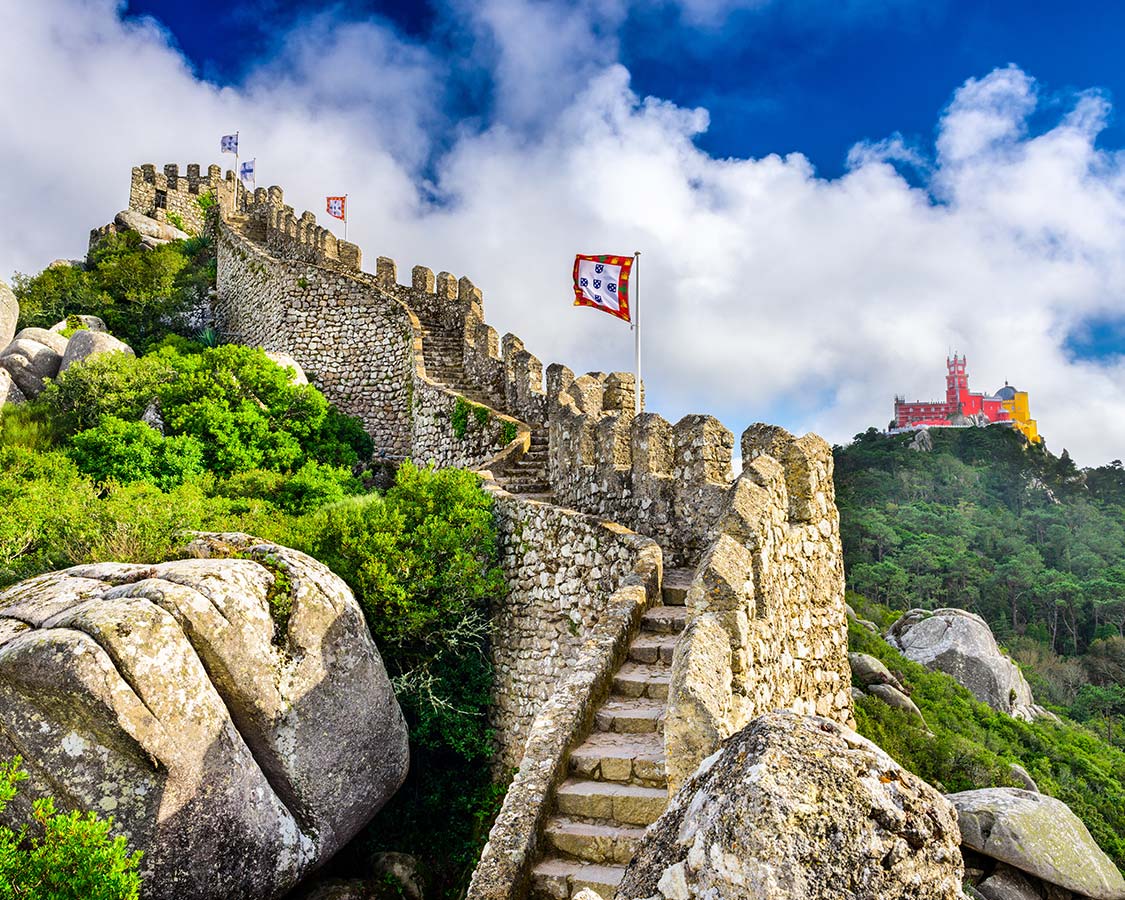
Tram 28 is the most famous and most crowded tram route in the city. It climbs through Alfama and Graça, and the views it delivers make it worth the crowds. The Castelo de São Jorge, the Moorish castle on the hilltop above Alfama, is one of those sites where children can feel free to run across the battlements and look out over a city that has held the same ground for three thousand years.
The Belém district, to the west of the center, is where the gorgeous tower, Mosteiro dos Jerónimos, sits, possibly the finest piece of Manueline architecture in the country, and where the original Pastéis de Belém bakery has been making its legendary custard tarts from the same recipe since 1837.
Cascais, the elegant coastal town 30 km west of Lisbon on the rail line, is an excellent alternative home base to the city of Lisbon itself. It is quieter, safer with small children, has its own beaches and restaurants, and puts you within easy reach of Sintra and the Estoril coast. We based our family there for most of our first visit to Portugal, and it was the right call.
You can read the full guide to visiting Lisbon with kids here.
Sintra
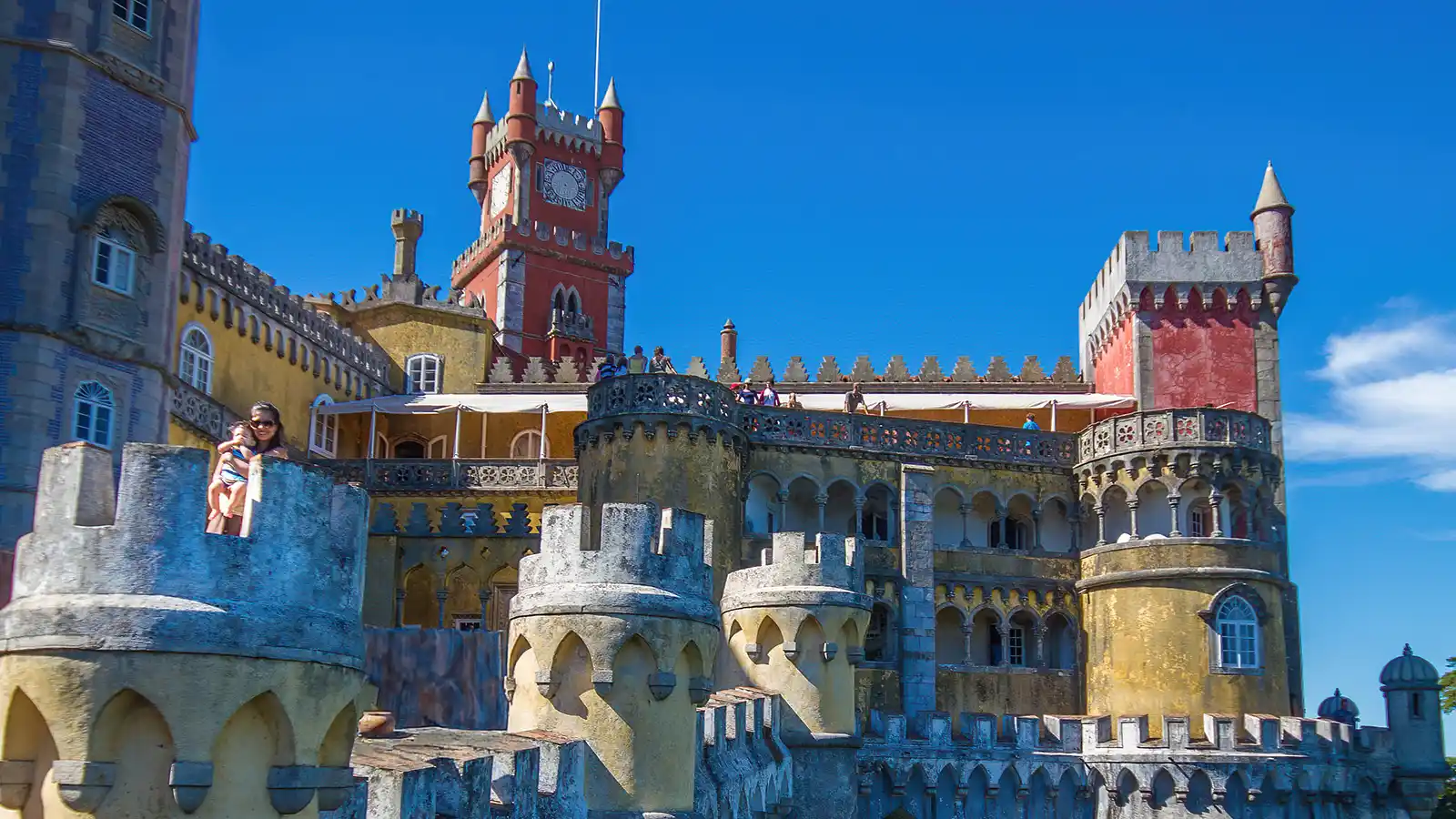
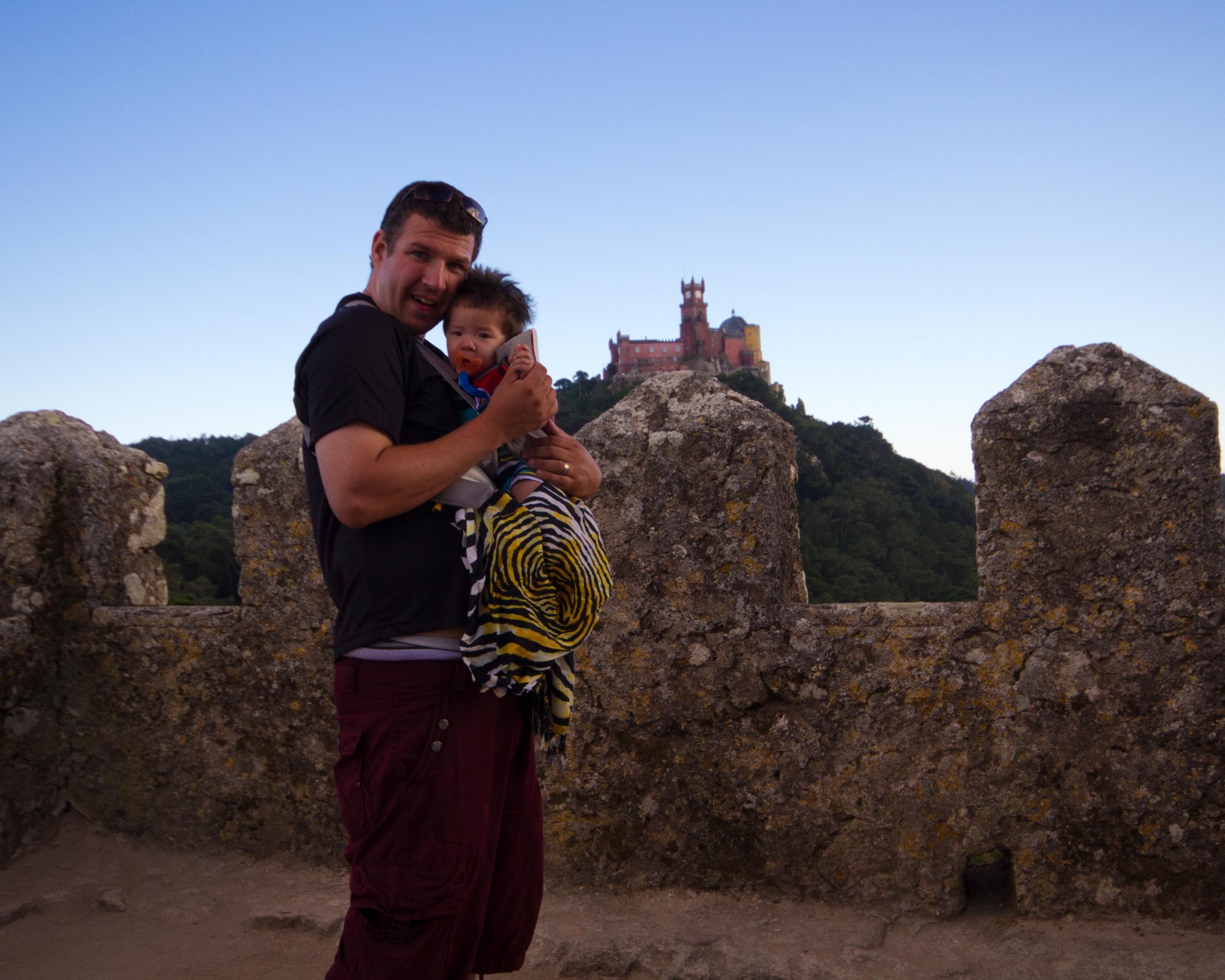
You’re driving up into the hills above Cascais, and then suddenly there is a palace painted in yellow, blue, and red sitting on a peak above the trees, and it looks like something a child would draw when asked to imagine what a castle looks like. That is the Pena Palace, and it is as excessive and extraordinary as that first glimpse suggests.
The Sintra UNESCO Cultural Landscape contains five significant palaces and estates within walking distance of the town center. Pena Palace is the colorful Romantic-era one on the peak. The Sintra National Palace is the medieval one in the town center with the two enormous conical chimneys. The Castle of the Moors is the ruined Moorish fortification on the ridge with the views. Quinta da Regaleira is the Gothic estate with the initiatic well, a spiral staircase descending into the earth through a tower of stone, which children find either magical or unnerving and sometimes both at once. And Monserrate Palace is the often-overlooked one to the west, with the Moorish-Gothic-Indian architecture and the extraordinary gardens that reward the families who make it past the more famous sites.
Visiting Sintra as a family requires advance planning. The site is one of Portugal’s few over-visited destinations, and parking in summer is a unique form of chaos. The train from Cascais or Lisbon takes 40 minutes from Rossio station and drops you in the town center. That’s the practical choice for families. Buy entry tickets to Pena Palace in advance online. The queue to purchase at the gate in peak season is long enough to ruin the morning.
You can read the full guide to Sintra’s castles here, and my guide to the best Sintra hotels here.
💡 PRO TIP: Do Not Try to See All of Sintra in One Day
Sintra has five significant sites, and well-intentioned families will often attempt to see all of them in a single visit and succeed only in exhausting everyone and enjoying nothing. Pick two, maximum three, and spend real time at each one. Pena Palace and Quinta da Regaleira make the best combination for families with children. The Castle of the Moors adds a great contrast for a third if energy allows.
Central Portugal: Óbidos, Fátima, and the Monasteries
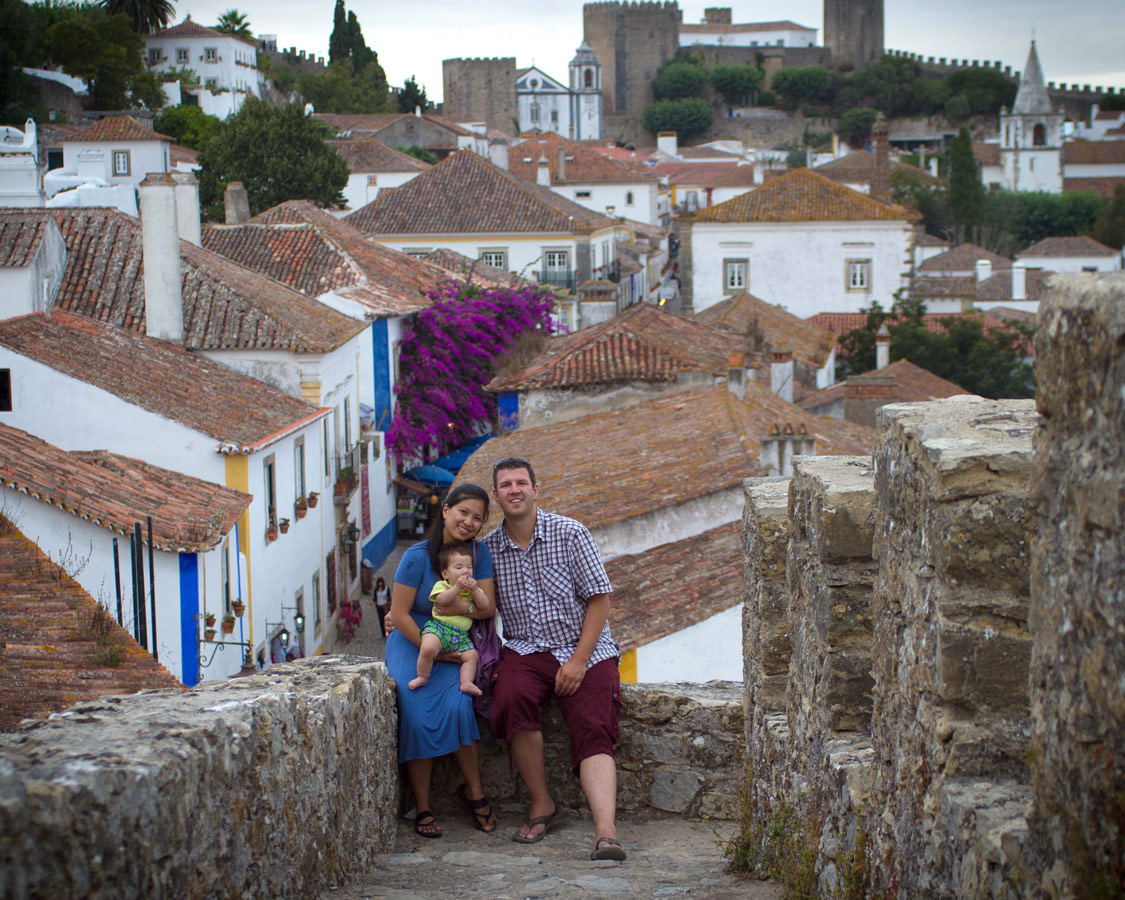
The stretch of coast and inland territory between Lisbon and Porto is one of the most historically dense areas in Portugal, and most families drive through it too quickly on the toll roads. Óbidos, a medieval walled town almost entirely preserved within its original walls, is worth a standalone visit.
Fátima draws pilgrims from across the world and genuinely affects them regardless of their religious background. And nearby, one of the most counterintuitive things in the country: a quarry containing Cretaceous sauropod footprints among the largest ever discovered. My son was several months old on our first visit, and already I could see the shape of the conversation that would happen when he was old enough to understand what he was standing next to.
The monasteries of Alcobaça, Batalha, and Tomar can be combined in a single long day trip and together form one of the finest concentrations of medieval religious architecture in Europe. All three are UNESCO World Heritage Sites, and all three earn the designation. You can read the full monasteries guide here, and the full day trips from Lisbon guide here.
Évora and the Alentejo
Our visit to Évora was the last day of our Portugal trip before flying home from Cascais. We were fully relaxed after several days in the Algarve and figured a day trip from Cascais, about two hours by car, would do the city justice. It did not.
Évora is a UNESCO World Heritage city with more significant sites per square mile than almost anywhere else in Portugal. The Roman Temple of Diana stands in the center of the city, intact enough that it reads immediately as a building rather than ruins.
The Cathedral is the largest medieval cathedral in Portugal. The Praça do Giraldo, the main square, is one of the finest in the country. And the Chapel of Bones, the Igreja de São Francisco’s famous ossuary, where the walls and ceiling are lined with the bones of several thousand monks, is one of those sites that children either refuse to enter or refuse to leave, with very little middle ground. We saw all of this and still felt we had scratched the surface.
The honest recommendation, which has been my position since that first visit, is this: do not do a day trip to Évora. Stay at least one night. The city changes character in the evening when the day visitors leave, and the restaurant scene, which is excellent across all price points, is best experienced when you are not watching the clock for the drive home. The Alentejo countryside around the city, with its cork oak forests, megalithic monuments, and white hilltop villages, requires more time than a single day allows. You can read the full Évora guide here.
🚫 DON’T MISS: Stay the Night in Évora
Évora is one of the most visited day trips from Lisbon in Portugal. It is also one of the most consistently underexperienced as a result. The city deserves an overnight stay. Book a hotel in the historic center, eat dinner after the day visitors have left, and wake up to the city before the coaches arrive.
The megalithic monuments in the surrounding Alentejo countryside, including the Almendres Cromlech stone circle, one of the largest prehistoric stone circles in Europe, are worth a morning on their own. None of that is possible on a day trip.
The Algarve
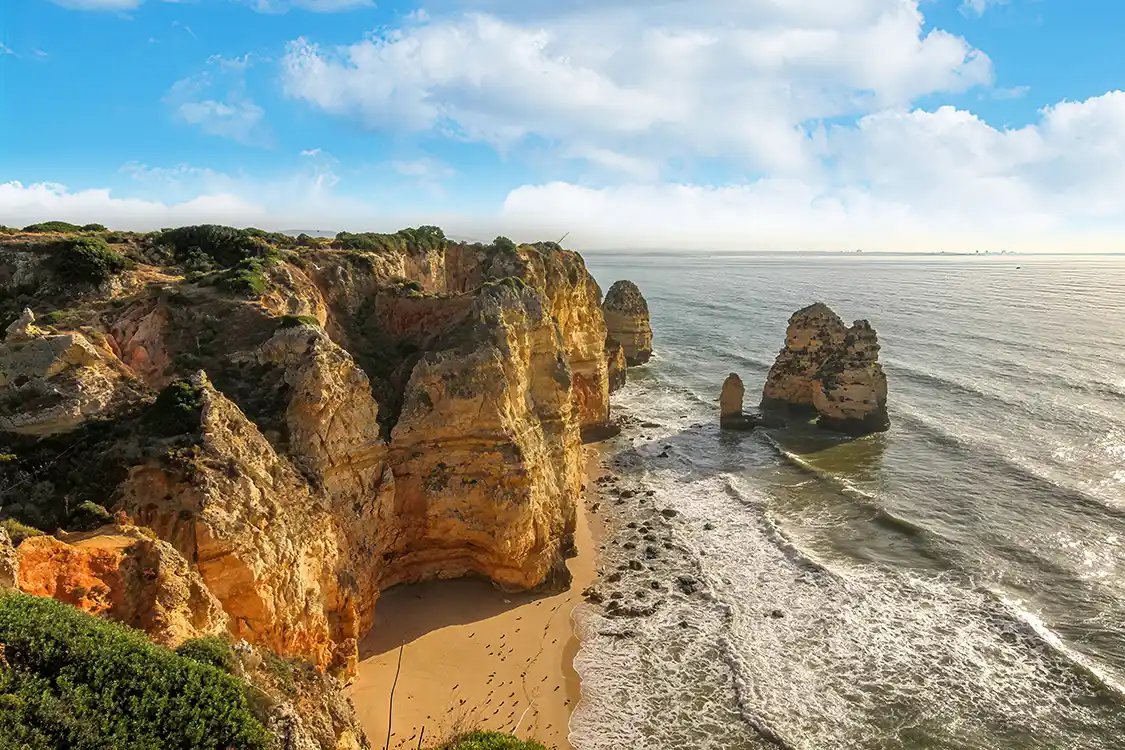
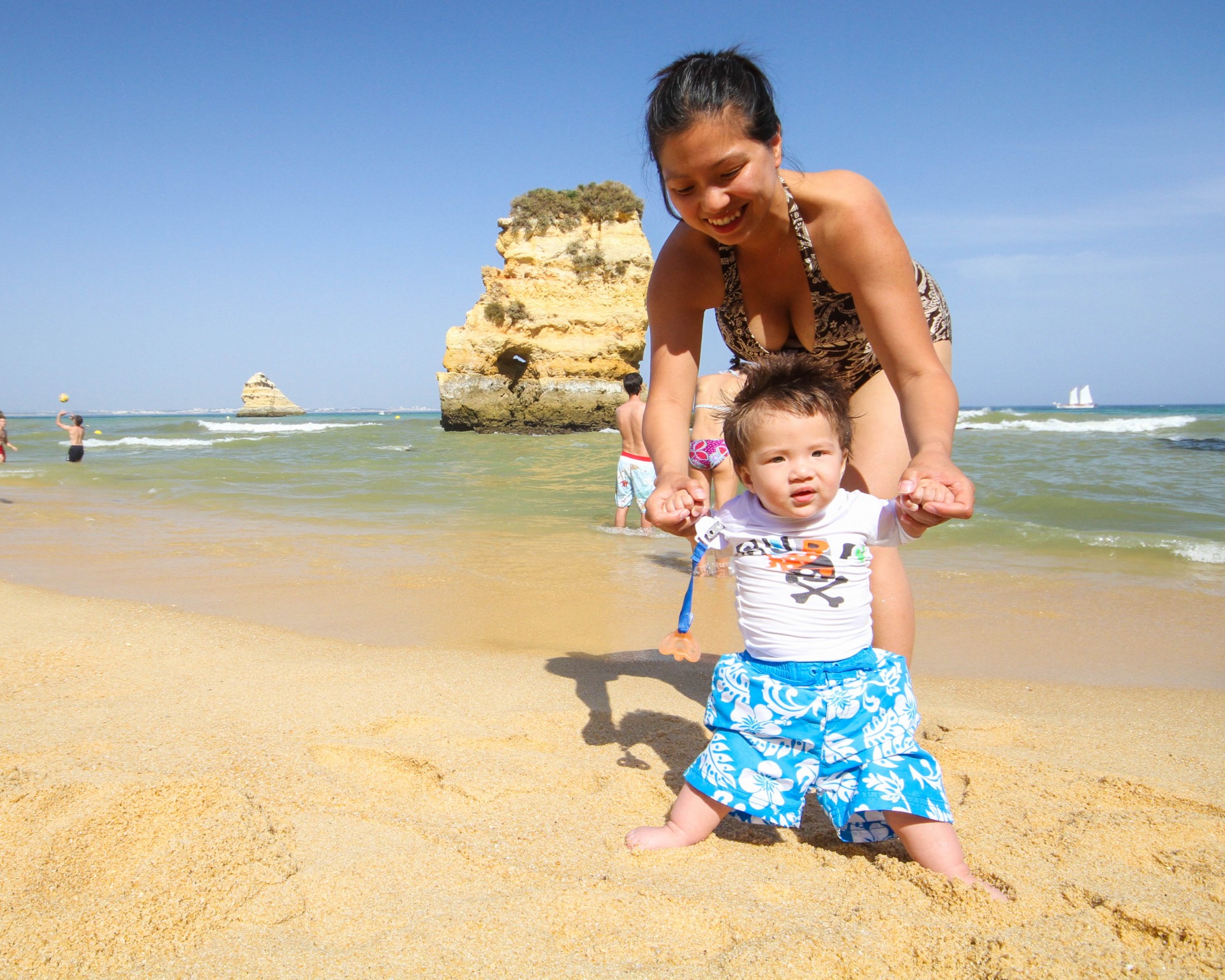
The Algarve is where Portugal goes to the beach, and the southern coast earns its reputation as one of the best beach destinations on Earth. The golden limestone cliffs, sea arches, and caves between Lagos and Tavira are among the most photographed coastlines in Europe, and they live up to the photographs from the water level.
The Algarve was our deliberate decompression at the end of our Portugal trip, a few days of discovering whether our then-infant son had opinions about sand. He did not, at that age, but the beaches set an unreasonably high standard for every beach he has encountered since.
For families, the east Algarve around Tavira offers calmer water and a less commercial atmosphere. The central Algarve has the best beach infrastructure for young children. The sea caves accessible by kayak or boat from Lagos are spectacular and manageable for most ages with a good operator. You can read the full Algarve guide here.
Porto and the Douro Valley
I have not personally traveled to Porto or the Douro Valley with my family, and I will be honest about that rather than write about them as if I have. They are firmly on the itinerary for a return visit, and the evidence from the families who have been is compelling.
Porto is Portugal’s second city, a steep Atlantic port city with a grittier, more textured character than Lisbon and a food and wine scene that has become one of the most celebrated in Europe. The Ribeira waterfront, the Dom Luís I Bridge, the historic azulejo-covered São Bento railway station, and the port wine lodges of Vila Nova de Gaia across the river are the obvious entry points. Families who spend three or four days there consistently describe it as one of the most liveable and enjoyable cities in Europe at that length of stay.
The Douro Valley inland from Porto, the UNESCO-listed wine region where the river has cut through terraced vineyards in a landscape that looks constructed rather than natural, is best explored by boat or by road over two or three days. It is not a destination with a high density of specific children’s activities, but as an immersive landscape experience, it is, by all accounts, one of the more extraordinary things in the country.
Money and Budgeting Tips for Family Travel in Portugal

Portugal uses the Euro and is one of the more affordable countries in Western Europe, which is one of the reasons it has become so popular with family travelers from North America. Meals at local restaurants are inexpensive by comparison with France, the UK, or Scandinavia.
Accommodation in most regions outside Lisbon and the Algarve in peak season is very reasonable. Entry fees at most historical sites are modest, and many of the country’s finest public spaces, markets, and viewpoints cost nothing.
The main cost pressure points for families are Lisbon in July and August, when accommodation prices spike significantly with demand, and Sintra, where the entry fees to individual palaces add up quickly for a family visiting multiple sites. The Lisboa Card mitigates the latter considerably. Booking accommodation well in advance for summer visits and considering shoulder season travel in April, May, September, or October both help with the former.
Credit cards are accepted virtually everywhere in Portugal, including smaller restaurants, markets, and tourist sites. ATMs are widely available. Tipping is appreciated but not obligatory, unlike in North America: rounding up or leaving 5 to 10% at restaurants is standard and welcome. There is no expectation of the 20 percent that has become the norm in Canada and the US.
What to Pack for Portugal
Portugal’s climate is mild and Mediterranean but varies enough by season and region to reward a small amount of packing thought. The Algarve in July is hot and dry. Lisbon in April is warm and occasionally rainy. The northern interior in autumn can be genuinely cold in the evenings. You can read my complete Portugal packing guide here.
- Comfortable walking shoes. Lisbon is beautiful and built on hills covered in cobblestones. This combination is hard on feet and hard on wheels. Good walking shoes are not optional, and wheeled suitcases are a specific kind of suffering in the Alfama and Mouraria neighborhoods.
- A light layer for evenings. Even in summer, Lisbon evenings can be cool with the Atlantic breeze. A light jacket or cardigan is worth the space in the bag for the whole family.
- High-factor sunscreen. The Algarve sun in summer is strong, and the reflected light off limestone cliffs and white sand compounds the exposure. Children burn faster than parents expect.
- Reef-safe sunscreen and water shoes for the Algarve. Sea cave and rock pool access involves rocky surfaces. Water shoes protect children’s feet and open up more of the coastline.
- A rain jacket. Lisbon and Porto receive meaningful rainfall in spring and autumn. A packable rain jacket takes almost no space and saves any number of days.
- Power adapter (Type F, 230V; North Americans need both an adapter and a voltage converter for non-dual-voltage devices).
- eSIM, installed before departure. Airalo provides reliable coverage on Portuguese networks.
- Lisboa Card. Purchase at the airport on arrival if spending two or more days in Lisbon. It covers transport and entry across the city and region.
- Family medical kit. Children’s pain relief, antihistamines, rehydration sachets, motion sickness medication for winding road trips to Sintra and the Alentejo, and any prescription medications in generous supply.
What Portugal Will Teach Your Family
Portugal is where history becomes something children can touch. The Alcobaça tombs, the Templars at Tomar, the Moorish castle above Sintra, and the Roman temple standing in the middle of a modern city in Évora. These are not reconstructions or interpretive centers. They are the original things, and the access Portugal extends to visitors, the ability to walk the ramparts, enter the cloisters, and stand in the actual spaces where history happened, is something that changes how children understand the difference between reading about a place and being in it.
The food here will raise the standards your children apply to pastries permanently. The pastel de nata, the Portuguese custard tart, is the obvious example. There is a version of it available in every city in the world now, and none of them is the same as eating one warm from the original bakery in Belém with powdered cinnamon on top. My son had his first one before he was old enough to understand what he was eating. He has been making informed comparisons ever since.
Portugal rewards the families who go beyond Lisbon. Lisbon is extraordinary and could fill a week on its own. But the families who also drive to Évora and stand inside a Roman temple, or spend a morning at the dinosaur footprint quarry near Ourém, or sit on a beach in the Algarve that they found by taking an unmarked track down a cliff, come home with a different understanding of what the country is. Portugal is small enough that all of it is within reach. The radius from Lisbon alone covers more than most families would expect in two weeks.
Portugal was our first real family trip, and it set the standard for everything that followed. Not because it was the most dramatic or the most ambitious, but because it proved the thing we needed to be proved at that moment: that travel with children was not just possible but genuinely better in ways we had not anticipated. A country that is safe, that is warm toward children, that has extraordinary things at almost every stop, and that feeds everyone well at every meal. Portugal is a very good answer to the question of where to take a family first.
Final Thoughts on Family Travel in Portugal
Portugal family travel rewards curiosity and a willingness to slow down. The destination guides on this site cover the details for each region, while the practical information above is designed to help your family move through the country with confidence. Book Sintra tickets in advance. Stay the night in Évora. Take the coastal train to Cascais and watch the Atlantic appear between the stations. Eat the tart while it is warm.
You will come home with the photographs everyone takes: Pena Palace above the clouds, the custard tart in paper on a zinc counter, a child on a limestone beach looking at a sea cave entrance with the specific expression that means they are deciding whether to go in or not. But what stays is the ease of it. Portugal is the country that makes family travel feel manageable, which turns out to be exactly what you need the first time you try it, and exactly what you want to return to after somewhere more demanding.
This page is updated as new regional guides and planning resources are published. Looking beyond Portugal? Explore my International Family Travel Guide.