
Everything families need before visiting Norway. Visas, the EES border system, driving, the Hurtigruten, fjords, Kirkenes, and what it really costs.
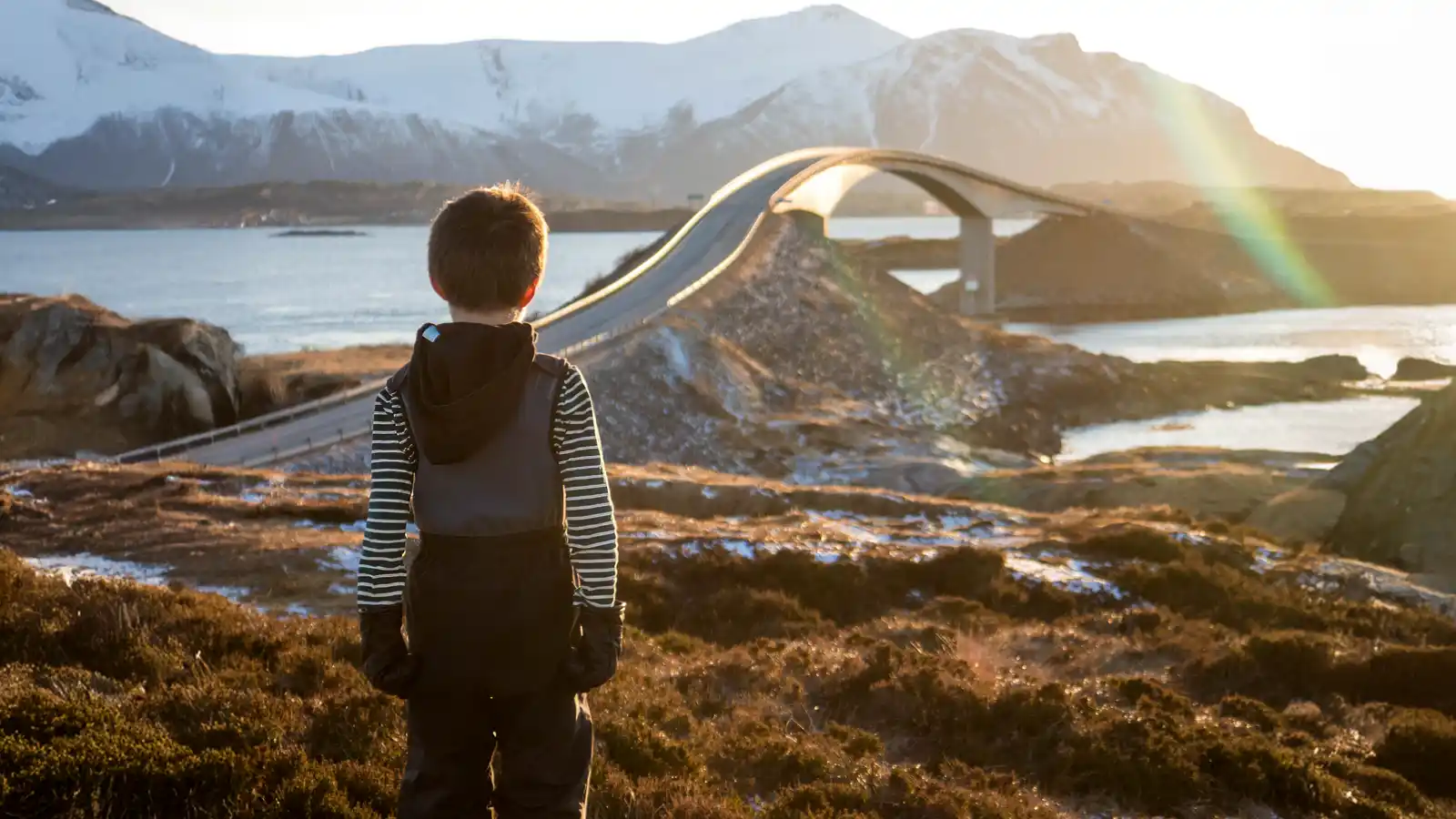
We had lost our luggage somewhere between Toronto and Kirkenes, and it was 5°F (-15°C) outside. Kirkenes is a town of roughly 3,500 people near the northern tip of continental Europe, a short drive from the Russian border, and what it is not is a place with a surplus of emergency thermal clothing for families who have just arrived without their bags.
Our host, a local named Roar Anderson, took this calmly. He had seen worse. He helped us sort out what we needed, got us into warm gear by the following morning, and proceeded to take us snowmobiling across a frozen fjord as if the whole episode had been planned as character-building.
That is the kind of adventure Norway excels at. The logistics can be a challenge, the country is dramatically expensive, and the darkness in winter is unrelenting, but none of that matters because Norway is one of the most extraordinary places on earth to take children.
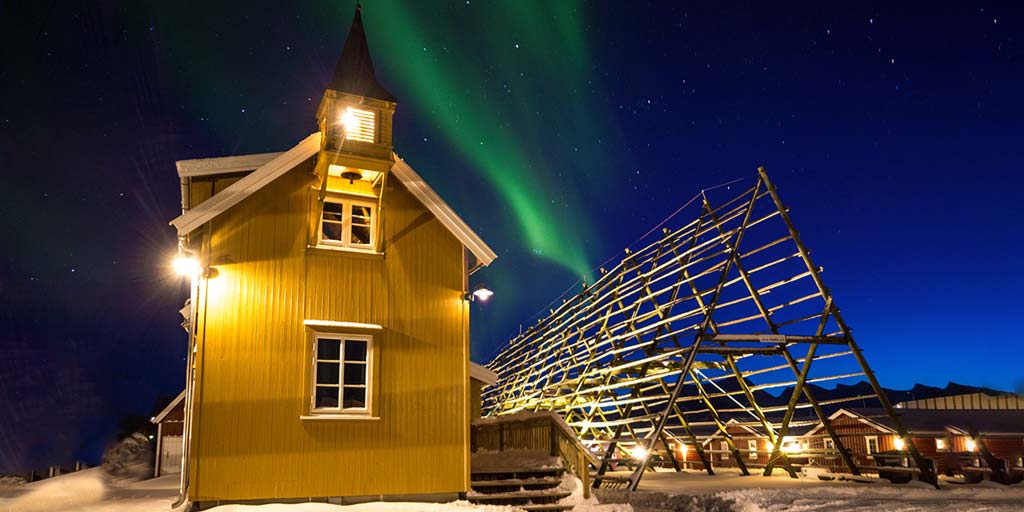
That first glimpse of the towering cliffs of the Norwegian fjords. The Northern Lights appear without warning in the middle of the night. The Flåmsbana railway descends 800 meters through a mountain valley, while frozen waterfalls hang from the cliffsides. Snowmobiling on a frozen fjord. Norway revels in the extraordinary, and it loves to show that off.
Family travel in Norway does require preparation. The seasonal decision, whether to visit in summer for the midnight sun and hiking through the fjords or to visit Norway in winter for the Northern Lights and snow-covered landscapes, shapes every other decision you make about the trip.
Here is everything you need to know before planning an epic family vacation in Norway.
Norway Family Travel: At a Glance Quick Facts
🗣Language: Norwegian. English is spoken fluently by almost everyone throughout the country.
💰Currency: Norwegian Krone (NOK). Credit cards are accepted virtually everywhere. Norway is a largely cashless society.
🔌Power Adapter: Type F (two round pins). 230V. North Americans need both a plug adapter and a voltage converter.
🚗Driving: Right-hand side. Roads well-maintained. Tunnels and ferry crossings are part of normal travel. Winter driving requires snow tires or even studs in some areas.
🆘Emergency: Police: 112 | Ambulance: 113 | Fire: 110
💧Water Safety: Excellent and safe to drink everywhere. One of the best tap water supplies in the world.
🛂Visas: Visa-free for Canadian, US, UK, Australians, and most EU citizens for up to 90 days in the Schengen Area. EES biometric registration is required as of 2026.
🌤 Best Time to Visit: June to August for fjords, midnight sun, and hiking. November to March for Northern Lights and winter activities.
Visas and Entry Requirements for Family Travel in Norway
Table of Contents
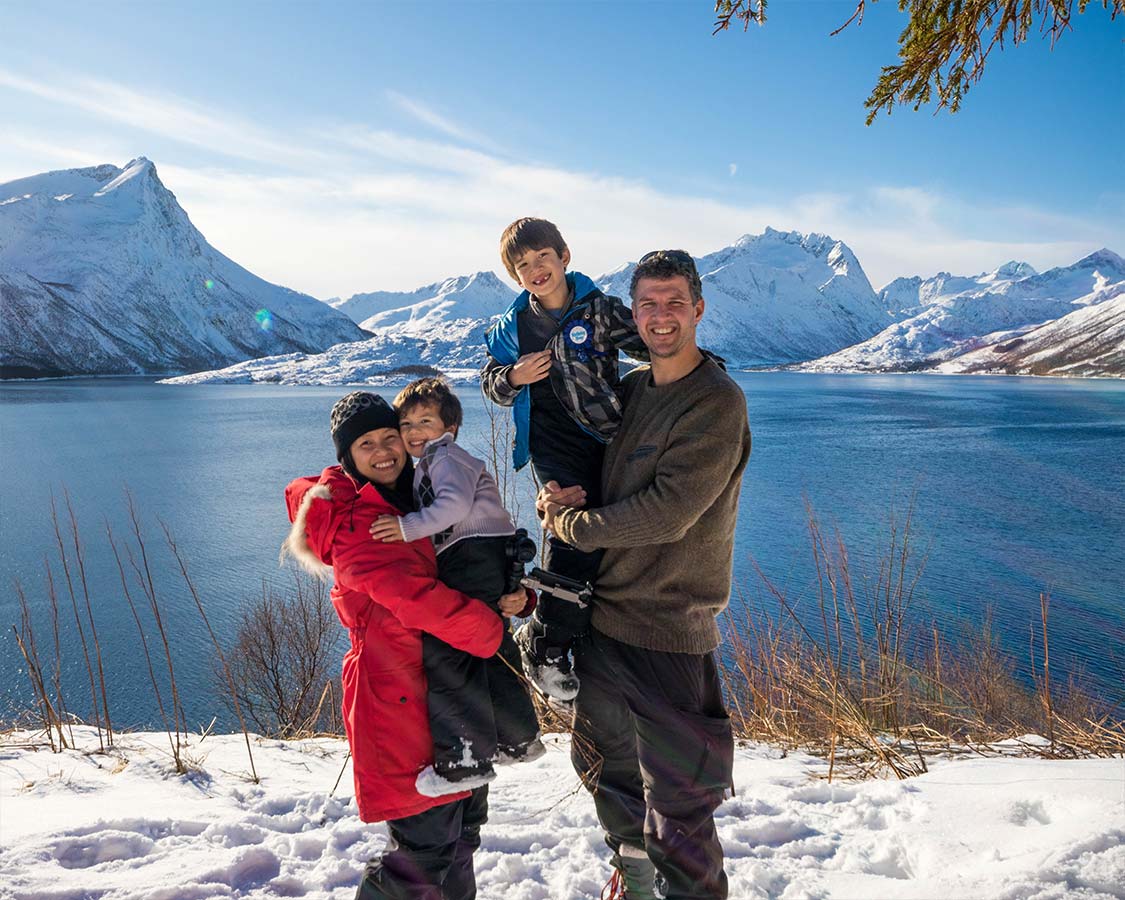
Norway is part of the Schengen Area, the 29-country European zone with no internal border controls. Canadian, US, Australian, and most non-EU citizens can enter Norway and travel throughout the Schengen Area visa-free for up to 90 days within any 180-day period. Your passport must be valid for at least three months beyond your planned departure from the Schengen Area and must have been issued within the last ten years.
The entry process for non-EU visitors has changed significantly as of 2026. The EU Entry/Exit System, known as the EES, became fully operational across all Schengen border crossings on April 10, 2026. The system replaces manual passport stamping with a digital biometric system. On your first entry into the Schengen Area, border officers will record your facial image and fingerprints, along with your passport and travel details. On subsequent entries, the biometric data is used to verify your identity. The system applies to every member of your family, including children, and first-time registration takes longer than a standard passport stamp. Plan extra time for your airport arrivals to account for this.
A second system, the European Travel Information and Authorization System, known as ETIAS, is expected to launch in the last quarter of 2026. This will require non-EU nationals who are currently visa-exempt to obtain a pre-travel electronic authorization before entering the Schengen Area, similar in concept to the US ESTA or Canada’s eTA. At the time of writing this, ETIAS is not yet required. Check the status before you book if traveling after mid-2026.
For solo parents or non-biological guardians traveling with children: a notarized parental consent letter is strongly recommended, as Norwegian immigration can request documentation proving authority to travel with a minor.
👀 HEADS UP: EES Biometric Registration Slows Border Crossings
The EU Entry/Exit System is now fully operational at all Norwegian border crossings. First-time registration requires fingerprints and a facial scan for every traveler in your family, including children. The process takes longer than a standard passport stamp. Build a buffer time into your Norway itinerary, and factor this into the timing of any connecting flights.
Winter or Summer: The Decision That Shapes Everything

Summer in Norway, roughly June through August, offers the midnight sun and the fjords at their most picturesque. This is the Norway travel experience that most people imagine. Hiking Trolltunga and Preikestolen in clear light at ten o’clock at night, fjord cruises through water that mirrors the mountains above it, Bergen’s Bryggen wharf bustling with lively markets under the Norwegian sun.
During the summer, crowds at Norway’s most popular sites are plentiful. Trolltunga in July looks like a queue at a theme park. But the landscapes are extraordinary, and the extended daylight means families can cover enormous amounts of ground without ever feeling rushed. Want to skip the jet lag and go for a hike at 2 am? Go for it!
Winter in Norway, roughly November through March, is a completely different experience. The far north above the Arctic Circle enters polar night, where the sun slides below the horizon for weeks at a time, teasing its glow, but never showing its face. The small coastal towns in the south get short days of pale grey light.
What you gain is the Northern Lights, the snow, and the winter experiences that are, quite simply, more epic than anywhere else. Dog sledding. Snowmobiling on a frozen fjord. Reindeer encounters in Sámi villages. A Hurtigruten coastal cruise from Kirkenes to Bergen that passes through some of the most dramatic coastal scenery in the world.
My family visited Norway in winter, and it changed our view on winter travel forever.
💡 PRO TIP: Winter Travel in Norway Is Quieter and Less Expensive
The most popular fjord towns, including Flåm, which receives massive cruise ship traffic in summer, are dramatically quieter in winter. Accommodations are easier to book and often less expensive. The landscapes are genuinely different and, for families interested in Northern Lights and fun in the snow, unforgettable.
Getting Around Norway with Kids
Trains
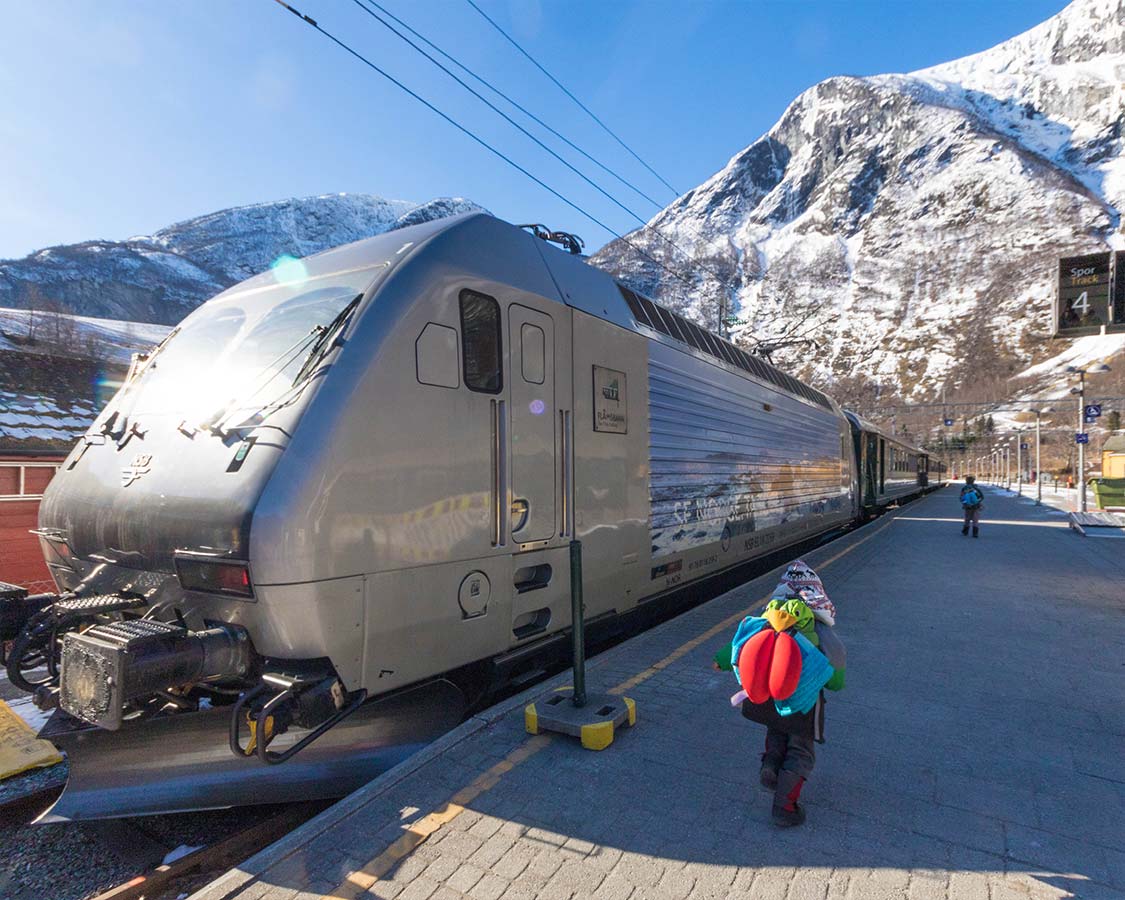
Norway’s rail network is excellent and a genuine pleasure to travel on. The Bergen Railway connecting with Oslo is one of the most scenic train journeys in the world, crossing the Hardangervidda plateau and reaching 4,265 feet (1,300 meters) above sea level.
The Flåmsbana, the branch line that descends from Myrdal to the village of Flåm at the head of the Aurlandsfjord, is one of the steepest railway lines in the world and a journey that will hold kids in awe. Book train tickets through Vy, the main Norwegian rail operator, well in advance for the most popular routes and seasons.
The Hurtigruten Coastal Cruise
The Hurtigruten cruise in Norway is not a cruise ship in the conventional sense. It is a working coastal ferry system that has been connecting Norwegian coastal communities since 1893, stopping at 34 ports between Bergen and Kirkenes. The route carries locals between towns, vehicles, and supplies alongside international travelers on the full Bergen to Kirkenes route, which takes up to eleven days northbound or twelve days southbound, depending on the route.
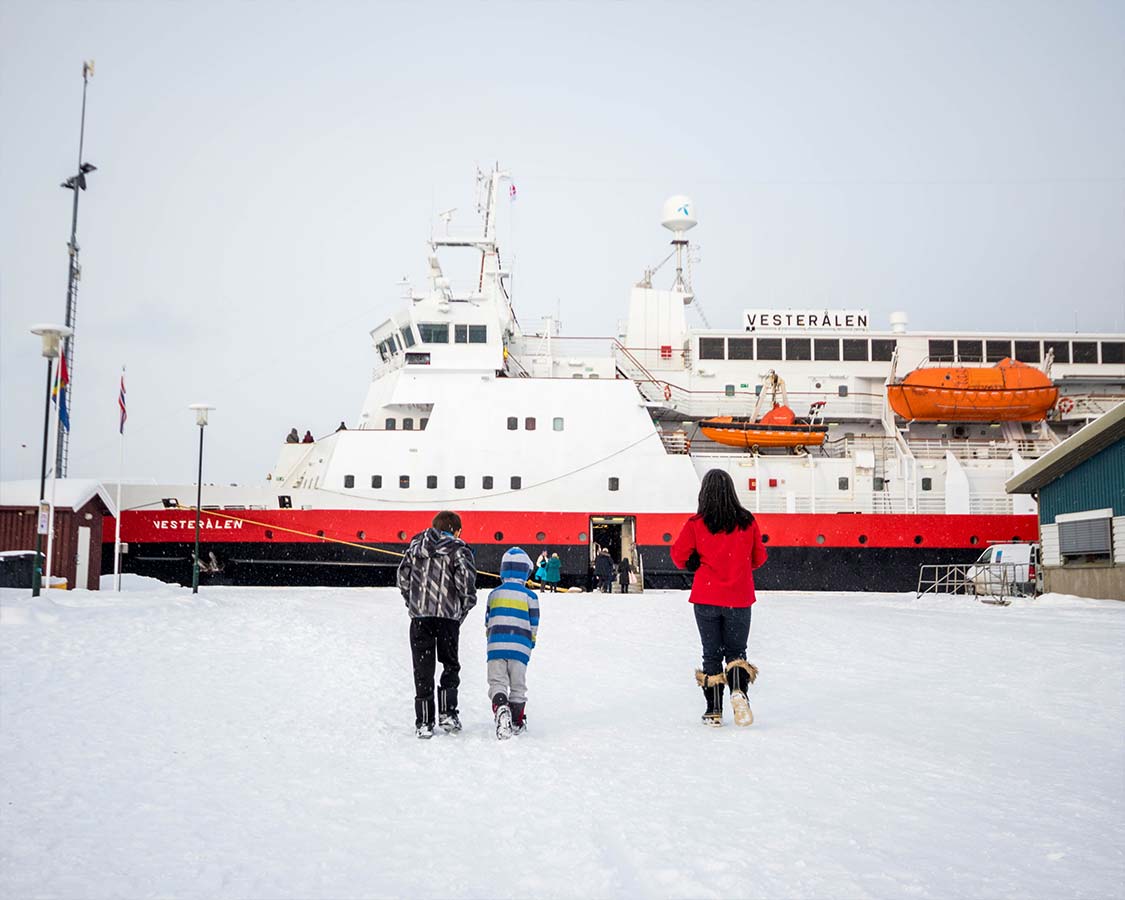
My family boarded the MS Vesteralen in Kirkenes and cruised south to Bergen over six days. We saw the Northern Lights four times. One display, south of Tromsø, was one of the most spectacular things I have ever seen with my own eyes. The ship announces Northern Lights sightings over the intercom, which can be piped into your cabin so you are woken when they appear.
Shore excursions at major ports can be rushed due to the ferry’s schedule, so plan excursions carefully in advance. You can read the full Hurtigruten Northern Lights guide and shore excursion guide here.
Norway in a Nutshell
The Norway in a Nutshell transit route is not a single transit system but a combination of public transport routes that together cover one of the most spectacular transit journeys in Europe. The standard route runs from Bergen by train to Voss, bus to Gudvangen, ferry through the Nærøyfjord and Aurlandsfjord, the Flåmsbana railway from Flåm up to Myrdal, and then the Bergen Railway on to Oslo.
It can also be done in reverse, from Oslo to Bergen. The fjord ferry section in particular, passing through the narrow walls of the Nærøyfjord, a UNESCO World Heritage Site, is among the most dramatic boat journeys available in Europe. My children were captivated by it. You can read the full Norway in a Nutshell guide here.
Ferries
Road ferries across fjords are a big part of driving in Norway. Many roads simply stop at one side of a fjord and resume on the other, with a short ferry crossing as the connection. These are not your typical tourist attractions; rather, they’re an integral part of Norwegian infrastructure, and they run frequently and efficiently.
Renting a Car
If you’re open to renting a car in Norway, self-driving is a genuinely rewarding way to explore the fjord regions, Lofoten, and the areas between cities that public transport rarely reaches. Roads in Norway are well-maintained and well-signposted. An International Driving Permit is recommended alongside your home license.
The key practical considerations: if you are driving in winter, snow tires are legally required on most Norwegian roads from November to April, and rental companies provide them as standard. Norway also has an extensive network of road tunnels, some of which are several kilometers long, and children find them either exciting or claustrophobic, depending on temperament. Toll roads and toll tunnels are common, and charges are linked to your rental car automatically.
Getting Around Cities in Norway
Oslo and Bergen both have excellent public transport networks. The Oslo Pass and Bergen Card, available as 24-hour, 48-hour, and 72-hour cards, cover unlimited travel on public transport plus free or discounted entry to most major museums and attractions in each city.
For a family spending two or more days in either city, the passes typically pay for themselves by midday on the first day. Buy them online or at the airport on arrival.
Staying Connected: Cellular and Data Service in Norway
Mobile coverage in Norway is excellent in cities, along the main road network, and in populated areas. It becomes patchy in remote fjord valleys, isolated mountain areas, and parts of the far north, particularly in winter. An eSIM purchased through a provider like Airalo and installed before departure gives solid coverage on Norwegian networks at a fraction of roaming costs. On the Hurtigruten coastal cruise, coverage varies by location along the route, but most boats have WiFi included.
Norway is among the most digitally connected countries in the world. Free Wi-Fi is available in most hotels, cafés, and public spaces. Cash is rarely needed anywhere, as Norway operates largely as a cashless society. Card payment is accepted at virtually every transaction point, including small shops, cafés, and ferry ticket machines.
Language in Norway
Norwegian is the official local language, but English proficiency in Norway is among the highest in the world. In practice, families will almost never encounter a situation in Norway where English is not spoken fluently. Hotel staff, restaurant workers, transport staff, and most members of the general public communicate easily in English. Norwegian is still worth a few words as an act of respect, and Norwegians receive the attempt warmly.
Phrase | Norwegian | Pronounciation |
|---|---|---|
Hello | Hei | HAY |
Thank you | Tusen takk | TOO-sen tahk |
Please | Vær så snill | vair soh snil |
Where is…? | Hvor er…? | voor air |
How much? | Hvor mye koster det? | voor MEE-eh KOS-ter deh |
My child is sick | Barnet mitt er sykt | BAR-neh mit air sewkt |
Help! | Hjelp! | yelp |
Bathroom | Toalettet | too-ah-LET-eh |
Yes | Ja | yah |
No | Nei | nay |
Power Adapters For Norway
Norway uses Type F sockets with two round pins, running at 230V. North Americans traveling from Canada or the US need both a plug adapter and a voltage converter for devices that are not rated for dual voltage. This is the one that I use and highly recommend.
Check the label on every charger before you travel. Most modern phones, laptops, and camera batteries handle 230V and need only the adapter. A multi-port USB charging hub with dual voltage covers the whole family from a single outlet and is worth the space in the bag.
Family Travel Safety in Norway
Norway is consistently ranked among the safest countries in the world. Violent crime is extremely rare. Petty theft in tourist areas exists, but at levels far below most European capitals. The primary safety consideration for families is outdoor and environmental rather than criminal.
Winter driving in Norway requires specific attention. Black ice, low visibility, and mountain road conditions demand winter tires and cautious driving. Check road conditions through the Statens vegvesen website or app before any road trip through the mountains or fjords during the winter.
In summer, some hiking routes, including Trolltunga and Preikestolen, have genuinely steep drops and difficult climbs. Some are not suitable for very young or inexperienced children without careful planning or a local guide. Check current trail conditions and weather before any mountain hike.
Cold weather is the other practical consideration for winter visitors. Norwegian winter is colder than many families from Canada and the USA expect, not because the temperatures are extreme by Arctic standards, but because the combination of cold, wind, and high humidity in the coastal regions is more penetrating than the dry Canadian cold.
Health and Vaccination Requirements for Family Travel in Norway
No vaccinations are required to enter Norway, and no specific vaccinations are recommended for routine tourist travel. Make sure the whole family is current on standard routine vaccinations, including MMR, DTaP, and polio, before any international travel.
Norway’s tap water is excellent and safe to drink throughout the country, from Oslo to Kirkenes. This is a quality-of-life convenience for families and means bottled water is never necessary.
Medical care in Norway is excellent by any global standard. Public hospitals are well-equipped and staffed. EU citizens are covered by the European Health Insurance Card. Non-EU visitors, including Canadians and Americans, should carry comprehensive travel insurance with medical coverage. Healthcare costs for uninsured visitors are substantial. I recommend either Safetywing or World Nomads for international family travel insurance.
For families visiting Norway in winter, one practical health note: polar night in the far north involves extended periods with little to no sunlight, which can affect mood and energy in adults and children alike. This is a real physiological response, not a travel inconvenience.
Build in more rest time to your Norway winter travel itinerary than you would on a summer trip, and do not over-schedule the dark days in the far north.
Regions of Norway: What Families Need to Know
Oslo
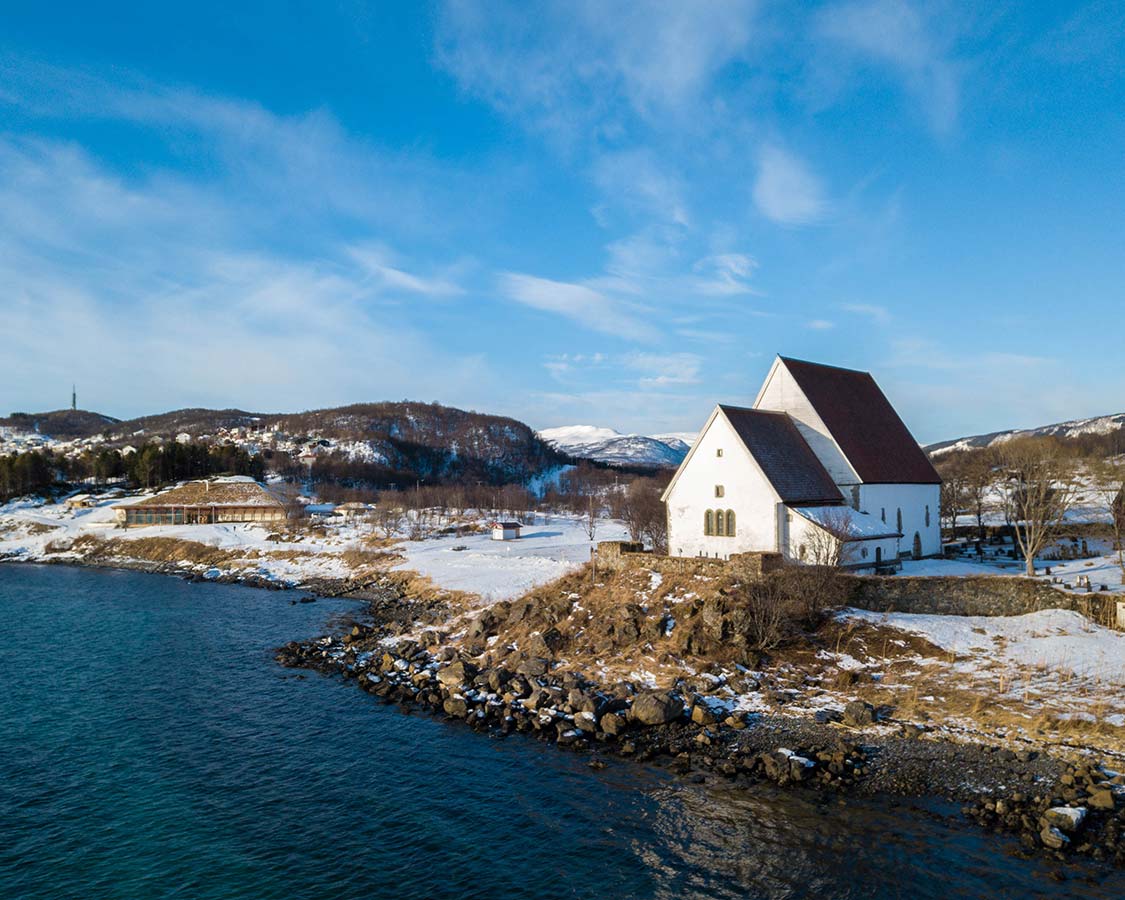
Oslo is where most international flights arrive and where most families typically begin or end their Norwegian travel itinerary. It is a compact, walkable, and genuinely excellent city for families to visit. If you’ve only got one day in Oslo, you’ll get a decent taste of the city, but I recommend putting aside at least two to three days to explore Oslo properly.
The Viking Ship Museum, at the time of our visit, one of the finest collections of intact Viking ships in the world, is the obvious first stop and delivers for children across a wide age range. The Vigeland Sculpture Park, an outdoor installation of 200 sculptures in bronze and granite by Gustav Vigeland, is free, enormous, and the kind of place where children can run freely while adults spend more time looking at the work than they expected.
The Oslo Pass makes the city significantly more manageable for families. It covers public transport, major museum entry, and discounts on a range of activities. For families spending two or more days in Oslo, it pays for itself quickly. You can read the full Oslo with kids guide here.
Bergen
Bergen is Norway’s second-largest city and the gateway to the Norwegian fjords. The city is beautiful, combining medieval wooden architecture at Bryggen wharf, the surrounding mountains on three sides, and a harbor that ties the dramatic experience together. It is also famously wet. Bergen receives more annual rainfall than almost any city in Europe, and packing accordingly is not optional.
The Fløibanen funicular from the city center to the top of Mount Fløyen runs every fifteen minutes and delivers a view across the city and harbor that justifies the trip completely. The fish market at the harbor is a great place for children to send their palate on a unique journey. The Bergenshus Fortress is free to walk through and has enough history to fill an afternoon.
Two days in Bergen is the minimum time to set aside to do the city justice. You can read the full Bergen guide here.
The Fjords: Flåm and the Nærøyfjord
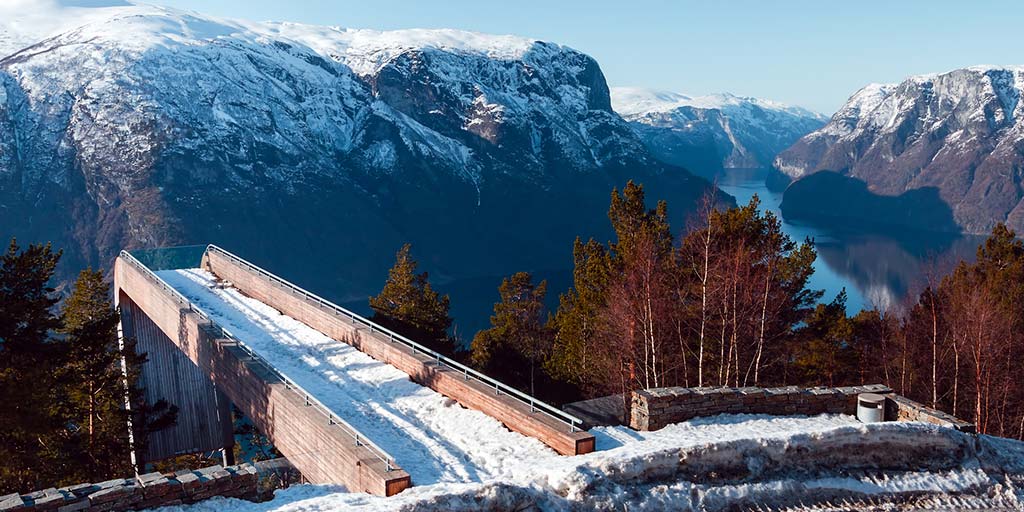
The Norwegian fjords are the reason most families travel to Norway, and the Flåm and Nærøyfjord area is among the most accessible and most jaw-dropping entry points into them. Flåm is a small village at the head of the Aurlandsfjord, surrounded by towering mountains, and it acts as the regional hub for several of the most famous fjord experiences in the country.
The Flåmsbana railway is one of the steepest standard-gauge railways in the world, descending 800 meters from Myrdal to Flåm through a mountain valley filled with waterfalls and sheer cliffs. The journey takes roughly an hour in each direction, and the engineering involved in building and maintaining it is remarkable enough to be interesting even to people who are not normally interested in trains. My kids were pressed against the windows the entire way down.
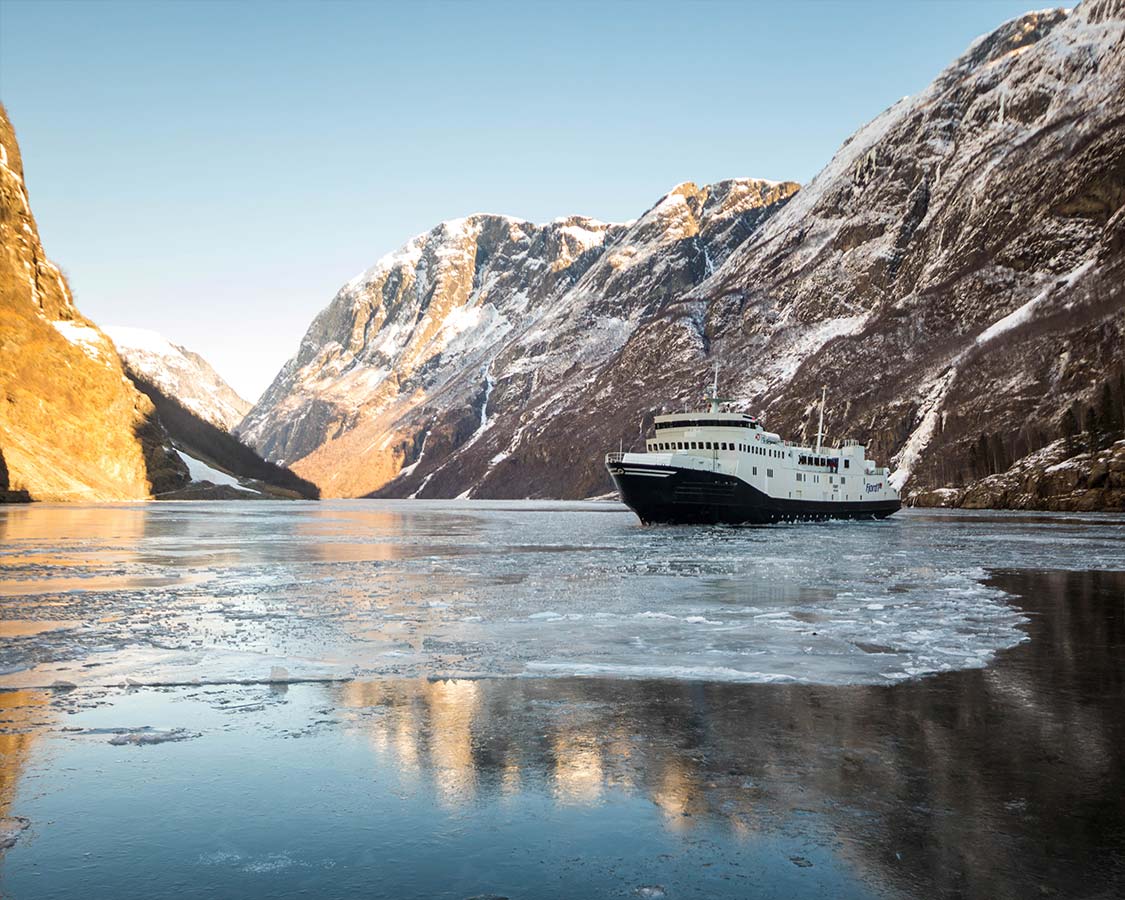
The fjord ferry through the Nærøyfjord, the narrowest fjord in Norway and a UNESCO World Heritage Site alongside the Geirangerfjord, is the other essential experience here. The walls of the fjord narrow to 250 meters at their closest points and rise hundreds of meters above the water on both sides. The scale is difficult to convey, and the ferry is, for most people who take it, the most dramatic boat journey of their lives. In winter, the waterfalls freeze into columns of ice on the cliff faces, and the light is something else entirely.
The best way to experience this is through the aptly named Norway in a Nutshell tour that combines trains, ferries, and buses connecting Bergen and Norway on one of the most dramatic public transit journeys on Earth.
The Far North: Kirkenes and Arctic Norway
The coastal town of Kirkenes sits nearly 250 miles (400 km) above the Arctic Circle, 9 miles (15 km) from the Russian border, and it is the kind of place that reframes what remote means. The town of 3,500 people is at the top of the Hurtigruten route and serves as the jumping-off point for Arctic Norway experiences that simply do not exist anywhere else in the country.
Snowmobiling across a frozen fjord is an experience that children do not have the vocabulary to fully describe afterward. They try, and what comes out is a series of superlatives and incomplete sentences, which is about right. Dog sledding, ice fishing, reindeer encounters at Sámi camps, and the King Crab safari in the Barents Sea, where you pull giant crabs from the water and cook them on the ice, are all available from Kirkenes in winter.
The polar night in Kirkenes in January means the sun does not rise above the horizon at all. This is not a drawback but a feature. The Northern Lights are best seen against a dark sky, and the far north provides more dark sky than anywhere else in Norway. Driving through the Arctic winter landscape in the dark with the lights overhead is the kind of experience that ends conversations.
Tromsø and the Lofoten Islands
I will be honest here: I saw Tromsø and the Lofoten Islands as day trips from the Hurtigruten cruise rather than exploring them on land in any depth, so I will flag that clearly rather than write about them as though I have explored them deeply.
Tromsø is the largest city north of the Arctic Circle in Norway and the primary urban base for Northern Lights tourism in the country. It has a university, a genuinely fun city feel, good restaurants, and a range of organized Northern Lights tours that operate throughout the winter season. Families who want a Northern Lights experience with more urban infrastructure and shorter travel distances from a major international airport than Kirkenes offers should consider Tromsø as their base.
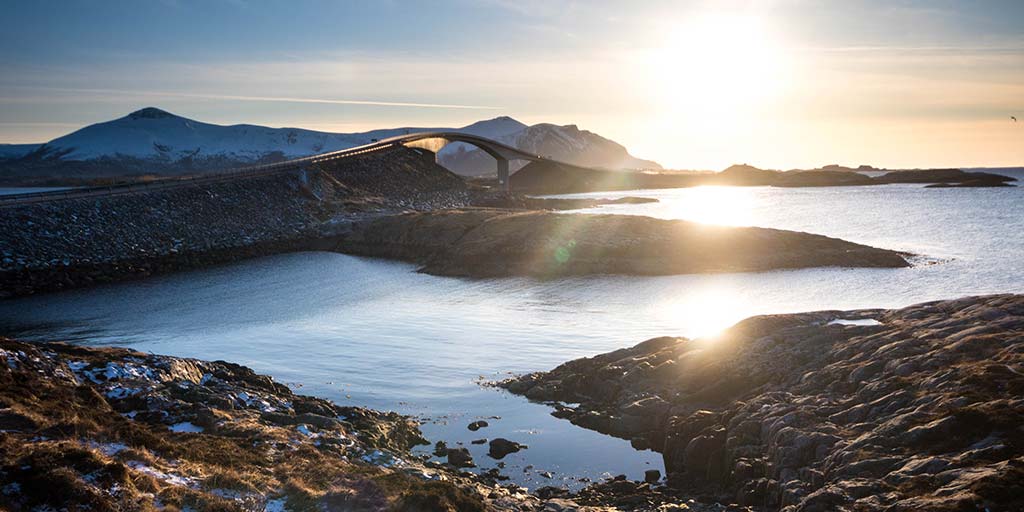
The Lofoten Islands, which I watched from the ship deck as we passed by them in the early morning, are a series of dramatic peaks rising directly from the sea that have become one of the most photographed landscapes in Norway. From what I could see from the water, the photography does not overstate the case. Families who drive or fly to Lofoten for a dedicated stay consistently describe it as among the finest outdoor destinations in Europe. It is on my family’s list of places to visit in Norway when we return.
Money and Budgeting for Travel in Norway
Norway is one of the most expensive countries in the world for travelers. This is not a rumor or an exaggeration, and there is no meaningful trick to avoid it. A simple lunch for a family of four at a casual restaurant in Oslo or Bergen will cost what a mid-range dinner costs in North America. A coffee is expensive. A hotel room at a three-star property in a tourist area is expensive. Petrol is expensive. Norway charges what Norway charges, and the quality is generally commensurate with the cost, but the budget impact is real, and families should plan for it honestly.
A few things that help families to afford travel in Norway. The Oslo Pass and Bergen Pass cover most major attractions and all public transport in their respective cities and typically save families money from the first day. Norway’s excellent tap water means you never need to buy bottled water or pack filtered water bottles.
Grocery shopping for picnics, snacks, and simple meals from a supermarket like Rema 1000 or Kiwi cuts costs substantially on a multi-day itinerary. Booking accommodation and popular transport well in advance locks in better prices. And the Hurtigruten, which is genuinely excellent value for what it delivers as a six or twelve-day itinerary, should not be dismissed as expensive without looking at what is included.
Norway is basically cashless in practice. Credit cards are accepted everywhere, including small cafés, ferry crossings, and market stalls. There is no practical need to carry cash. Inform your bank before travel to prevent transactions from being flagged.
What to Pack for Family Travel in Norway
What to pack depends almost entirely on when you are going, and the gap between summer and winter packing is wider in Norway than in almost any other destination in this series.
When packing for winter travel in Norway, the key principle is layers, and the layering system needs to be more serious than Canadian or American families typically assume. Norwegian coastal winter involves cold, high humidity, and wind, and that combination penetrates clothing in a way that dry continental cold does not. You can read the full Norway winter packing guide here, which covers the system in detail. The short version:
- Thermal base layers in moisture-wicking fabric for every member of the family.
- Mid-layer insulation, such as a down or synthetic puffer jacket, is worn under the outer shell.
- Waterproof and windproof outer shell that covers the full body. The coast is wet regardless of the temperature.
- Insulated waterproof boots rated to at least -20C for any far north or outdoor winter activity.
- Balaclava, neck gaiter, and liner gloves under waterproof mittens. Face and hands are the first things that suffer.
For summer travel, the layering principle still applies in a lighter form. Norwegian mountain weather can vary significantly, and afternoon temperature drops are common even in July. The additions for summer:
- Sturdy waterproof hiking boots. The major hiking routes involve wet, rocky, uneven terrain.
- Rain jacket for every family member. Bergen in particular will test this.
- Sunscreen. Midnight sun in the far north means extended UV exposure at hours when most families are not accustomed to applying sunscreen.
Year-round practical items:
- Power adapter (Type F, 230V, North Americans need an adapter and a voltage converter for non-dual-voltage devices).
- eSIM, installed before departure. Airalo provides reliable coverage on Norwegian networks.
- Oslo Pass or Bergen Pass. Purchase at the airport on arrival. Do not wait until you are in the city center.
- Family medical kit. Children’s pain relief, antihistamines, motion sickness medication for fjord ferry crossings and mountain roads, and any prescription medications in generous supply.
What Travel in Norway Will Teach Your Family
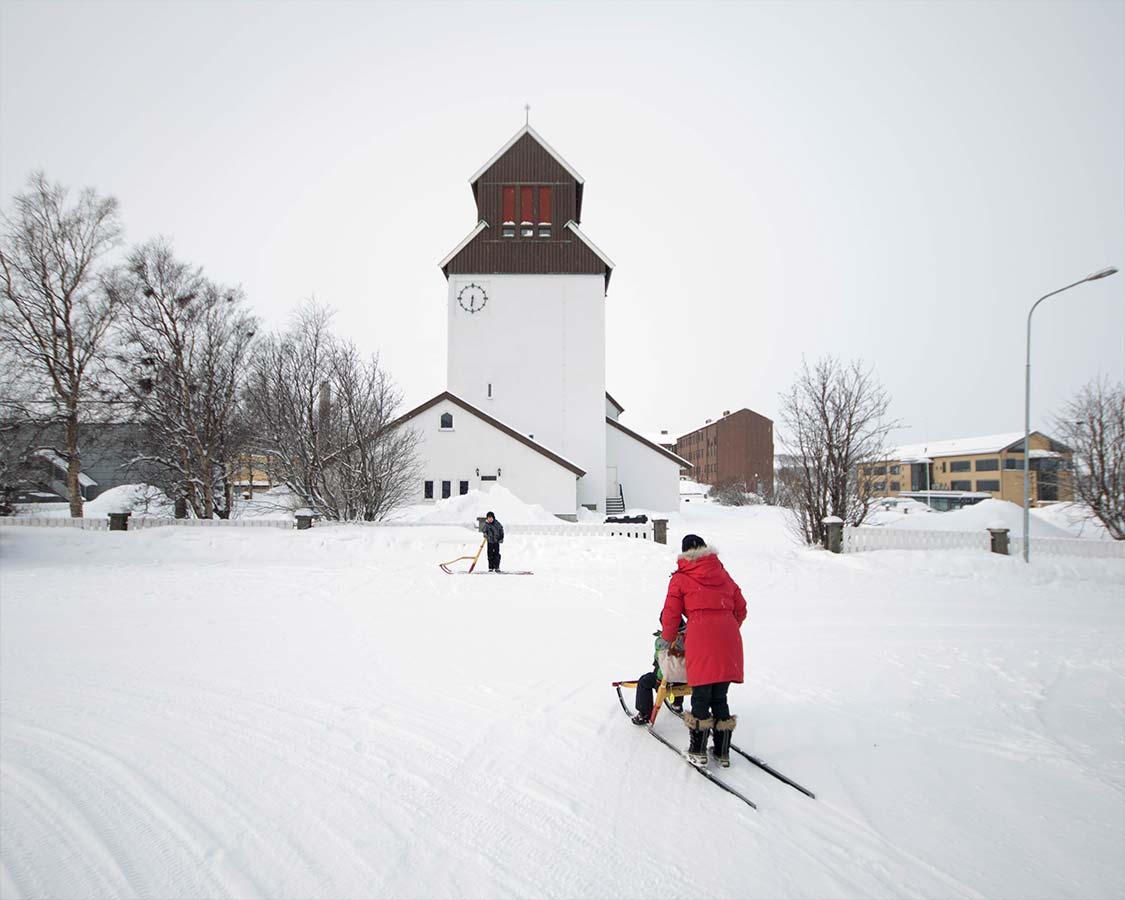
Norway will redefine what darkness and light mean for your children. The polar night in Kirkenes in January is real and total, and children respond to it differently from adults. Some find it disorienting. Some find it exciting. Most find it the right backdrop for the Northern Lights, which are best appreciated when there is absolutely nothing competing with them in the sky. And the summer midnight sun is the other side of the same coin: my kids at home have a bedtime.
In Norway, in July, they were arguing at eleven o’clock at night that it was clearly still afternoon. They were not wrong.
The Flåmsbana will cause a specific problem that I want to warn you about. The problem is that it sets a standard for scenic train journeys that almost nothing else can meet. We have been on trains in Switzerland, Canada, Peru, and Japan since then. My kids compare everything to the Flåmsbana. This is Norway’s fault entirely.
Norwegians have a relationship with outdoor life called friluftsliv that has no direct English equivalent. It translates roughly as open-air living, but it is less a hobby and more a philosophy. Norwegians go outside regardless of the weather, and they regard the outdoors as a normal and essential part of daily life rather than a special occasion. Children who spend time in Norway absorb some of this, and it is one of the better things a travel experience can leave behind. My kids came home more willing to go outside in the cold than they had been before.
Norway is expensive, and that is the wrong way to frame it. The correct framing is that Norway costs what Norway costs, and the quality is there. The Hurtigruten is not cheap, but what it delivers over six days of coastal Norway is worth more than the fare. Kirkenes in winter is not convenient or inexpensive to reach, but snowmobiling on a frozen fjord in the dark with the Northern Lights above you is not an experience that has a reasonable substitute. Budget honestly and then go.
Travel Resources For Families Visiting Norway
For practical planning, safety considerations, and logistics, these dedicated guides provide all of the resources you need for family travel in Norway.
Final Thoughts
Norway family travel rewards preparation, a realistic budget, and a willingness to choose the season that fits your family’s interests and then commit to it fully. The destination guides on this site cover the details for each region, while the practical information above is designed to help your family move through the country with confidence.
You will come home with the photographs. The fjord from the ferry with the walls above you. The Northern Lights from the deck of the Hurtigruten at two in the morning. Your child is on a snowmobile on a frozen fjord with an expression that is half concentration and half disbelief. But the thing that stays, the thing that is harder to photograph, is the scale. Norway operates at a scale that recalibrates children’s understanding of what the natural world is capable of. The fjords are deeper than the mountains above them are tall. The Northern Lights fill the entire sky. The train descends a mountain that is mostly inside the mountain. Norway does not do ordinary. It does not know how.
This page is updated as new regional guides and planning resources are published. Looking beyond Norway? Explore my International Family Travel Guide.