A complete three-day Banff itinerary for families: what to do each day, how to reach Lake Louise and Moraine Lake now that the roads are restricted, where to stay, where to eat, and what you need to book before you fly. Based on a summer visit with two teenagers and two grandparents, and half a dozen trips before that.
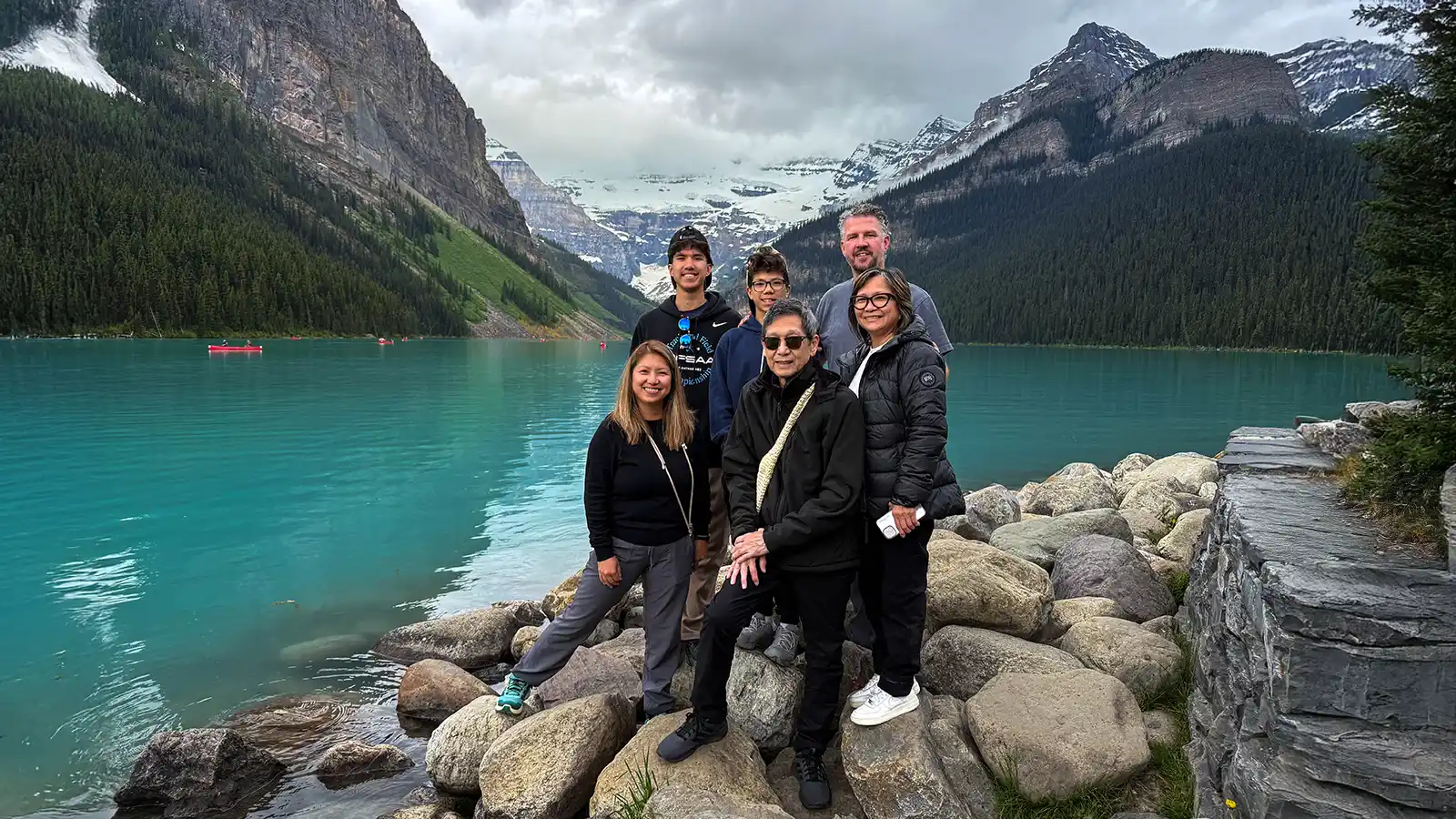
My in-laws moved to Canada thirty-five years ago from the Philippines. They were drawn to my home country by its reputation for world-class healthcare, education, and strong job opportunities. But beyond the lifestyle, there was a vision of Canada that they had in their minds. A town in the Canadian Rockies surrounded by mountains reflected in glassy lakes filled with impossibly milky blue water.
Maria and Felix settled in my birthplace, Peterborough, Ontario, which is a lovely mid-sized city in its own drumlin-and-lake sort of way. But it’s about as far from an alpine summit as you can get without leaving the country. For three and a half decades, the Rocky Mountains were something they saw on a twenty-dollar bill. This summer, Christina and I gathered up the boys, and we finally took them to the part of Canada they had always dreamed of.
When most people from outside of Canada picture the country, Banff is what they imagine. A postcard-perfect town where elk wander the streets, mixing with crowds of young hikers and snowboarders. And Banff is exactly that.
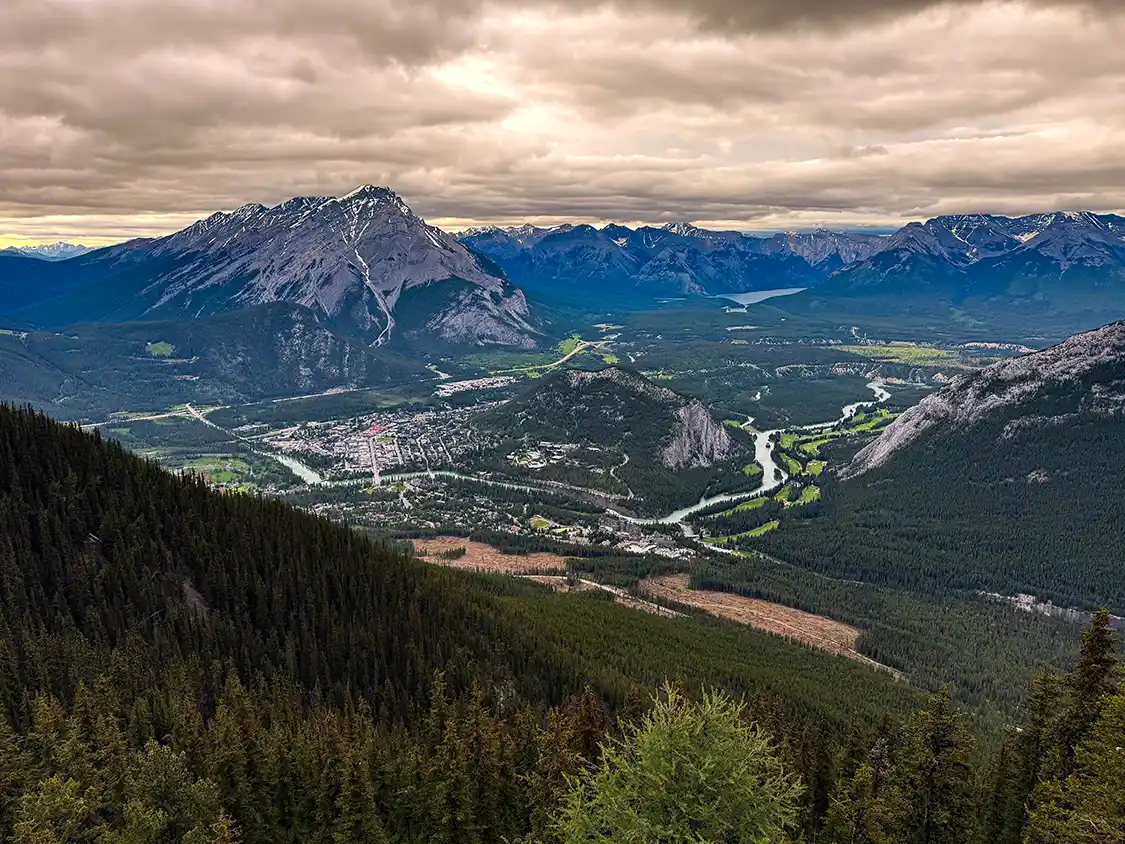
Banff is a town of around 8,000 people sitting inside Banff National Park, roughly 130 km (81 miles) west of Calgary along the Trans-Canada Highway. That is about a 90-minute drive from the Calgary airport. The town is small enough to walk end to end in about twenty minutes; it has a bus system that reaches most of what you want to see, and it sits within easy reach of some of the most iconic locations in the Canadian Rockies, such as Lake Louise and Moraine Lake.
A town sitting within a Canadian National Park is unique. To visit Banff, you need to have a valid Parks Canada Pass. And there are a lot of rules for those visiting. So I wrote this to give you a complete three-day family itinerary for Banff that includes every worthwhile thing to do, where to stay, where to eat, and the logistics that you’ll need to know to avoid ruining your day.
Quick Planner: Banff, Alberta
Where: Banff, Alberta, inside Banff National Park in the Canadian Rockies.
Getting there: Fly into Calgary (YYC), rent a car, drive 130 km (81 miles) west. About 90 minutes.
How long: Three days minimum for the town and the big lakes. Five if you want to breathe.
Best time: Late June through September for everything open. September for the same views with fewer people.
Top picks: Banff Gondola, Lake Louise, Moraine Lake, Cave and Basin, and a sunrise drive along Vermilion Lakes.
Plan ahead: Moraine Lake has been closed to personal vehicles since 2023. You must book a shuttle. Lake Louise parking fills before dawn.
Don’t miss: Vermilion Lakes at sunrise, when the water goes glassy and almost nobody is awake.
My Family’s Visit To Banff: Three Days With Two Teenagers and Two Grandparents
Table of Contents
Before you dig into my three-day Banff guide, here is how my family trip to Banff rolled out. Here’s what we saw on this trip, and why Christina and I planned everything the way that we did. My father-in-law is not in great health and cannot walk far. That’s something that many people undertaking multi-generational family travel can probably relate to.
On a lot of our travels, we’re a “go big or go home” kind of family. This time, we kept things a little more tame. There were no summit scrambles and no twenty-kilometer days. We treated this trip to Banff as a sightseeing excursion rather than an all-out adventure. I came away having seen more of the place than on trips where I covered three times the ground.
Day One: A Waterfall, a Vintage Coach, and the Duck Wings
We landed in Calgary, collected a rental car, and drove west without stopping. That drive from Calgary to Banff is an appetizer that I never get tired of, no matter how many times I drive it. We crossed an hour of prairie flatness, and then the Rockies simply spring up out of the ground like giant teeth gnawing at the sky. Maria and Felix and the boys had those looks that every first-timer does when they first see the Rockies. It was awesome to see.
Bow Falls
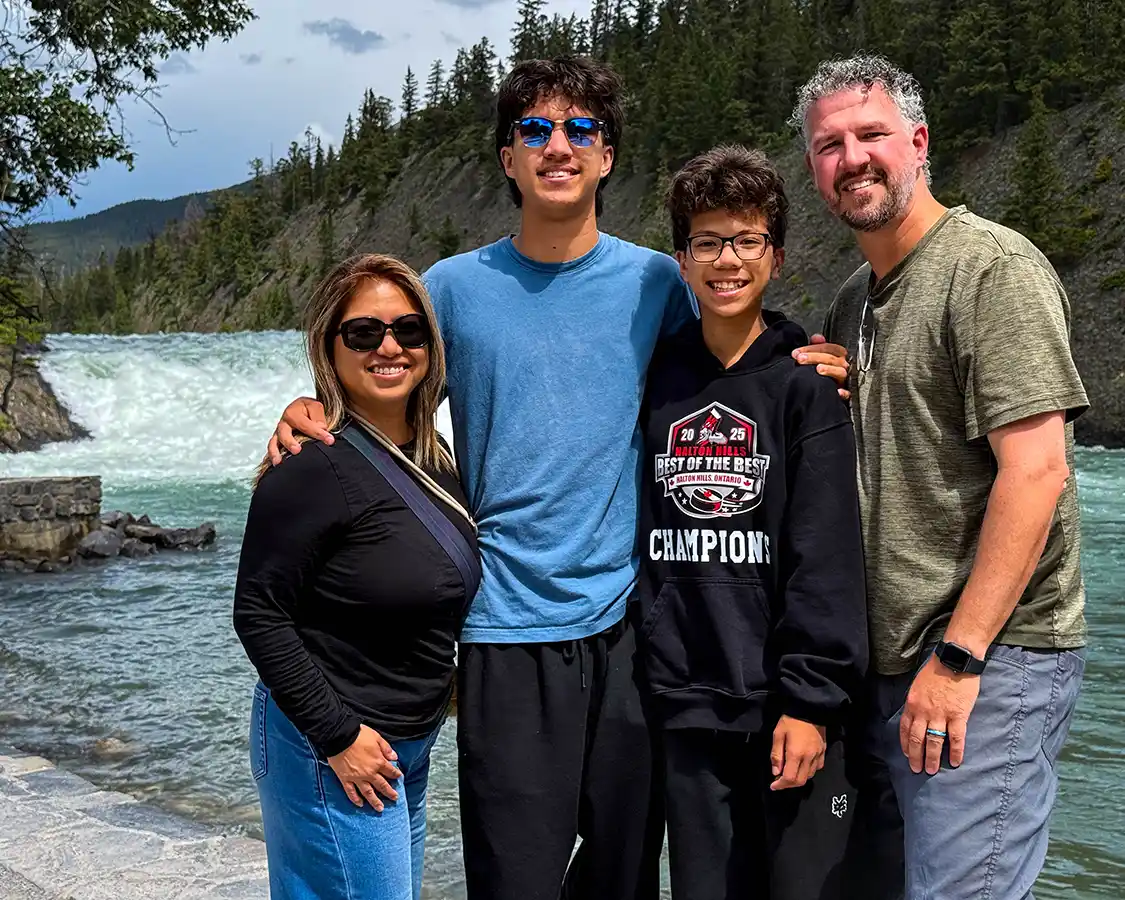
We went to Bow Falls first, which works well as an introduction to the Banff experience. We all got out, stretched, and were immediately greeted by a wide waterfall backed by mountain views. This spot is Banff in miniature. We all drank in the views, took a photo by the waterfall, and welcomed ourselves to the Rocky Mountains.
Surprise Corner
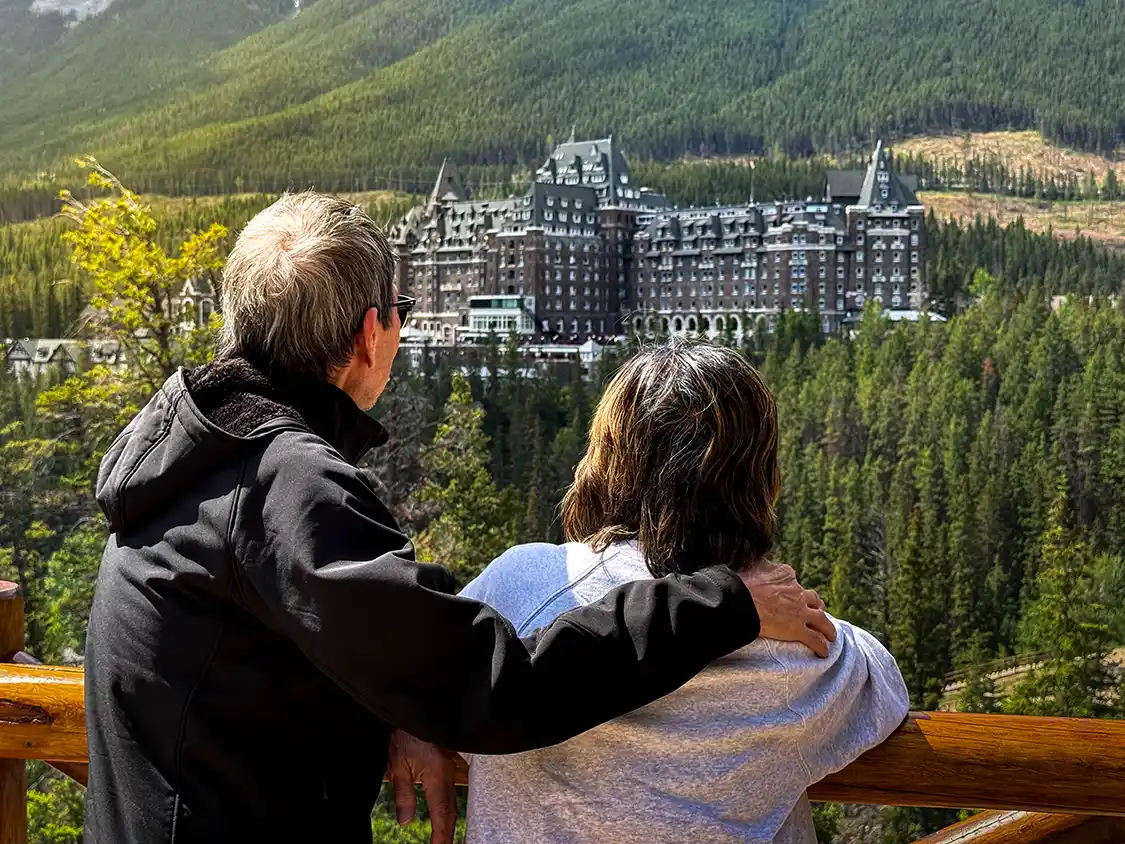
From there, we drove up Buffalo Street to the aptly named Surprise Corner. Now, Surprise Corner is a very Banff name. This town names a lot of its streets and viewpoints in what I like to call “non-ironic humor.” Surprise Corner was given its name because, SURPRISE!, there’s a beautiful lookout overlooking the famous and dramatically perched Fairmont Banff Springs Hotel. This was the first viewpoint that really nailed that we had arrived in Banff. And we took a few minutes to absorb it all together. Watching Felix and Maria huddle up together with that mountain view in the background was a special one for Christina, me, and the kids.
Open Top Touring
After checking into our Banff hotel, the comfortable and family-friendly Tunnel Mountain Resort, we took the Banff bus system into downtown. The bus system in Banff is excellent and is often complimentary for those staying in a local hotel. It’s really useful as well, because Banff gets incredibly busy. If you visit on a weekend in the summer, there’s a good chance you could spend as much time looking for parking as you do exploring the town itself.
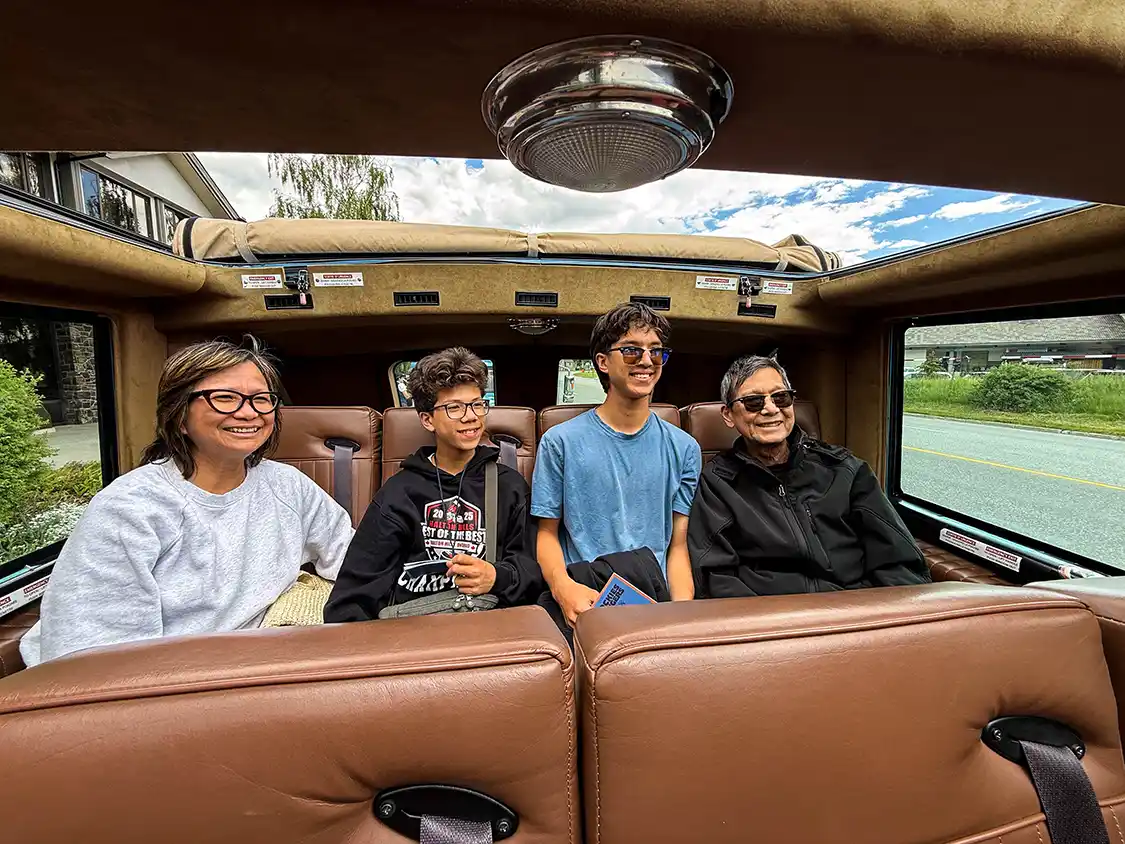
Then we did Pursuit’s Open Top Touring, ninety minutes around the townsite viewpoints in a vintage-styled open-roof coach with a guide in period costume. This isn’t the kind of tour we would normally do, but with Christina’s parents along, it was a great choice for a multi-generational Banff trip. It gave all of us a high-level view of the town, including the history and the character. We hit four or five scenic viewpoints. And we did it all from the comfortable seats of a cool stretcgh convertible modeled after the original tour vehicles that served the Banff region 100 years ago.
For younger kids, it’s also a great way to get engaged. Pursuit, the company that runs the Open Top Tour, has a Rockies Rangers program similar to the US National Park system’s Junior Ranger program. It’s like a scavenger hunt and questionnaire. Do your part, and you get a cool badge at the end. I’ll be honest, at 15 and 12, I thought my kids were too old for this. But they jumped into the fun too and had a blast doing it.
Banff Town and Duck Wings for Dinner
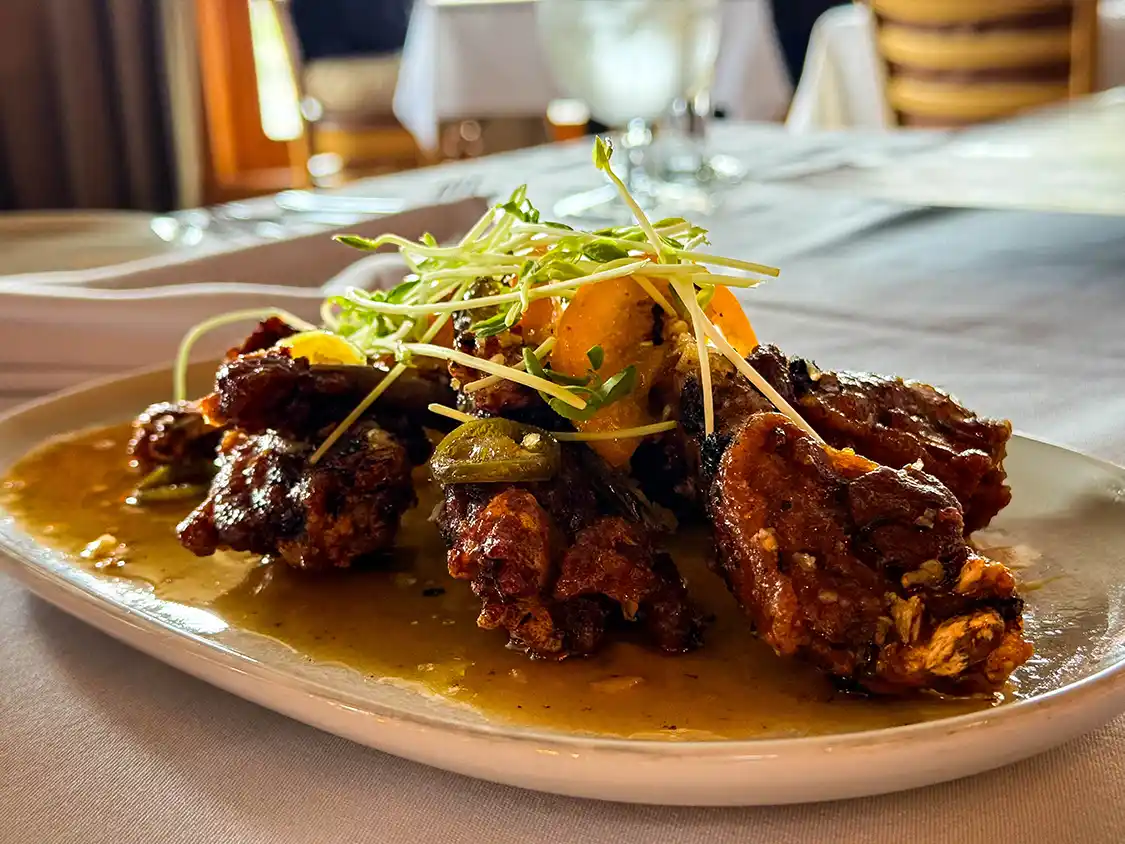
We wandered the town for the rest of the afternoon, checking out the views of one of Canada’s most beautiful small towns. When the hunger hit, we had dinner at Maple Leaf Steakhouse and Seafood on Banff Avenue. We ordered in my favorite way, with many dishes eaten family-style. Everything was a hit, but one dish stood out. The duck wings. Cohen and Dylan demolished the first order and immediately negotiated for a second, and we ended up ordering enough that there were leftovers. The food was fantastic, the service was great, and the restaurant was not busy.
Day Two: The Iconic Lakes and Dinner With a View
We started the morning at Whitebark Cafe on Banff Avenue for coffee and breakfast sandwiches. It’s a busy joint with locals as well as visitors going in and out of the front door like a turnstile, which in a resort town is the signal you want. This is a take-out joint at the base of the Banff Aspen Lodge hotel, but there are some propane firepits and tables outside that make for a pretty nice place to enjoy a morning coffee.
Lake Louise
Then we joined a tour, because Banff is so busy now that it’s next to impossible to drive to some of its most iconic locations like Lake Louise and Moraine Lake. Parks Canada runs a shuttle service to both lakes from a free Park and Ride at the Lake Louise Ski Resort, and one booking covers the Lake Connector between them. It is not free, and more importantly, it books up incredibly fast. If you don’t get lucky and reserve the Lake Louise Shuttle at just the right time, you’ll likely be in the same situation as us, booking a tour bus to take you to the most famous sites in Banff.
This tour takes off from Calgary, Canmore, and Banff and visits Lake Louise, Moraine Lake, as well as Yoho National Park. The one we did just did the lakes. We’re saving Yoho for another day.
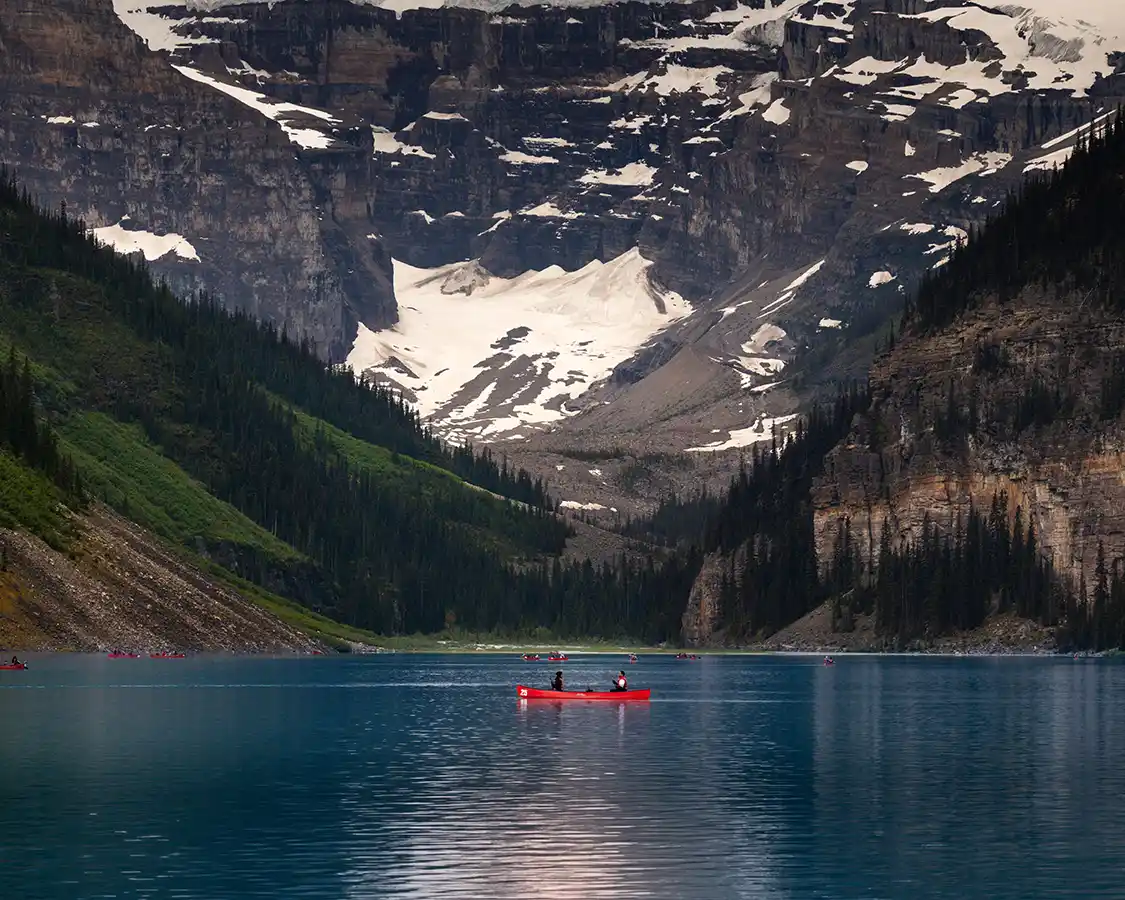
Lake Louise was our first stop. This is probably the most photographed lake in Canada, and one of the most beautiful lakes in the world. This is one of the best places to get a grasp of that “impossible blue” that everyone talks about when they speak about the lakes of the Canadian Rockies. Christina and I, who had been here before, had the chance to sit back and see the scale of the scenery reflected in the eyes of our boys and Christina’s parents, who were all seeing this view for the first time. I’m honestly not sure which moment I preferred. My first view of Lake Louise, or watching them take it all in for the first time.
We walked the lakeshore trail as a group at grandparent pace. There’s a paved path that reaches about 2 km (1.2 miles) out and back. Halfway across the little bridge near the boathouse, a marten, which is a small ferret-like animal native to the Rockies, came barreling out of the rocks and ran directly between my legs.
Moraine Lake
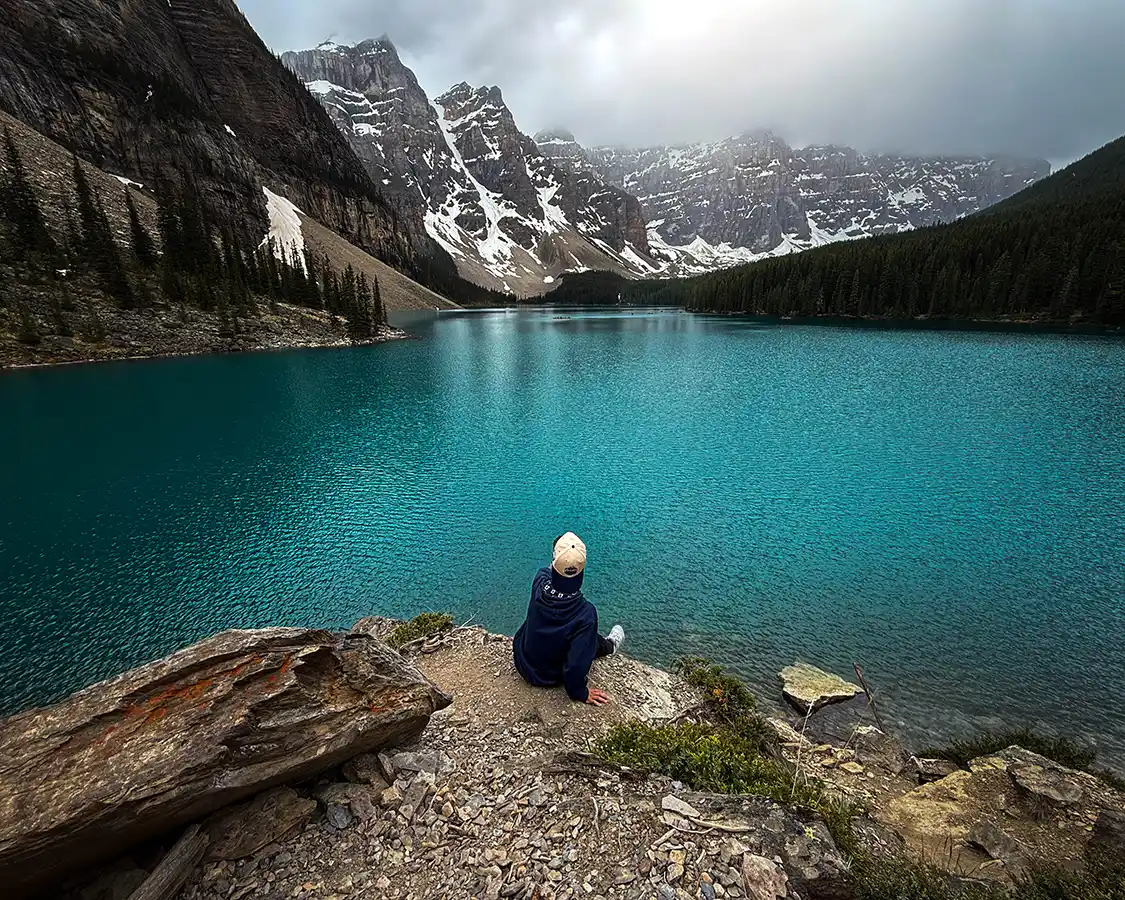
We loaded back into the tour bus and made our way to Moraine Lake. I’ll be honest, Lake Louise is, in my opinion, the third-best lake in the Canadian Rockies. Moraine Lake is my second. The backdrop is just jaw-dropping. Moraine Lake sits in the Valley of the Ten Peaks, a horseshoe of mountains standing over that silty blue water. My favorite, well, you’ll need to read my upcoming guide to the Icefields Parkway to learn that one. But if you have a guess, drop it in the comments.
Christina and her parents took a walk around the lakeshore. The boys and I burned off some energy on a climb up the lake’s famous Rock Pile that offers the best views over Moraine Lake. Let’s face it, we’re all still the kind of guys that see a pile of rocks and want to see how quickly we can get to the top. Pushing 50, I’m still a kid at heart.
Remember Surprise Corner from earlier? Well, the Rock Pile was named in the same non-ironic Banff style. It’s a giant pile of rocks that have tumbled from the surrounding mountains and collected on the edge of the lake. Getting up means climbing an uneven stairwell to the main viewing level and scrambling up further if you want a view that’s not surrounded by crowds. Dylan, who is normally a bit of a tornado in a bottle when he’s outdoors, had eyes the size of pie plates when he took in the first view. He was so blown away at the beauty of the lake that he actually climbed down to the water’s edge just to sit by himself and absorb the scenery for a while. It was a beautiful thing.
After about an hour and a half at Moraine Lake, we boarded the shuttle and made the hour-long drive back to downtown Banff.
Banff Gondola and Sulphur Mountain
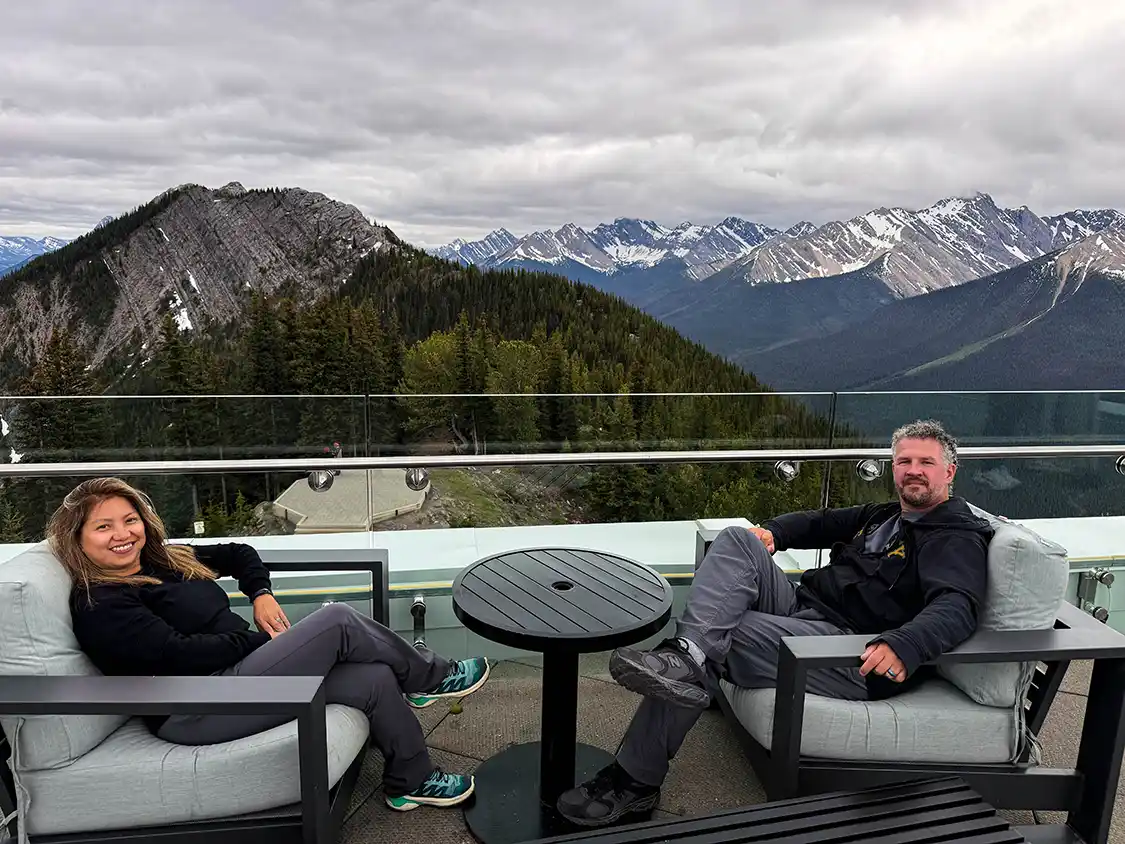
We stopped to rest for a bit at our Tunnel Mountain Resort accommodations before hopping back on the local Banff transit out to Sulphur Mountain. Our evening plans were set a while back. Take the Banff Gondola up to the top of the mountain, hike to the summit, and then enjoy dinner at Northern Lights Alpine Kitchen overlooking the town of Banff.
The gondola ride up was gorgeous. There’s something about riding a gondola that I love. A few weeks ago I’d ridden the gondola up Whistler Mountain in British Columbia for the first time; I’ve taken gondolas in Turkey, Kazakhstan, and many other places, and I’ve always loved them. I think it’s that a gondola forces you to slow down and appreciate the scenery that’s unfolding below. You have nothing to do except breathe in fresh mountain air and enjoy the view. Felix, well, he loved it so much that he still says that scenic ride up was his favorite part of our entire three-day Banff itinerary.
The hike to the summit of Sulphur Mountain was a bit much for Christina’s father, so he relaxed in the Banff Gondola summit complex, which has an interpretive center, a multi-sensory theater, and interactive ecological exhibits. The rest of us strapped up our laces and began the walk up the well-maintained stair system to the top, stopping to check out the incredible views over the valley and mountains along the way. At the very top of the mountain, we found the historic stone meteorological observatory built in 1903. To think something has withstood more than 120 winters up here was pretty incredible.
We met back up with Felix at the interpretation center and walked to the Northern Lights Alpine Kitchen. I’ll be honest, I went in with low expectations. Mountaintop buffets are usually low-quality, high-cost. This one was actually pretty good, and very reasonably priced for the quality of food that we got. The best part was the views looking out over the town of Banff from above as the sun began to set over the town.
Several of the things we did in Banff and Jasper were covered by the Pursuit Pass, a bundled ticket that covers the Banff Gondola, Open Top Touring, the Lake Minnewanka Cruise, the Columbia Icefield Adventure, and a set of other Jasper and Golden attractions including the Maligne Lake Cruise out to Spirit Island. If you are doing more than two of them, it pays for itself very quickly.
Day Three: Lakeside Sunrise, the Birthplace of Canada’s Parks, and a Wildlife Drive
We ate reheated duck wings for breakfast in the kitchen of our suite at Tunnel Mountain Resort. Time was of the essence that day because we were heading out from Banff and beginning the two-day drive up to Jasper. Why two days? It’s only 288 km. Well, here’s an expert tip for you. The drive from Banff to Jasper is one of the most scenic road trips on the planet. Rushing is a mistake. I’ll talk about that road trip in my Banff to Jasper article that’s well worth the read if you’re planning on driving it.
Vermilion Lakes
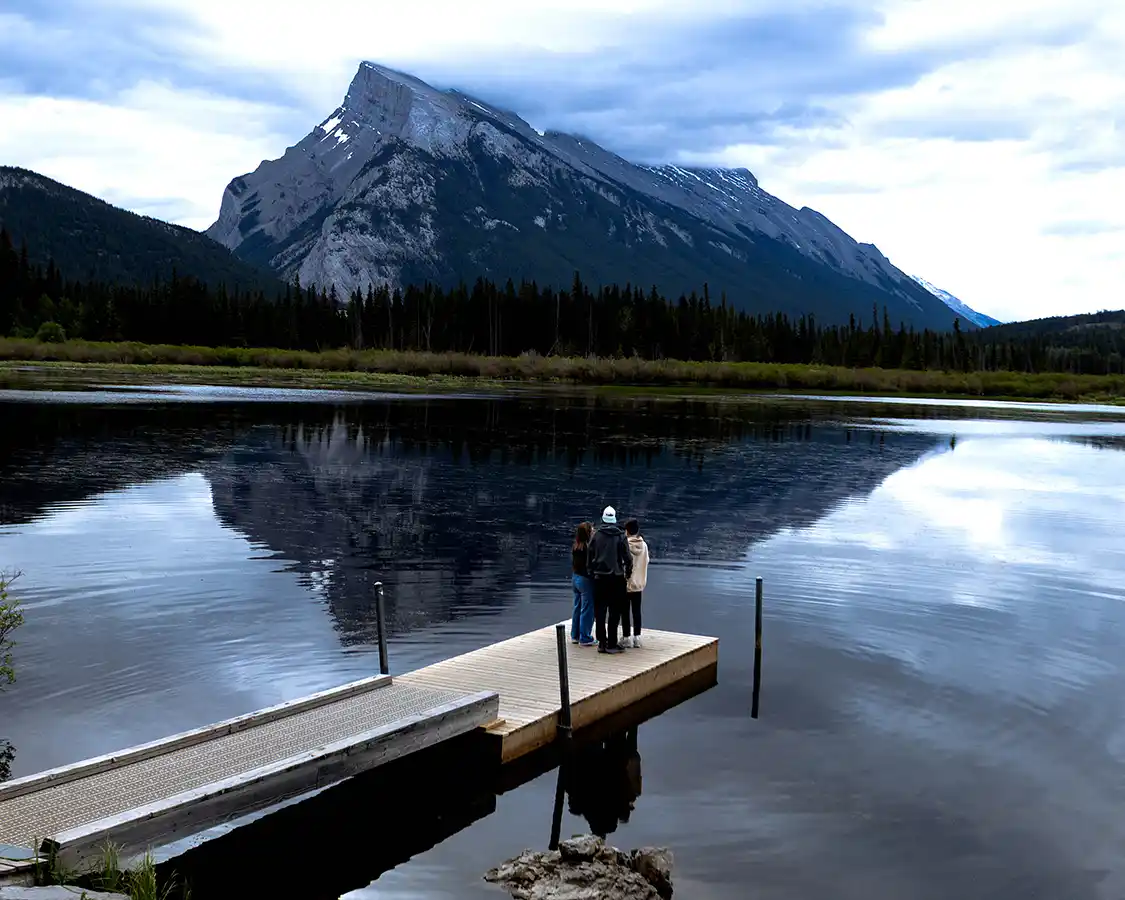
We had one last big stop to make before we left Banff for Jasper, but a lack of planning on my part meant that I misjudged what time Cave and Basin National Historic Site opened. To fill the time, we all piled into our rental car and made the drive to the Vermilion Lakes. It was just after sunrise, so these three lakes were glassy smooth, reflecting the surrounding mountains like mirrors. Ospreys, Canada jays, and geese occasionally broke the illusion as they’d launch themselves into the sky.
Vermilion Lakes Drive is a paved 4.3 km (2.7 miles) road with pullouts the whole way, which makes it one of the few world-class viewpoints in Banff you can enjoy entirely from a car seat. It is also the most reliable wildlife spot within minutes of town. I’ve written a full guide to spotting wildlife in the Canadian Rockies if you want to know where and when to look for each species.
One of the most unique stops along the drive, which runs parallel to the Trans-Canada Highway, is near the very end. Drive down Vermilion Lakes Road to the third lake, and the unmistakable smell of sulfur will hit your nose. This is one of the lowest points of the Banff Hot Springs, where they drain out into the Vermilion Lakes. It’s easy to miss, as it’s on the opposite side of the road from the lake, but follow your nose, and you’ll see the water bubbling up from the ground, the rocks, and even through the road before pouring over a small waterfall into the lake.
Cave and Basin National Historic Site
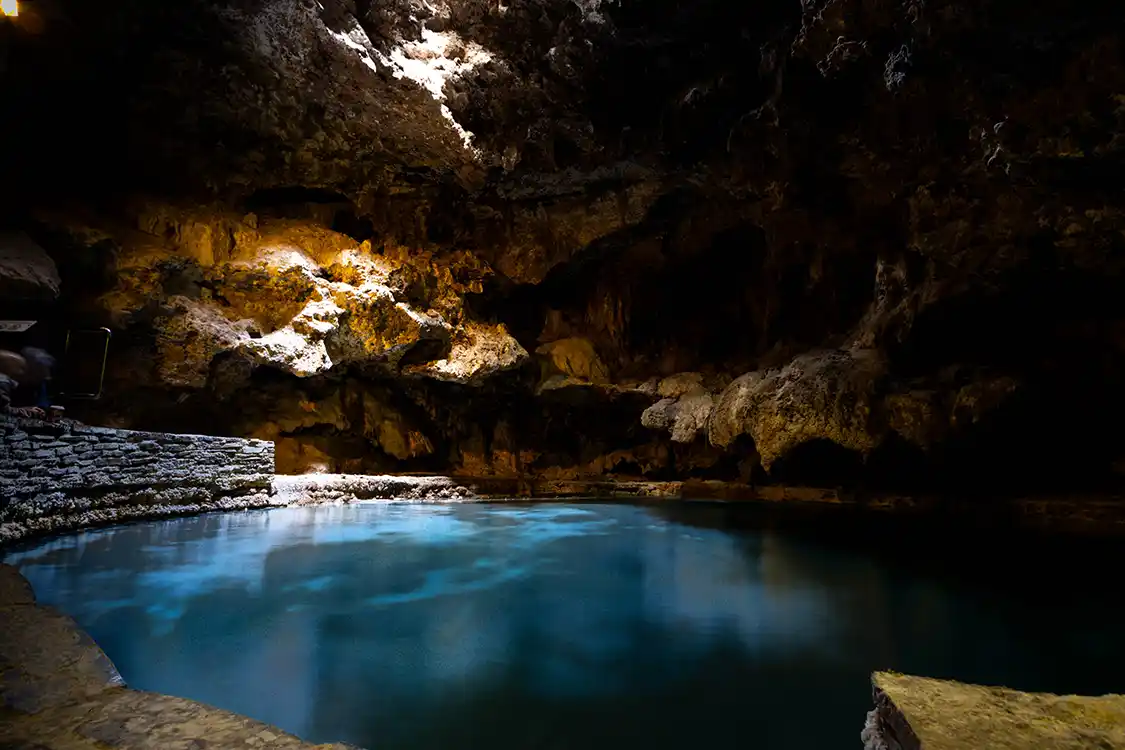
Our last stop was one that was very special for me. Canada’s National Park system has given me a lot over the years. These parks preserve some of the most beautiful natural landscapes in all of Canada, and I’ve made it a goal to explore as many of them as I possibly can from coast to coast to coast.
Cave and Basin National Historic Site is where that entire park system began. It was the birthplace of Canada’s first national park, and only the fourth national park on Earth, after Mongolia’s Bogd Khan Uul, protected by imperial decree in the 1700s, Yellowstone National Park in the United States (1872), and Australia’s Royal National Park (1879).
The Cave and Basin hot springs were not discovered in 1883. But they were stumbled upon that year by three Canadian Pacific Railway workers. The Stoney Nakoda and generations of Indigenous peoples had used these waters for warmth and healing for roughly ten thousand years. What the railway men found was a business opportunity. They built a fence and charged admission.
The government watched as speculators seized a prized public asset and decided it wanted that revenue for itself, in the form of a hot spring, hotel, and resort. Yep, greed and capitalism. Profiteering launched the reserve that was declared in 1885, and the Rocky Mountains Park Act that followed in 1887; Today, Parks Canada protects more than 450,000 square kilometers (170,000 square miles) across 37 national parks, roughly 1,000 designated national historic sites, and a growing network of marine conservation areas. All of it traces back to this small spring in Banff.
We made our way into the cave, the kids gagging at the strong sulfur smell from the hot springs that bubble up from deep below ground. Hundreds of thousands of bathers flocked here for more than a century, right up until the mid-1990s.
What ended that was a snail. The Banff Springs snail lives in these springs and nowhere else on Earth. It was first described in 1926, and over the following decades of bathhouse and swimming pool use, its range collapsed from nine springs down to five. In 1996, Parks Canada closed the pool to save it. A year later, it became the first living mollusk placed on Canada’s national list of species at risk. Look closely into the water today, and you can see thousands of the little critters just below the surface.
Worth knowing: this closure applies to Cave and Basin only. You can still soak in mineral water at the Banff Upper Hot Springs on the side of Sulphur Mountain, which is open year-round.
The Bow Valley Parkway
There are two roads between Banff and Lake Louise. Almost everyone takes the Trans-Canada, which is four lanes at highway speed, fenced on both sides, and gets you there in forty minutes.
The Trans-Canada Highway, or Highway 1, is fast and efficient. The other one is better.
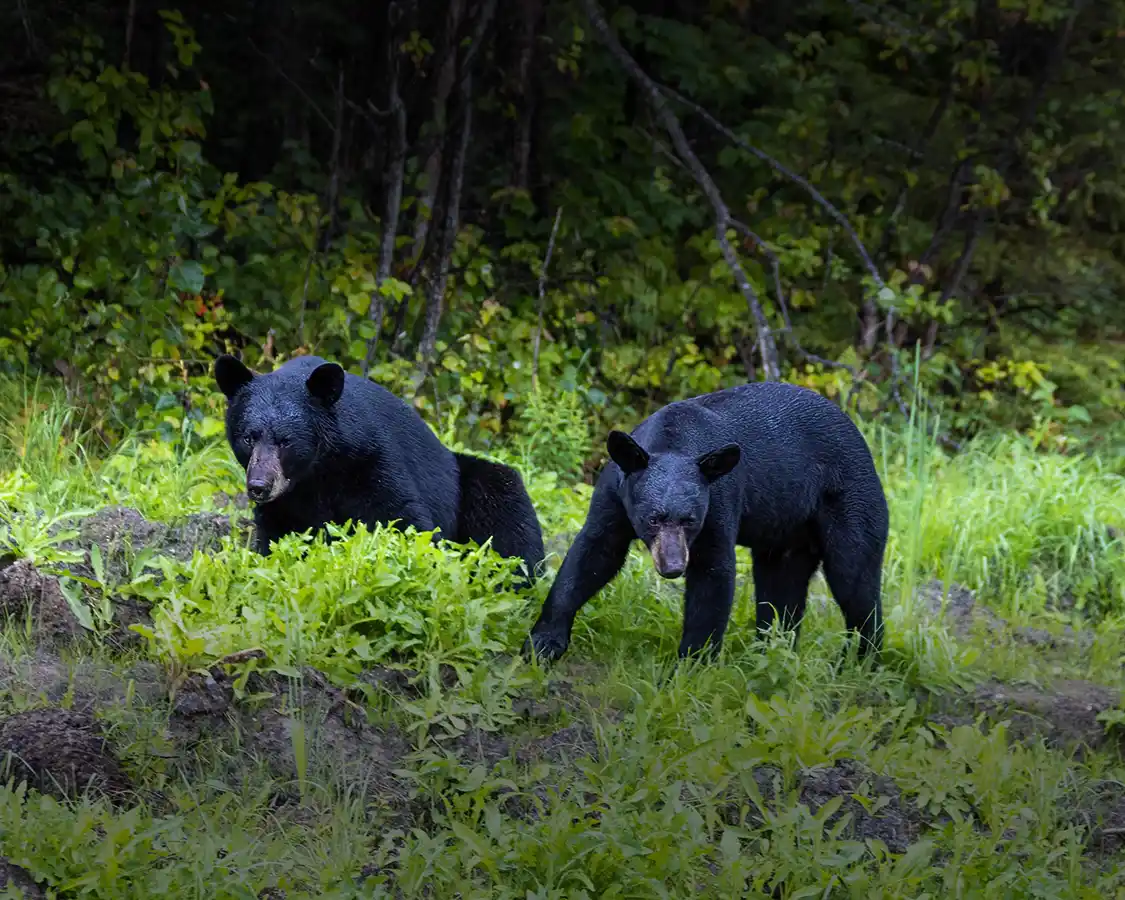
The Bow Valley Parkway, also known as Highway 1A, runs roughly 48 km (30 miles) on the far side of the Bow River through montane forest, with a 60 km/h limit and pullouts every few minutes. It takes twice as long (at least), and that is the entire point. This is the best wildlife-viewing road in the park, and the fencing that makes the Trans-Canada safe for high-speed traffic is exactly what makes it useless for seeing wildlife. On the Bow Valley Parkway, elk, deer, bighorn sheep, wolves, and both brown and black bears all use the valley bottom, and you are moving slowly enough to actually see them.
For the best wildlife viewing along the Bow Valley Parkway, drive at dawn or the last hour before the sun sets. This is when most animals are on the move. Stay in your vehicle for roadside sightings, pull fully off the road when you want to take photos or gawk, and never stop in a driving lane.
If you end up including the Bow Valley Parkway on your three days in Banff, here are a few of my top stops. You can also check out a bit more in my guide to wildlife viewing in the Canadian Rockies, here.
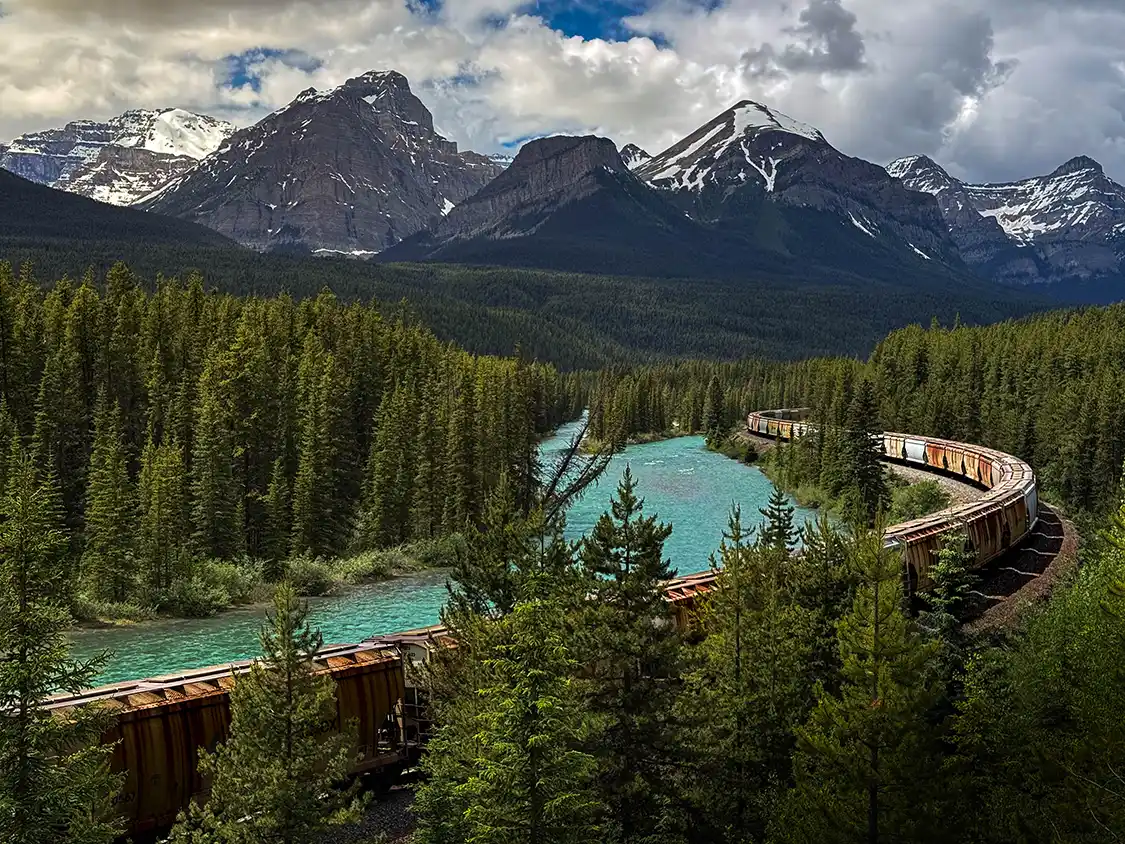
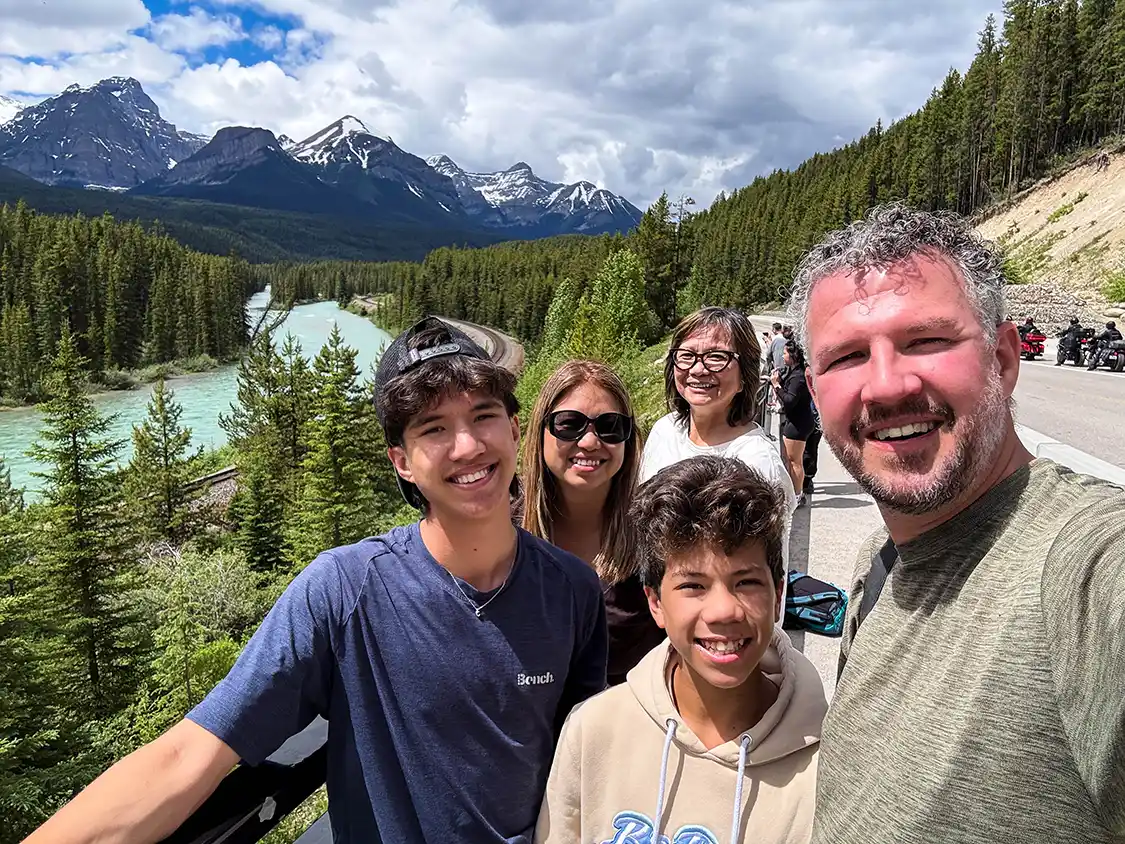
- Morant’s Curve, a railway bend framed by Mount Temple that has been photographed since the 1950s and still delivers when a train appears. Between 8 and 22 trains pass the corner each day, and we were lucky enough to catch one. It was such a fun moment for the whole family.
- Castle Mountain, which looks exactly like the name suggests.
- Johnston Canyon, where a catwalk bolted to the canyon wall leads to the Lower Falls in about 2.4 km (1.5 miles) return and the Upper Falls in about 5.1 km (3.2 miles).
- The Backswamp and Muleshoe viewpoints, for reflections and marsh birds.
Important planning note: The eastern 17 km between the Fireside Day-use Area and Johnston Canyon carries seasonal restrictions that often catch people off-guard. That stretch is cyclist and pedestrian only during daylight hours from May 1 to June 25, and again from August 28 to October 2. It also closes to everyone, including cyclists, from 8 p.m. to 8 a.m. between March 1 and June 25, to give wildlife the valley back at night. Johnston Canyon stays reachable from the Lake Louise end when the eastern section is shut.
We drove the Bow Valley Parkway on our way north to Jasper, but it works just as well as a half-day loop from town: out on the Parkway, back on the Trans-Canada, with a stop at Johnston Canyon in the middle. If you have a third morning in Banff and the weather is good, this is what I would do with it.
Tips For Getting To Banff and Getting Around Once You’re There
You Need a Park Pass
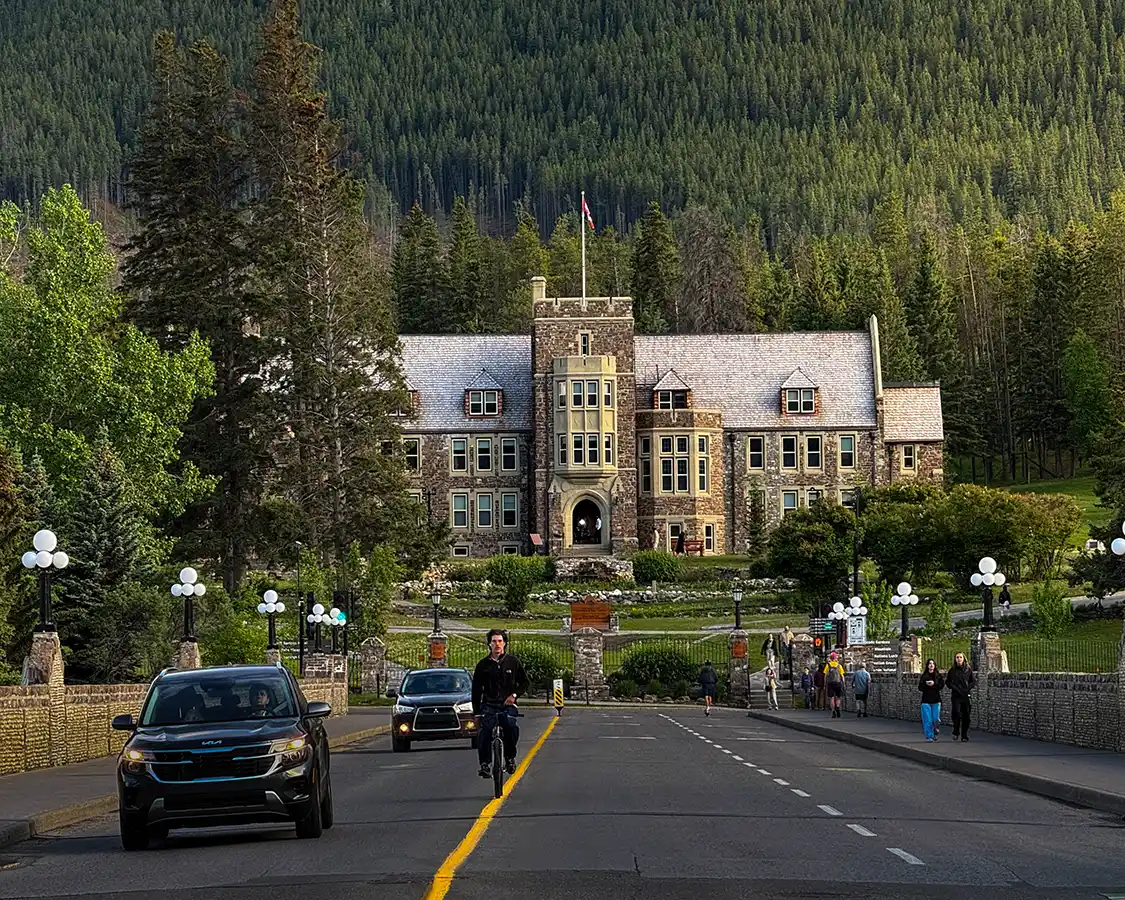
Everyone entering Banff National Park needs a Parks Canada pass, including those only visiting the townsite. Buy a daily pass at the park gates, or if you are hitting more than about a week of national parks in a year, the annual Discovery Pass ends up being a better deal and covers all Parks Canada locations across the country. Buy it online in advance and skip the gate queue.
Roam Transit, and Why Your Hotel Choice Matters
Banff runs an excellent public bus system called Roam, and a lot of hotels include free local passes with your stay. Ours did, and it made getting around the city very easy. Being able to leave the car at the hotel and bus into town for dinner removes the single most irritating thing about Banff: parking. Roam buses are also low-floor with fold-out ramps for those with accessibility considerations.
The Lake Louise and Moraine Lake Shuttle System
Understanding the Lake Louise and Moraine Lake shuttle system is the best way to save yourself a headache. And it’s important to understand it before you arrive in the town.
Moraine Lake Road has been closed to personal vehicles since 2023. It is permanent, year-round, and as of 2026, it applies even to visitors holding accessibility parking placards. You cannot drive there, period. Anyone who tells you otherwise is wrong.
The Parks Canada shuttle system runs from mid-May to mid-October from the Park and Ride at the Lake Louise Ski Resort, every thirty minutes, roughly 6:30 a.m. to 6 p.m. Parking at the Park and Ride is free; the shuttle itself is not, and one reservation includes the Lake Connector between Lake Louise and Moraine Lake. Reservations open in mid-April, and 60% of seats are held back and released at 8 a.m. Mountain Time, two days before travel. Set an alarm. Book at reservation.pc.gc.ca or call 1-877-737-3783.
I’ll be honest, even knowing when the Banff shuttle reservation systems open doesn’t guarantee you a spot. I’ve got pretty good connections with Parks Canada, and even I couldn’t get myself and my family a seat. But missing out on the Banff lakes shuttle isn’t the end of the world. There are a few alternatives, including Banff’s city shuttle: Roam Route 8X, and the Lake Louise Express, which runs year-round from Banff directly to the Lake Louise lakeshore. Its Reservable Super Pass bundles the round trip, unlimited Roam travel, and a round trip on the Lake Connector to Moraine Lake. If you can’t book that, a third option is what we did. Book a commercial tour like this one.
Driving yourself to Lake Louise is still technically possible, but risks turning your day into a logistics nightmare. Parks Canada reports that roughly 75% of vehicles attempting to reach the Upper Lake Louise lot get turned away, and the lot routinely fills up before sunrise in summer. For live parking and traffic conditions, BanffNow is very good and updates in real time.
Have More Than Three Days In Banff? Here Are More Things To Do in Banff
Three days in Banff will get you to the town’s headline attractions. But this is a town that slowly sets its hooks into you, convincing a lot of visitors to slow down and stay a while longer. If you’ve got some extra time in the area, here’s how I’d spend my time.
Lake Minnewanka and the Lake Loop
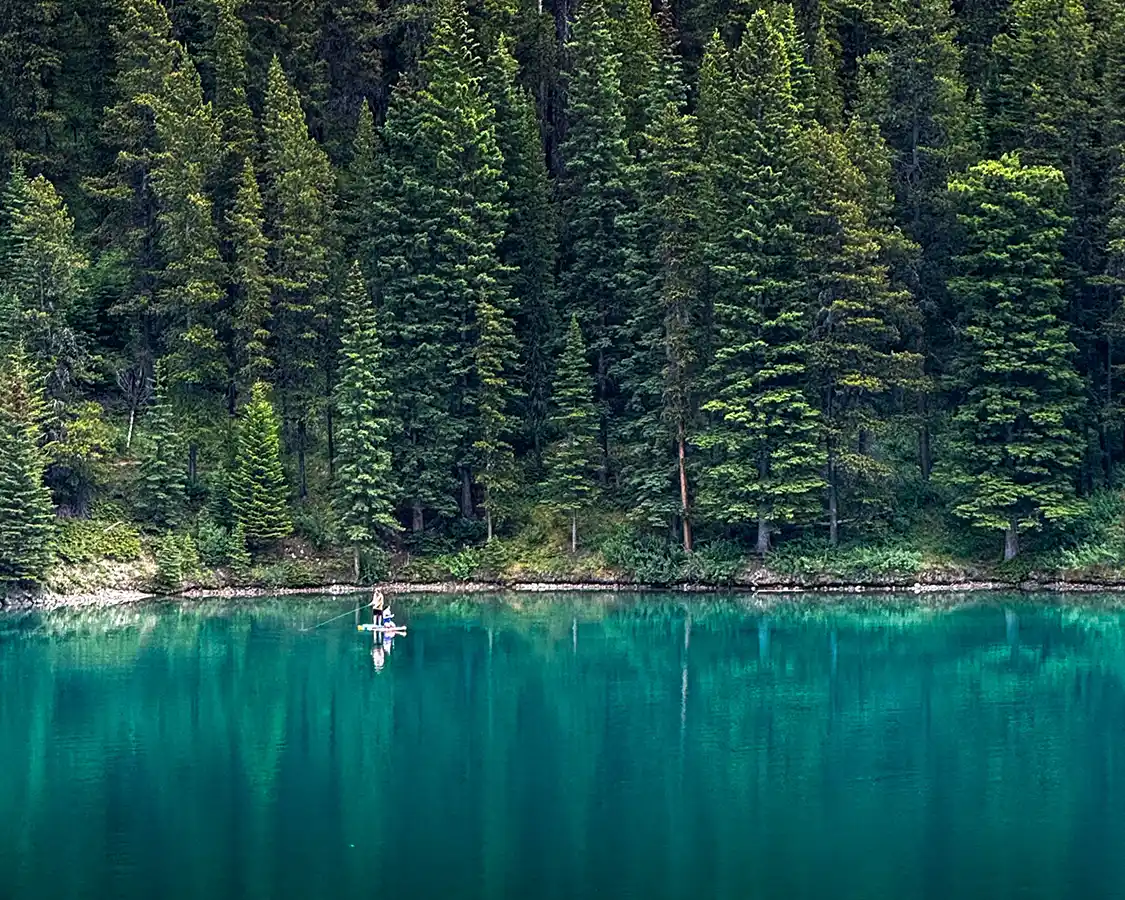
Lake Minnewanka is the largest lake in Banff National Park. It’s about 5 kilometers from the town center. There is a flat 1.5 km (0.9 mile) paved lakeside walk, picnic areas, and an interpretive boat cruise that is accessible and works well for a mixed-ability group.
The road out here loops past Two Jack Lake, Johnson Lake, and Cascade Ponds. Johnson Lake has a small sandy beach and water that actually warms up, which in the Rockies is close to a miracle. So if you love swimming, this is the best lake for your visit to Banff. Cascade Ponds has shallow water, picnic tables, and little bridges, and is about as good as it gets for younger kids. Minnewanka also hides the Bankhead ghost town, the remains of a coal mining community abandoned in 1922, with an interpretive trail through the ruins.
Banff Upper Hot Springs
The Banff Upper Hot Springs is a large outdoor mineral pool on the side of Sulphur Mountain, steaming away at around 39 degrees Celsius (102 Fahrenheit) with mountains on every side. Swimsuit rentals are available. There is accessible parking near the rear entrance and a water-accessible wheelchair.
For those short on time, this tour offers a Banff highlights experience that includes the hot springs, the gondola, and Bow Falls on a day trip from Calgary.
The Museums, and What To Do When It Rains
The Buffalo Nations Luxton Museum tells the story of the Indigenous peoples of the northern plains and mountains, with exhibits, VR experiences, and drumming. It is the right first stop if you want your kids to understand that this valley has a history longer than the railway. Banff sits within Treaty 7 territory, the traditional lands of the Stoney Nakoda, the Blackfoot Confederacy, the Tsuut’ina, and the Métis Nation of Alberta Region 3.
The Banff Park Museum is a 1903 log building housing a Victorian-era natural history collection of more than 5,000 specimens, arranged the way museums were arranged before anyone worried about how that looks. It is a museum of a museum. The Whyte Museum covers mountain art and the history of climbing and guiding in the Rockies, with heritage cabins on the grounds.
Banff Avenue and the Town Itself
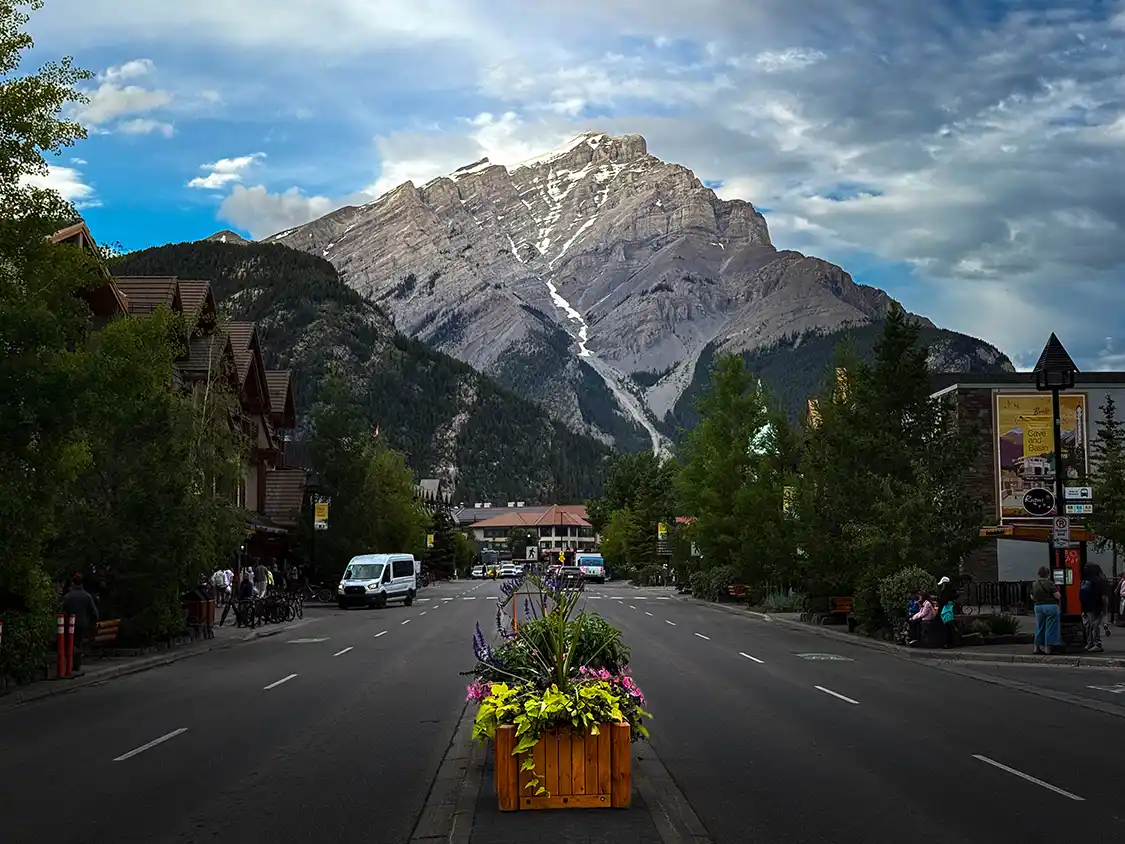
Banff Avenue is the main strip, and it has a lot going on. I will say, this is a town that could have easily gone gaudy, but hasn’t. Still, you’ll find everything from candy stores, outdoor gear, maple syrup in every conceivable format, and a BeaverTails stand that my children found by teenage echolocation within five minutes of arrival.
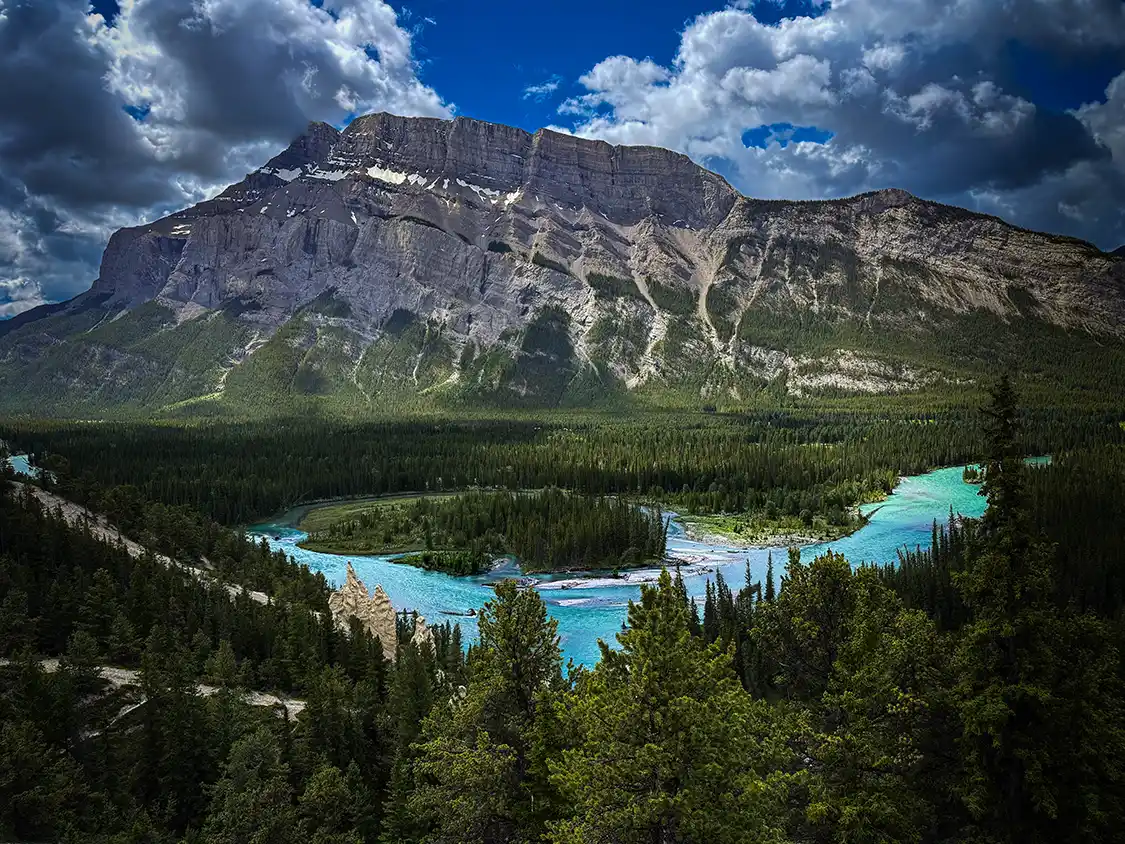
Downtown Banff is a part of the experience; even if the outdoors is your focus for your three-day Banff visit, don’t write the town off. Central Park runs down to the Bow River with a good natural playground. The pedestrian bridge over the Bow gives you the classic view up the avenue to Cascade Mountain. And the Hoodoos viewpoint, about ten minutes’ walk from its lot, shows off strange eroded rock pillars above the river valley.
There are elk in town. Actual wild elk, often bedded down on lawns, particularly in fall. They are enormous, and they are not tame. Keep three bus lengths away, keep children close, and never get between a cow and a calf. Elk seem sweet and pet-able. They aren’t, especially during rutting season and calving season. At those times of year, both the males and females can be very aggressive.
The Best Family Hikes in Banff
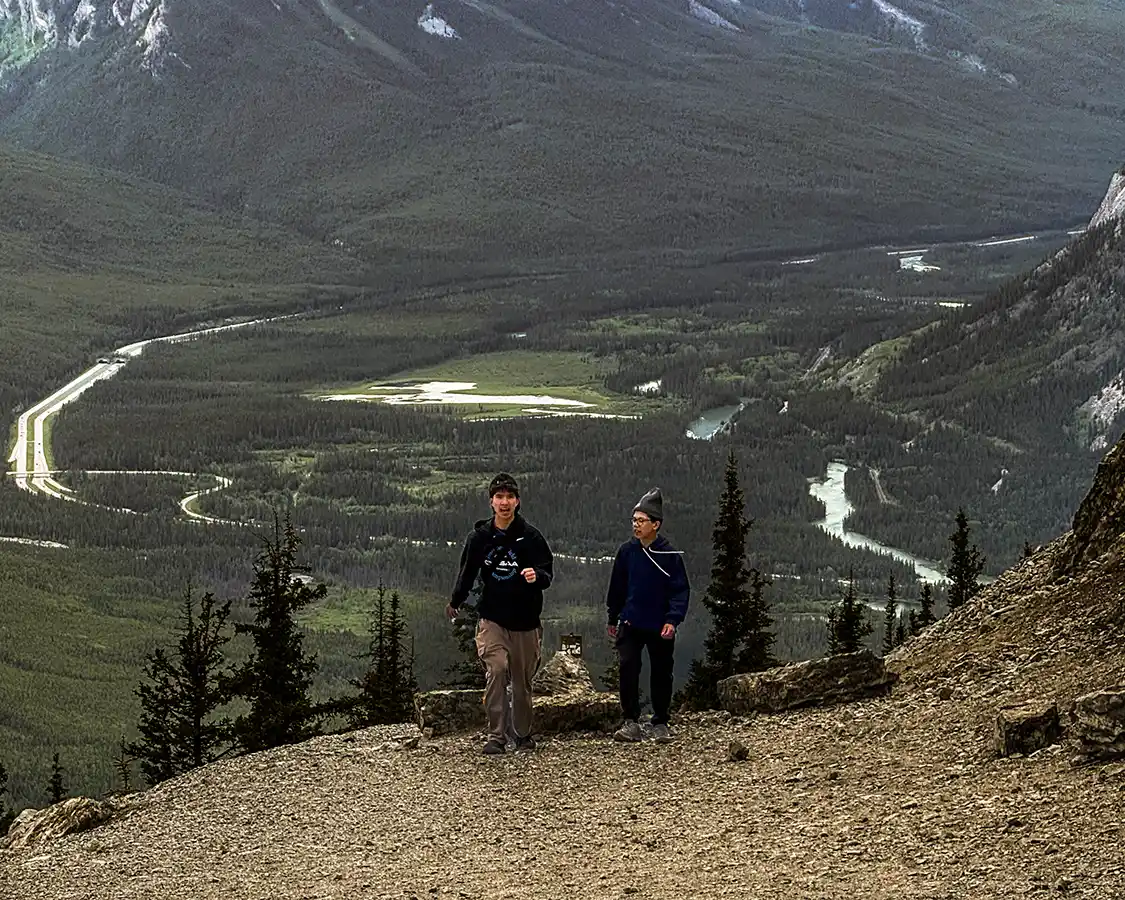
Our three-day family trip to Banff wasn’t a serious hiking trip. That doesn’t mean yours won’t be. Let’s face it, Banff is a hiking Mecca, and any chance to get out on the trails here is one that you shouldn’t pass up. Here are the walks we actually did, along with routes I know from previous trips.
Easy, and truly family-friendly hikes in Banff
- Fenland Trail. 1.8 km (1.1 mile) loop, essentially flat, boardwalk and packed gravel, minutes from town. Good for strollers.
- Bow River Trail. Paved, flat, runs along the river through town for up to 5 km (3.1 miles).
- Lake Louise Lakeshore. 2 km (1.2 miles) return, paved at the start, flat the whole way.
- Moraine Lake Lakeshore. 1.5 km (0.9 miles), flat, right along the water.
- The Rock Pile at Moraine Lake. Short but not flat, with stairs and about 30 m (100 ft) of climb.
- Johnson Lake Loop. Around the lake with a beach at the start, first 0.5 km (0.3 miles) paved.
Moderately challenging Banff hikes for families looking for something more
- Johnston Canyon. 2.4 km (1.5 miles) return to the Lower Falls, 5.1 km (3.2 miles) return to the Upper Falls, on suspended catwalks. Spectacular and extremely popular. Go before 8 a.m. or after 5 p.m.
- Tunnel Mountain. About 4.8 km (3 miles) return with 266 m (873 ft) of climb, starting essentially in town. The classic first mountain for kids.
- Sundance Canyon. A paved 3.7 km (2.3 miles) approach from Cave and Basin, then a 2.4 km (1.5 miles) loop. The paved approach is accessible.
More challenging hikes in Banff for fit families and families with older kids
- Lake Agnes Tea House. 3.6 km (2.2 miles) one way, 400 m (1,300 ft) of gain, with tea and pie at the top.
- Plain of Six Glaciers. 5.3 km (3.3 miles) one way with its own tea house and glacier views.
- Consolation Lakes from Moraine Lake. About 3 km (1.9 miles) one way over rocky ground, far quieter than everything around it.
For more on building hiking into family travel generally, I have a roundup of the best hiking destinations for families.
Important note on Bear Safety in Banff: Banff is bear country. The area around town is home to both grizzly and black bears. Carry bear spray on any trail away from the townsite, and importantly, know how to use it. Make noise as you walk (humming, singing, talking, etc.), hike in groups of four or more where Parks Canada advises it, and check trail reports for closures before you set out. If bears are known to be in the area of popular hikes, Parks Canada will often close those trails. Follow their instructions and don’t try to hike anyway.
Banff as a Multi-Generational Travel Destination
I do a lot of research when I write these guides. This is information that I couldn’t find anywhere when I was planning this multi-generational trip to Banff. Felix cannot walk far, and my worry going in was that we would spend a fortune to show my in-laws a mountain range through a windshield. That is not what happened, because Banff is actually well set up for families with older travelers and those with mobility needs.
Big Views That Require Little to No Walking
- The Banff Gondola summit. Wheelchair-accessible cabins, an accessible summit building, and the biggest panorama in the park with no hiking at all.
- Vermilion Lakes Drive. A paved road with pullouts. World-class reflections from the passenger seat.
- Surprise Corner. The Fairmont Banff Springs viewpoint, essentially from the parking area.
- Lake Minnewanka. Paved 1.5 km (0.9 mile) lakeside path, plus an accessible boat cruise.
- Bow Falls. Parking close to the viewpoint, short level approach.
- The Bow Valley Parkway. An entire wildlife drive experienced from the car.
- Two Jack Lake and Cascade Ponds. Drive-up picnic spots with immediate water views.
Accessible Trails and Sites
- Lake Louise Lakeshore: Paved, 2 km (1.2 miles) return.
- Bow River Trail: Paved asphalt through town.
- Fenland Trail: Boardwalk and packed gravel, 1.8 km (1.1 miles).
- Cave and Basin: All-terrain accessible surface, accessible washroom, guides on request.
- Banff Upper Hot Springs: Accessible parking at the rear entrance and a water-accessible wheelchair.
- Roam Transit buses: Low-floor with fold-out ramps, across the whole network.
Accessibility note: As of 2026, accessibility parking placards no longer grant vehicle access to Moraine Lake Road. Everyone must take the shuttle, so build in time for the transfer at the Park and Ride. Banff and Lake Louise Tourism maintains a useful accessibility page, and Rocky Mountain Adaptive is a Bow Valley charity that helps people with disabilities get into mountain sports if you want to do more than sightsee.
My Top Tip for Multigen Travel to Banff
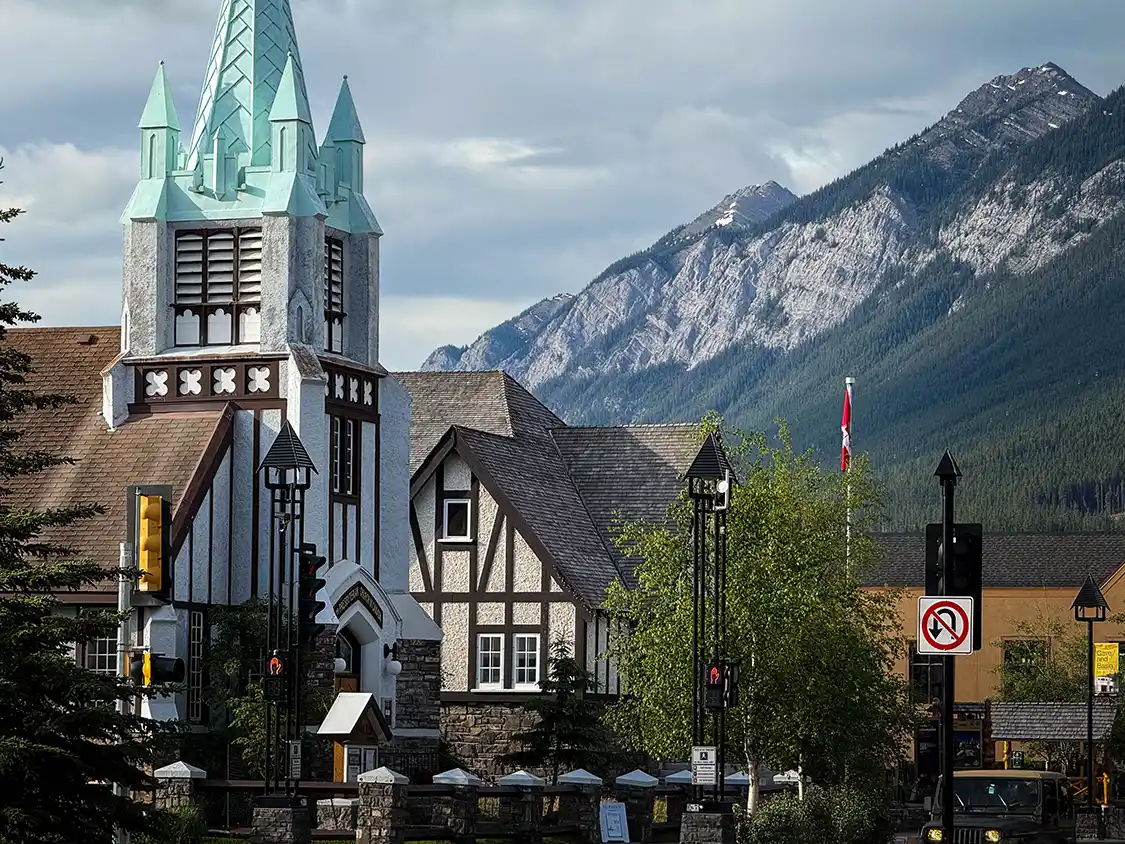
Go slower than you think you should. Build each day around one anchor experience rather than three. Front-load a guided tour so you can get the lay of the land quickly. Book a hotel with a kitchen so nobody has to get dressed and go out for every meal. Go in with the understanding that seeing less is not the same as getting less.
Where to Stay in Banff
Banff accommodation is expensive, and it books out early. Two decisions matter more than the specific property: get something with a kitchen, and check whether your rate includes Roam transit passes.
Tunnel Mountain Resort
This is where we stayed, and I would happily book it again. Tunnel Mountain Resort sits on Tunnel Mountain Road about 1.7 km (1 mile) above the townsite, in a quiet forested pocket that feels properly removed from the Banff Avenue bustle.
The units are condos, cabins, and suites rather than hotel rooms, most with full kitchens and fireplaces, which meant we could feed six people breakfast without organizing everyone into a restaurant at eight in the morning. There is a pool, there are barbecues, and there is a playground. Guests also get complimentary Roam passes for the local Banff routes, which is what let us leave the car parked all week.
Other Places Worth Knowing
- Fairmont Banff Springs. The castle on the hill, and the reason half the photographs of Banff exist. A splurge, with a pool complex that justifies a lot on a rainy day.
- Moose Hotel and Suites. Central on Banff Avenue, with rooftop hot pools looking at the mountains.
- Banff Park Lodge. Solid mid-range, walkable to everything, indoor pool.
- Hotel Canoe and Suites. Good value for families by Banff standards, with suite layouts that work for more than four people.
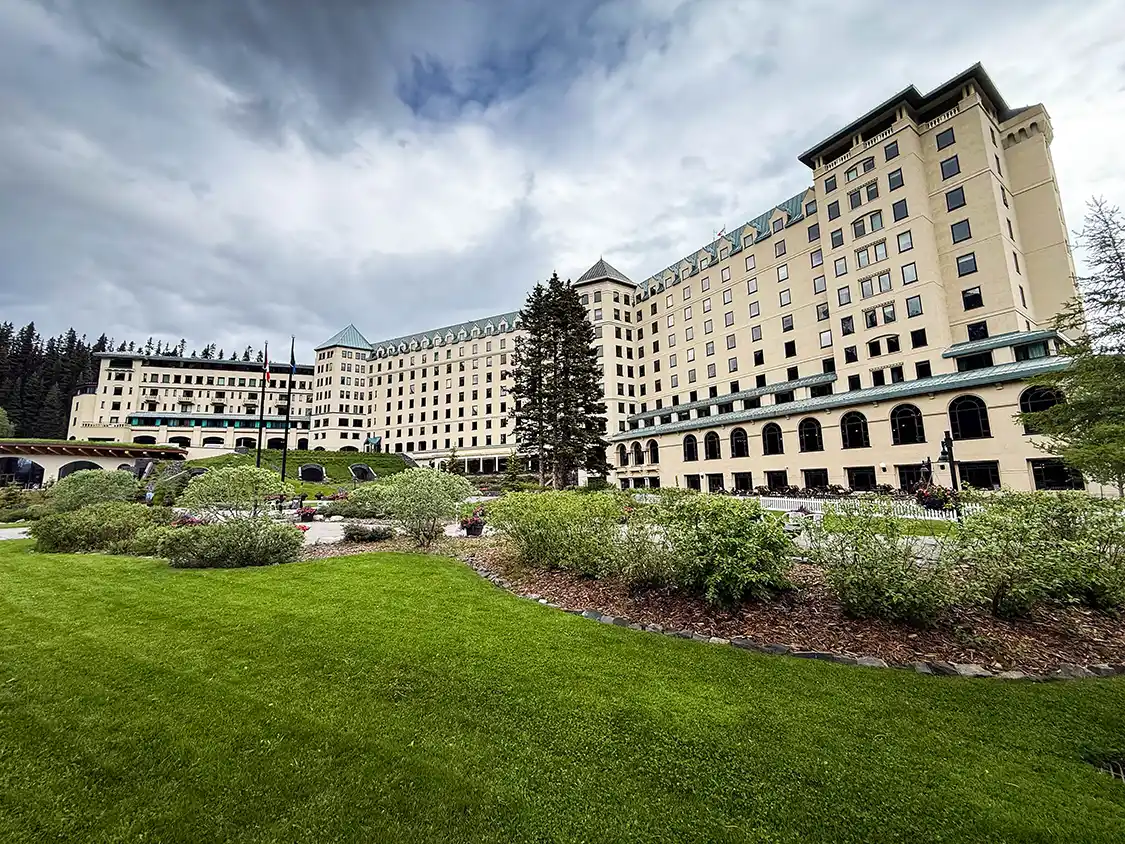
- Fairmont Chateau Lake Louise. Staying at Lake Louise means seeing the lake at dawn without a shuttle booking, which is a real argument for the price.
- Canmore. Twenty-five minutes outside the park gates, meaningfully cheaper, with its own excellent food scene. The trade-off is driving in daily and dealing with Banff parking.
Where to Eat in Banff
Banff has a culinary scene that’s far better than a town of 8,000 normally has. It’s a culinary destination because, on top of the locals, it’s feeding four million visitors a year. Be warned, if you’re visiting in the summer, reservations are not optional.
Maple Leaf Steakhouse and Seafood
The best meal of our trip and the one the boys still bring up. Maple Leaf Steakhouse and Seafood on Banff Avenue does Canadian steak and seafood in a room full of timber and stone that looks exactly like what a person who has never been to Canada imagines Canada looks like, and then backs it up with the cooking. Order the duck wings.
Whitebark Cafe
Our breakfast stop. Whitebark Cafe at the Banff Aspen Lodge does proper coffee, pastries, and breakfast sandwiches, with firepits and tables outside. Get there early on a shuttle morning.
Sky Bistro and Northern Lights Alpine Kitchen
Both are at the top of the Banff Gondola. Northern Lights is the buffet, and it is a better deal than I expected. Sky Bistro does window-side fine dining at the same elevation. I’ve heard from good friends who have eaten at both that the buffet is actually the better meal. Book either ahead in summer.
More Places to Eat in Banff
- Park Distillery. Campfire-themed cooking and house spirits, loud in a good way, and very happy to have kids in the room.
- Bear Street Tavern. Pizza on a patio, reliably good, reliably packed.
- High Rollers. Bowling, arcade, and pizza. Your rainy afternoon and your teenager-management tool in one building.
- The Old Spaghetti Factory. This is a small chain that serves up decent, predictable food. It’s good for families with tired kids who just need a place to stop and have a slow meal in a fun place.
- Banff Poutine. A small place doing one thing properly.
- BeaverTails. Fried dough, cinnamon and sugar, and a Canadian rite of passage.
- Rocky Mountain Chocolate. Serves up great ice cream. We rolled in here in the afternoon looking for a cool treat, and the owner stopped to chat for a bit. Very nice guy.
The Best Time to Visit Banff
July and August
Everything is open, the lakes have thawed to full color, and the high trails are clear. This is also Banff high season; shuttle reservations are snatched up within minutes, and Johnston Canyon in the middle of the day feels like a queue. If you are tied to school holidays, come anyway, and start every day earlier than you think makes sense.
September
September is my top pick. Crowds thin noticeably after Labour Day, the light gets better, the larches turn gold late in the month, and the lakes still hold their color. Nights get cold, and some services wind down, but the trade is worth it.
Late May and June
Beautiful, green, and unpredictable. Lake Louise and Moraine Lake may still be partly frozen into June. Moraine Lake Road typically opens around the start of June. Snow can close high trails well into the month.
Winter
A completely different Banff experience. Skiing at three resorts, frozen waterfalls in Johnston Canyon, skating on Lake Louise, and a town that turns properly festive. Most summer infrastructure is closed, including Moraine Lake Road. Come in winter on purpose.
Practical Tips for Visiting Banff With Kids
- Book shuttle reservations the moment they open, and set an alarm for 8 a.m. Mountain Time releases two days out if you miss the first round.
- Buy your park pass online before you arrive and skip the gate queue.
- Choose a hotel with a kitchen. Banff restaurant bills with a family of six are their own kind of altitude sickness.
- Check whether your rate includes Roam passes. If it does, use them and leave the car parked.
- Start early. Everything about Banff in summer rewards being out by seven and punishes arriving at eleven.
- Layers, always. It can be 25 degrees Celsius (77 Fahrenheit) in town and near freezing with wind at the gondola summit on the same afternoon.
- Carry bear spray on trails outside the townsite, and know how to use it before you need it.
- Stay three bus lengths from elk and one hundred meters from bears.
- Refill water bottles everywhere. The tap water here comes off the mountains.
- Download offline maps. Cell coverage disappears in the valleys.
- Use BanffNow for live parking and traffic before you drive anywhere in July or August.
- Build one flexible slot into the three days. Mountain weather will take something from you.
Frequently Asked Questions About Spending Three Days in Banff
Three days is enough to see Banff properly. It covers the townsite and Bow Falls on day one, Lake Louise and Moraine Lake on day two, and Vermilion Lakes, Cave and Basin, and the Bow Valley Parkway on day three. Five days let you add Lake Minnewanka, Johnston Canyon, and the hot springs without rushing.
Day one: arrive, Bow Falls, Surprise Corner, an Open Top tour of the townsite, dinner on Banff Avenue. Day two: the Lake Louise and Moraine Lake shuttle, then the Banff Gondola for sunset. Day three: Vermilion Lakes at sunrise, Cave and Basin, and a slow drive along the Bow Valley Parkway.
No. Moraine Lake Road has been closed to personal vehicles since 2023, year-round and permanently, and as of 2026, accessibility parking placards no longer grant access either. You must take the Parks Canada shuttle from the Lake Louise Park and Ride, a Roam transit bus, a commercial shuttle, or a guided tour. Book well in advance.
Banff is about 130 km (81 miles) west of Calgary International Airport, roughly a 90-minute drive on the Trans-Canada Highway. Rental cars are available at the terminal, and several shuttle and bus services run the route if you would rather not drive.
Not strictly. Roam Transit covers the townsite and runs year-round to Lake Louise, and many hotels include free local passes. A car gives you Vermilion Lakes at sunrise, the Lake Minnewanka loop, and the Bow Valley Parkway, which are hard to replicate on transit. You cannot drive to Moraine Lake either way.
Yes, and it is the best wildlife drive in the park. Highway 1A runs about 48 km (30 miles) between Banff and Lake Louise at 60 km/h with frequent pullouts. Watch for seasonal restrictions on the eastern 17 km, which is cyclist-only during daylight in late spring and early fall.
Yes. Everyone entering Banff National Park requires a Parks Canada pass, including visitors who only stay in the townsite. Daily passes are sold at the park gates, and an annual Discovery Pass covers all Canadian national parks and usually pays for itself in about a week of park days.
Considerably more than most mountain destinations. The Banff Gondola has wheelchair-accessible cabins and an accessible summit; Vermilion Lakes Drive delivers world-class views from a car; and Cave and Basin, Lake Louise Lakeshore, the Bow River Trail, and Lake Minnewanka’s lakeside path are all accessible. Roam buses have ramps and low floors.
Regularly. Elk wander the townsite, bighorn sheep frequent the Lake Minnewanka road, and the Bow Valley Parkway is the most reliable wildlife drive in the park. Dawn and dusk are best; stay in your vehicle for roadside sightings, and never approach or feed anything.
Final Thoughts on Spending Three Days in Banff
Banff is the most photographed place in Canada and one of the few that take the preconceived expectations and actually improve upon them. The lakes are really that color of blue. The mountains really do spring up out of nothing. This isn’t a place where you’ll leave disappointed.
What most families get wrong when they’re planning their three-day Banff itinerary is the pace. Because Banff is so compact, you could easily tick off six viewpoints a day. You can rent a car and drive four hundred kilometers, and come home with a full camera roll but no memories.
Banff will treat you better if you settle on one anchor experience a day. Build time in for weather, and book a hotel with a kitchen so nobody has to get dressed and go out for every meal. If you’re relaxed and a marten runs between your legs or the lake goes glass-still at six in the morning, you can actually pay attention and absorb the wonder.
Banff earns its place on every list of must-see destinations in Canada. Take your kids. Take your parents. Give it more days than you think it needs. This wasn’t our first multi-generational family travel experience, and it definitely won’t be our last. But it may have been one of the best.
Have you taken your family to Banff? Tell me in the comments what stopped you in your tracks, and whether you found a viewpoint I have been walking past all these years.
You May Also Like To Read:
Disclosure: Pursuit provided my family with passes covering several of the attractions described below, including the Banff Gondola and Open Top Touring. They had no input into this article and did not review it before publication. Everything I say about those experiences, and about the buffet, is what I actually thought.