
Whistler has a gap between the last chairlift of winter and the first of summer. Here’s what runs, what’s shut, and why late spring is quietly one of the best times to go.
I stood in front of the PEAK 2 PEAK station on Blackcomb with my camera up and nobody in the frame. No line. No staff. No hum from the overhead cable. A single snowmobile parked by the doors and a groomed, empty apron of snow running away from the building toward a view most people pay top dollar to see.
It was late April. The gondola everybody comes to Whistler to ride had closed nine days earlier, and it wasn’t going to turn on again for seven weeks.
I’d like to tell you I knew that going in. I didn’t.
Here’s the thing nobody writes about Whistler: this resort has a seam in its calendar. Winter ends on one mountain before the other, summer doesn’t start when you’d assume, and for about a month in between, the lift map looks nothing like the one in every Whistler travel guide that you’ve read. I went looking for a clear answer to what spring in Whistler looks like and found, instead, the single most popular travel writer in this niche telling a reader in her own comments section to go ask the resort. So I’m going to answer that awkward question properly. “What is open in Whistler in the spring?” I’ll lay out the dates, lifts, what’s open, what isn’t, and what to do with the most confusing and underrated period of time at Whistler Resort.
Something that I learned while spending a spring weekend in Whistler, standing in that mushy snow, is that the seasonal gap at the resort isn’t a problem to work around. A black bear on a green ski run with nobody watching it but me. A rainforest boardwalk and a 1956 train wreck with the trail nearly to ourselves. Tulips out in front of the hotel while the peaks behind it were still white. Whistler in the shoulder season is a different town, and it’s cheaper, and almost nobody bothers to visit.
Whistler Spring Trip: Quick Planner
Check this before anything else: Whistler Blackcomb’s lifts do not run continuously from winter into summer. There is a gap of roughly four weeks, typically from around April 20 to mid-May, when the PEAK 2 PEAK Gondola and Whistler Mountain are both shut and summer operations have not started. Full daily summer service does not begin until around June 13. The section below breaks down the exact dates, and it is the single most important thing to get right about a spring trip here.
- Where it is: In the Coast Mountains of British Columbia, about two hours north of Vancouver on Highway 99, the Sea-to-Sky Highway. The drive is a genuine part of the trip, and in spring you get snow on the peaks and green in the valley at the same time.
- When spring actually is: For planning purposes, late April through mid-June. Late April and early May are the deepest part of the gap and the quietest. Mid-May to mid-June is the ramp, with more opening each week. After about June 13, you are in summer and the prices follow.
- Why go then: Lower rates, no lift lines, restaurants you can walk into, bears freshly out of their dens, and snow on the peaks with flowers in the village. The trade is that the alpine is largely closed and the weather is a coin flip.
- What to pack: Both seasons at once. I wore a flannel over a T-shirt in the village and wanted a proper jacket on the mountain in the same afternoon. Waterproof shell, warm layer, and shoes you don’t mind soaking, because the valley trails are wet and the alpine still has snow on it.
- How long to stay: Two nights is enough for the valley in spring. Three if you want a day trip south to Squamish or north to Pemberton. There’s less to fill the days with than in summer, and that’s rather the point.
- Getting around: Whistler Village is pedestrian and walkable end to end. You’ll want a car or a shuttle for Train Wreck, Brandywine Falls, and anything down the highway. There is no Uber in Whistler. Local transit runs through the valley, and the Sea to Sky coach services run from Vancouver airport.
- What it costs: Spring is the cheapest Whistler gets outside of November. Hotel rates in late April and early May sit well below both ski season and July, and you are not paying for lift tickets you cannot use. Budget for food, which stays resort-priced year-round.
- Where it fits in a bigger trip: Whistler pairs naturally with a visit to Squamish, 45 minutes south, which has its own slower side worth a night. If you’re building a wider province-wide route, I’ve mapped more of it in my British Columbia travel guide.
The Whistler Lift Season Gap, Explained
Table of Contents
This is worth bookmarking, because it’s the reason spring trips to Whistler often go sideways.
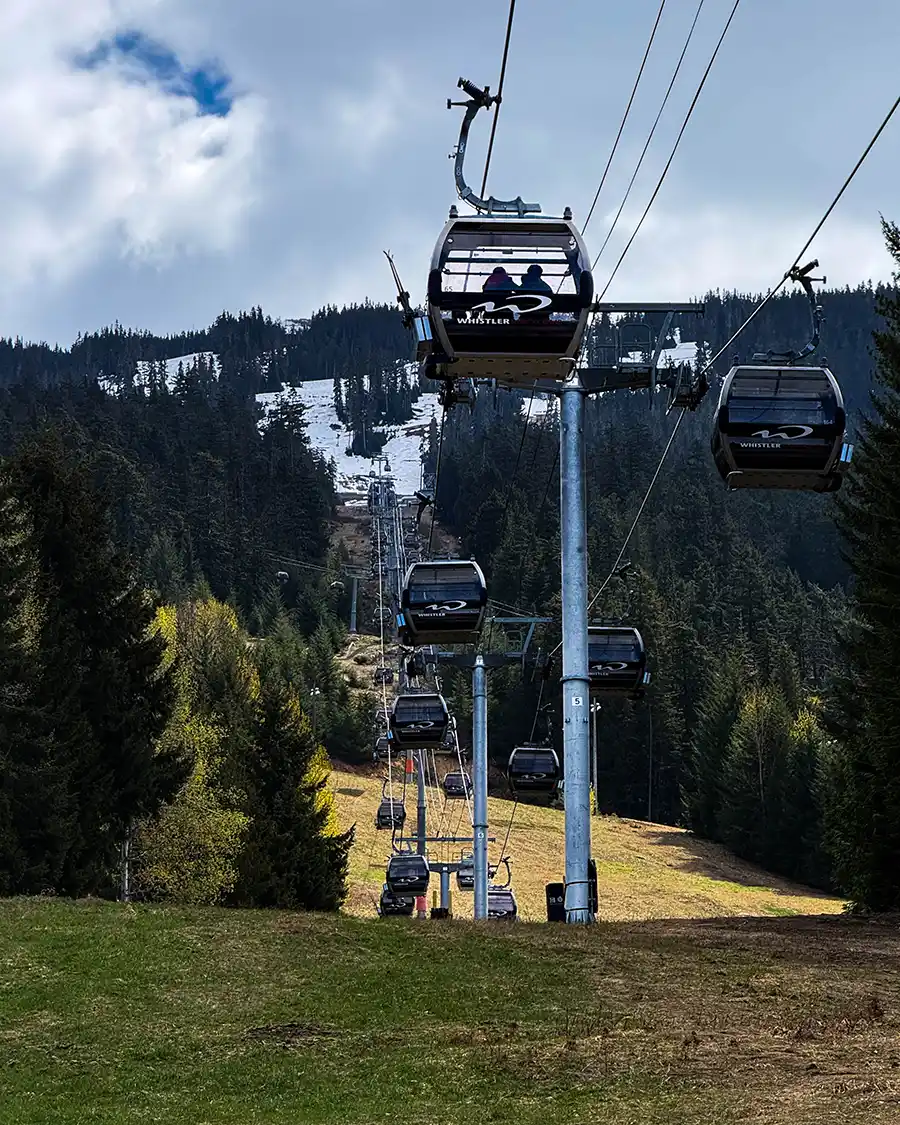
Whistler Blackcomb Resort is North America’s largest ski resort. It runs across two mountains, and in spring they do not keep the same schedule. One keeps lifts open while the other shuts down for maintenance. Summer alpine operations then start on a third date that has nothing to do with either. The result is a stretch of roughly four weeks when the resort is open, the village is busy, and most of the lifts you came for are either stopped completely or not operating on the schedule many visitors might expect.
How the 2026 season actually ran
Let’s be realistic about outdoor resort schedules. They aren’t locked into hard dates like most attractions. At big B.C. resorts like Whistler-Blackcomb, Big White, and SilverStar, the seasonal weather, snowpack, and popularity of the season dictate the opening and closing dates. When you’re planning a spring trip to Whistler, it’s important to understand that opening and closing dates vary each and every year based on a lot of factors.
Using real dates rather than averages- because averages are what got me standing alone in the snow- this is what the 2026 spring season looked like:
- April 19: Whistler Mountain closed winter operations. The PEAK 2 PEAK Gondola closed the same day.
- April 20 to May 15: the gap. Blackcomb kept running for skiing. Whistler Mountain, PEAK 2 PEAK, and summer sightseeing were all shut.
- May 15: the Whistler Mountain Bike Park opened its Fitzsimmons Zone. Bear viewing tours started. Mini golf opened on weekends.
- May 16: the Summer Alpine Experience began, running on the Whistler Village Gondola. The Blackcomb Gondola ran for the Victoria Day long weekend, then closed for maintenance.
- May 16 to June 12: PEAK 2 PEAK ran weekends and the Victoria Day holiday only.
- May 18: the winter ski season ended on Blackcomb.
- June 13: full summer operations. Whistler Gondola, Blackcomb Gondola, PEAK 2 PEAK, Peak Express, and Top of the World all running daily, weather permitting.
- June 14 to June 20: the rest of it fills in. Garbanzo bike zone June 13, Family Adventure Zone June 14, Creek Zone June 20.
The previous year followed the same shape. In 2025, the PEAK 2 PEAK closed on April 21 along with Whistler Mountain and the Creekside Gondola; Blackcomb skied until May 19, and summer alpine operations started on May 16.
What this means for your Spring visit to Whistler-Blackcomb Resort
Averaging out the dates is one way to schedule your spring getaway to Whistler, but it’s also a good way to be disappointed. Here are three rules that I recommend following to find the perfect dates for a spring visit to Whistler. Follow them, and they’ll serve you better than any seasonal average ever can.
- If you’re coming in late April or the first half of May, assume the alpine is closed. Blackcomb may still be open for skiers, but PEAK 2 PEAK, the Peak Express, and the summit trails are out. Plan a valley trip and treat any lift as a bonus.
- If you’re coming between mid-May and mid-June, check the day of the week before you book the hotel. In that window, PEAK 2 PEAK runs weekends only. A Tuesday in early June and a Saturday in early June are completely different trips.
- If you want the full alpine experience, the Cloudraker Skybridge, Top of the World, and the high trails, you need to plan for mid-June. Not all of June. Mid-June.
Dates move every year. Whistler Blackcomb Resort publishes its opening and closing schedule each spring, and the mountain that stays open late can switch. Treat the dates above as the pattern, not a promise, and confirm with the resort before you book anything that depends on a specific lift.
How I Spent Four Days In Whistler In The Spring
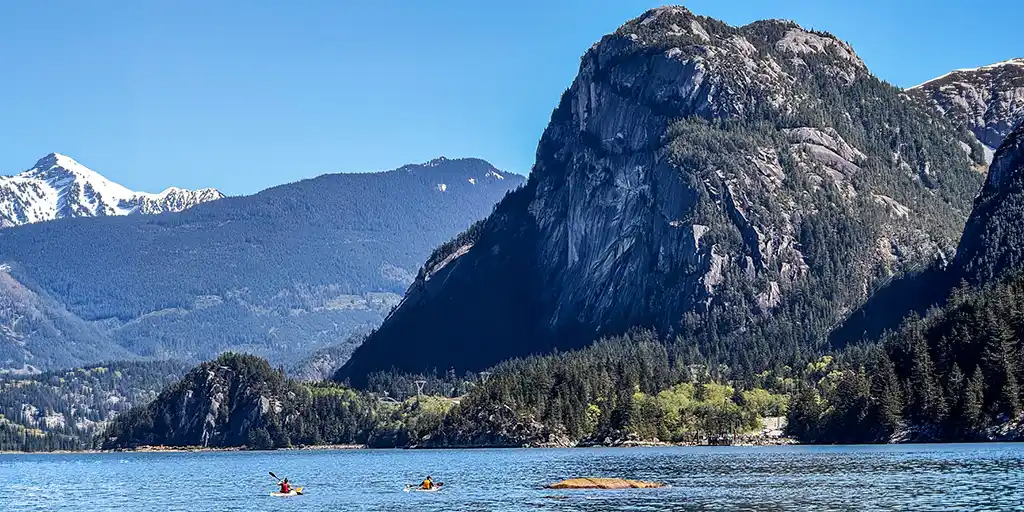
I drove up to Whistler from Squamish on a Sunday afternoon in late April, on the back half of a post-conference media trip through the famous Sea to Sky Highway. We stopped at the Tantalus Lookout on the way, which is a viewpoint that makes people pull over whether they planned to or not: the whole Tantalus Range dusted with snow across the valley, forest running green and black below it, and barely a cloud in the sky. If you drive this road and only stop once, stop there.
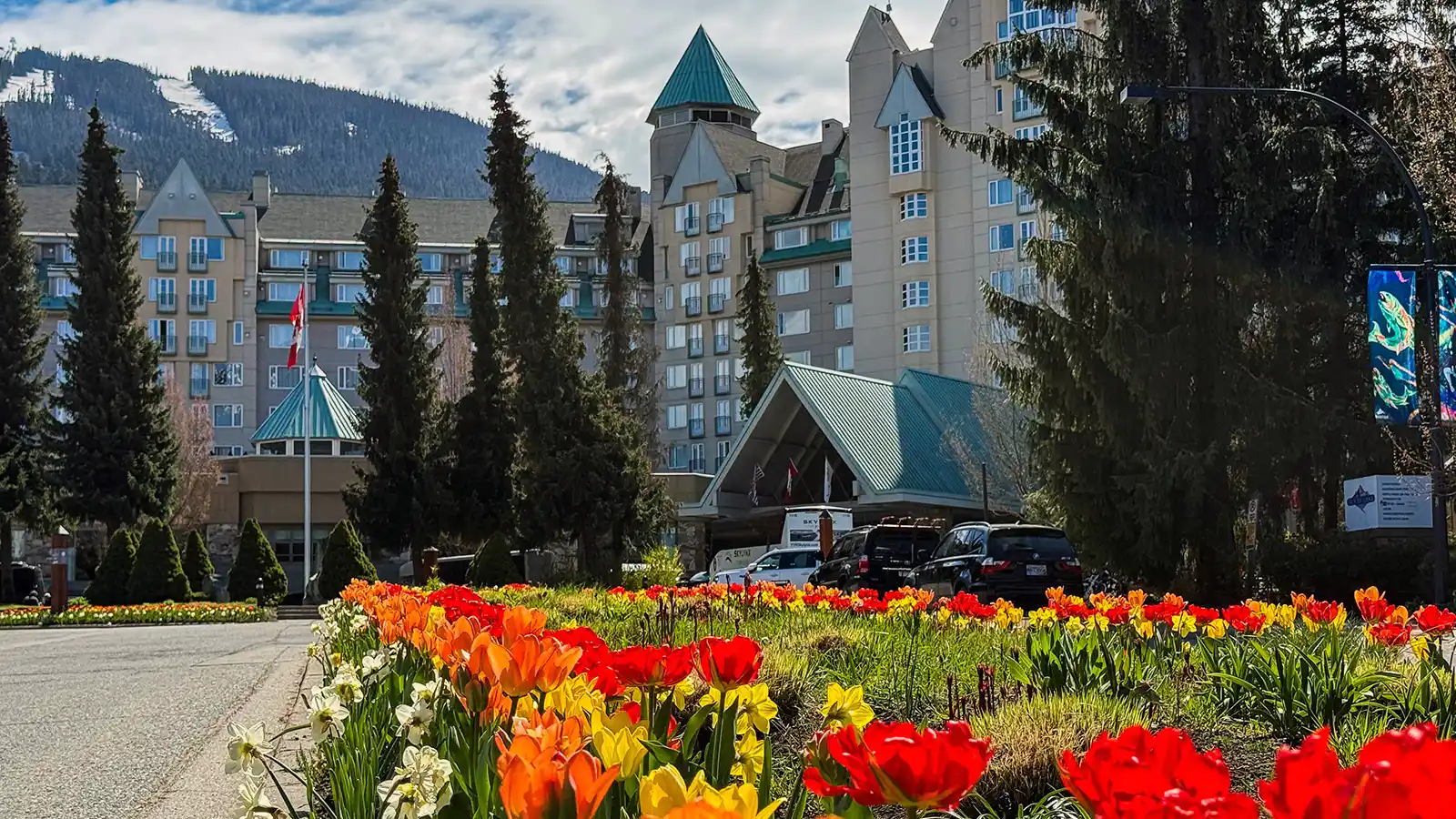
Whistler, when we got there, was deep in the throes of a dual-personality shift. The resort, during the spring, experiences two seasons at once. Tulips and daffodils in full color out front of the Fairmont Chateau Whistler, scarlet and orange against the grass. Behind the hotel, Blackcomb is still white to the treeline. I have never been anywhere that so clearly could not decide what month it was until I took my family to Banff, Alberta, a few weeks later.
The best way that I can describe it is like living in two seasons at once. As I walked down the brick-laid pedestrian pathways of Whistler Village, I could, at any moment, pass someone in shorts and a T-shirt carrying a skateboard, or someone in full snow gear carrying a snowboard.
Night one: Dinner, wine, and a forest that talks back
After arriving in Whistler and settling into our hotel, the beautiful Fairmont Chateau Whistler, my fellow travelers and I had worked up one heck of an appetite. For dinner, we all met downstairs in the hotel’s spacious lobby at the hotel’s premier restaurant, The Wildflower.
During the day, the restaurant serves up an expansive breakfast buffet as well as an à la carte menu in an airy, relaxed atmosphere. At night, it transforms into a sophisticated and intimate dining area. The menu was full of outstanding dishes made with locally-raised and harvested ingredients. I’ll be honest, I was so hungry that I dove into the meal and only took a single photo. That oversight may have also been due to The Wildflower boasting Whistler’s most extensive wine list.
We waddled out of the restaurant to the village’s central transportation hub and caught the shuttle from the Gateway Bus Loop out to Vallea Lumina, and this turned out to be the thing I’d tell you to book first.
The Lumina series is one I’m very familiar with. I’ve experienced these incredible shows in Wendake, Quebec, Kingston, Ontario, Coaticook, Quebec, and I’d visit one more that summer during a trip to Moncton, New Brunswick, with my son, Dylan. Each one is thoughtfully created, unique, and focused on the local nature, culture, and experience.
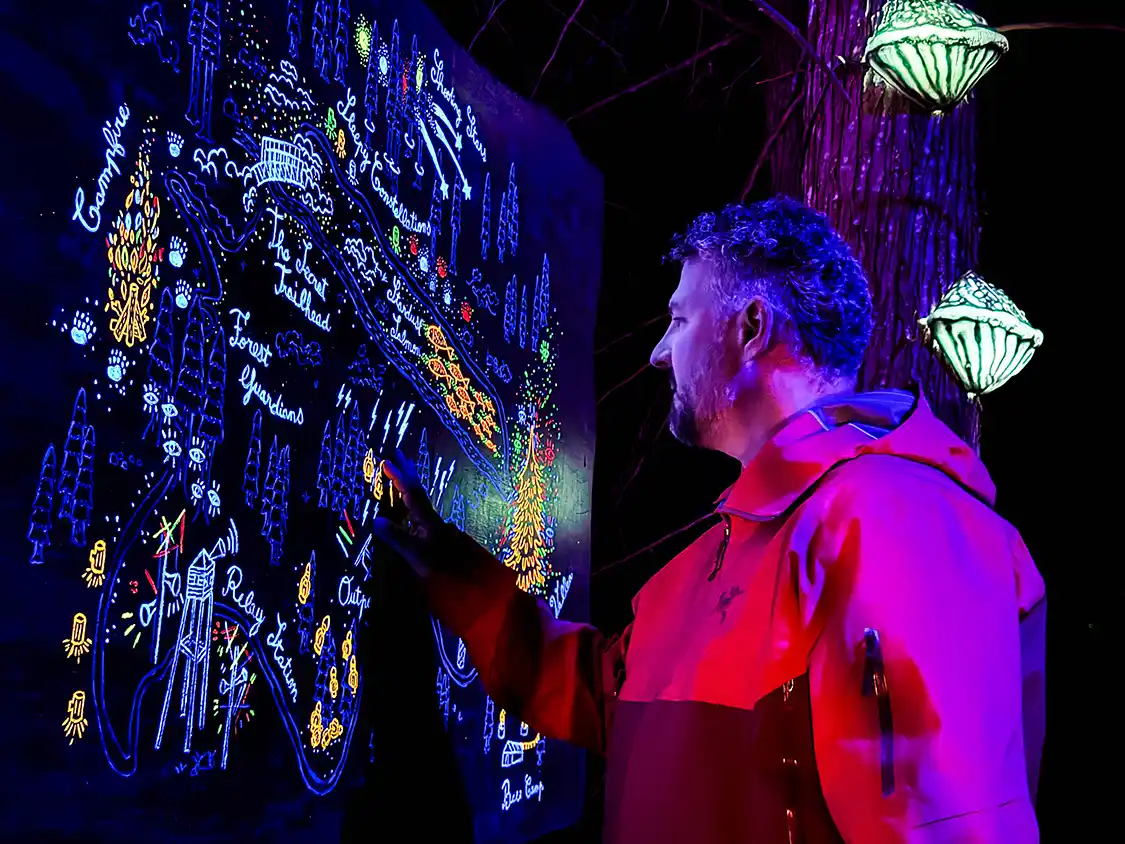
The Lumina light show in Whistler is a night walk through old-growth forest on Cougar Mountain, built by Montreal’s Moment Factory and run by The Adventure Group. We followed a 1.5-kilometer trail in the dark through light, projection, and sound, chasing a story about two hikers who vanished looking for a hidden valley. There’s a hand-drawn map at the start glowing under blacklight, all shooting stars and forest guardians and something called Stardust Salmon, one beautiful piece of luminous artwork that captured my eye the moment the trail started.
What makes these experiences so memorable is restraint. It would be easy to make the Lumina experiences gaudy. Instead, it’s dim and slow, allowing the beautiful mountain nature to do most of the heavy lifting. I came out the other side at a basecamp with firepits and a café, waiting for the shuttle, having walked through the woods at night with my phone barely ever leaving my pocket.
Crucially, for planning a spring trip to Whistler: Whistler Lumina runs rain or shine.
Day two: a 1956 train derailment and a dive into First Nations culture
The Fairmont runs a program called the Whistler Experience Guide, where staff guides take hotel guests out on daily outings. It’s something that’s included in the resort fee. Ours took us to the Whistler Train Wreck.
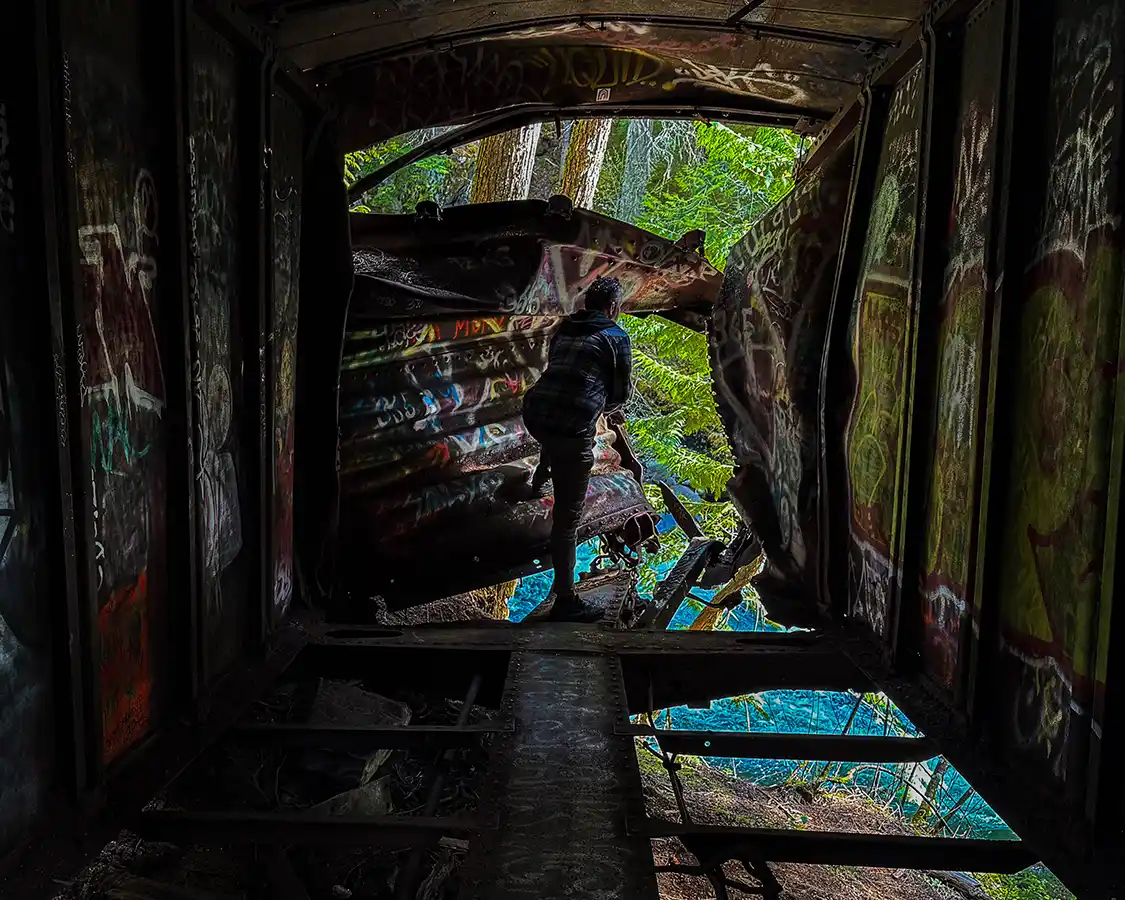
We crossed the Cheakamus River on a suspension bridge and came out into a forest full of boxcars, seven of them, lying spaced out through the forest. A southbound freight from Lillooet in 1956 was doing about 35 mph through a 15 mph track-repair zone. The fourth engine turned a rail. Three cars ended up wedged in a rock cut, and the Valleau family’s local logging company pulled them free with D8 Cat machines, dragged them up the tracks, and rolled them into the forest, which is exactly where they still sit.
Art and creativity go hand in hand with the outdoors in Whistler, and in true local form, every surface of the train cars is covered in graffiti, layers of it, decades deep, and the artwork is changing. The whole gravel route is 2.6 kilometers and is an easy hike, which makes it one of the best things to do in Whistler at any time of year and close to the best thing to do in spring, because it does not care what the weather is like on the mountains.
We had it nearly to ourselves. In July, this trail is shoulder-to-shoulder with people.
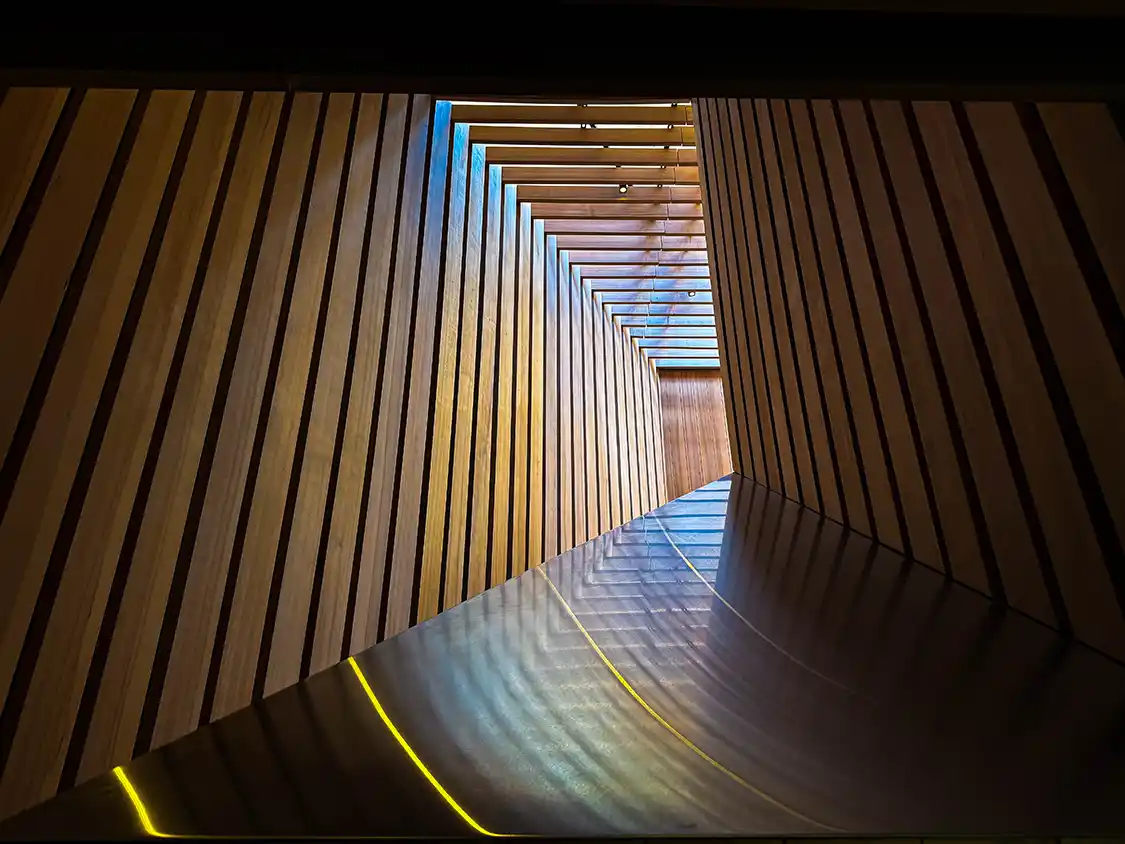
Lunch was at Hunter Gather on Main Street, which serves fantastic casual local food, along with Coast Mountain Brewing beer and Okanagan wine. Then the Audain Art Museum, which, for me, was one of the village’s true highlights. The building alone is worth the entrance ticket. Patkau Architects put 56,000 square feet on stilts in the forest, a long dark wedge with a glass-roofed entry walk and a carved column standing in it, and the trees come right up to the glass. Michael Audain and Yoshiko Karasawa founded it in 2016 to hold British Columbian art from the late eighteenth century to now.
Inside, the First Nations mask collection stopped me. Nineteenth- and twentieth-century Northwest Coast masks lit in the dark, a raven with a long ochre and red beak hanging at eye level, its shadow thrown hard on the wall behind. The anchor of the whole collection is James Hart’s The Dance Screen, the most significant contemporary carved cedar dance screen in the world. There are Emily Carrs. There’s Jeff Wall and Stan Douglas. In a ski town. Christina and I have been slowly creating a collection of masks representing unique cultures and traditions from around the world. At last check, the ones we have mounted on our wall number over a dozen. Seeing these laid out in front of me was like being a kid in a candy store.
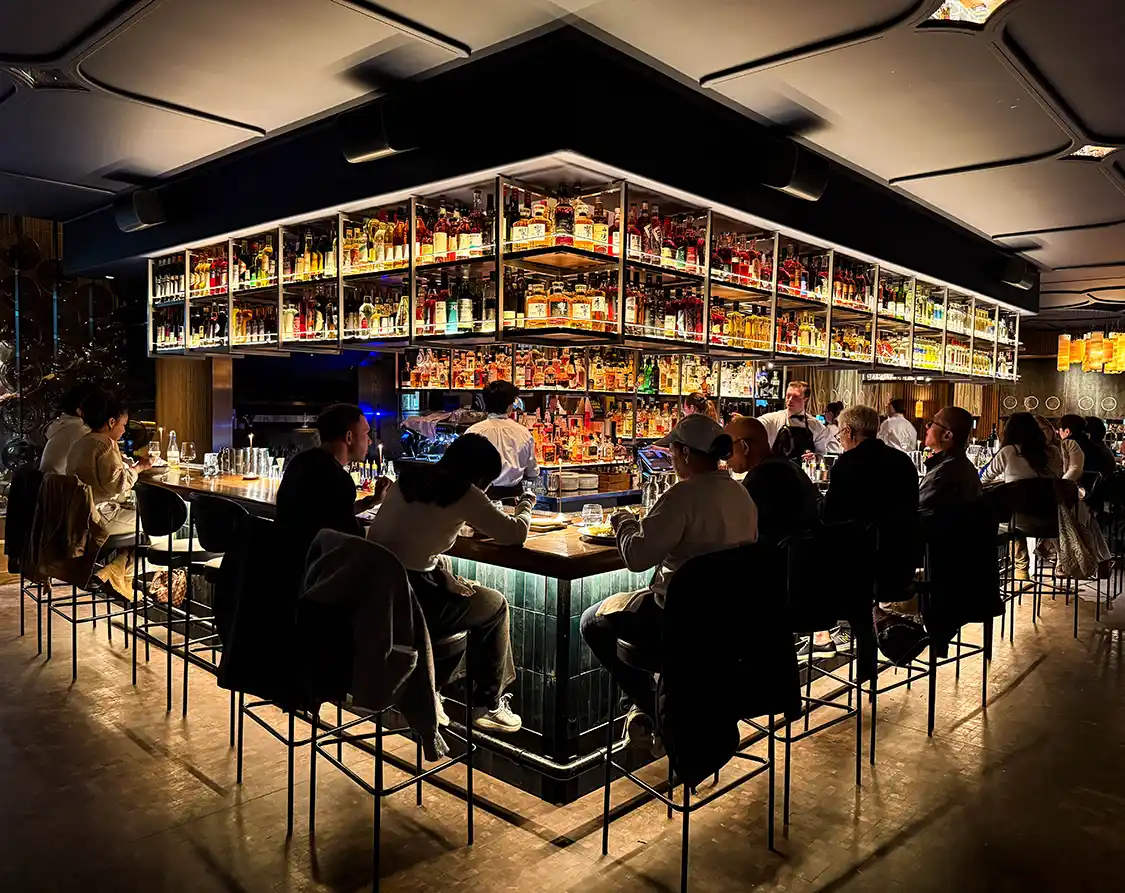
Dinner was at Wild Blue, which has since landed on Canada’s 100 Best Restaurants and the Top 10 Best New. Pacific Northwest, sustainable seafood, a raw bar, and a square bar in the middle of the room under a lit wall of bottles that is a genuinely beautiful piece of design. A tower of shellfish came out on ice: mussels, clams, shrimp, and crudo, and we worked through it slowly. It’s the most serious food in the village, and it does not feel stuffy. The staff was fabulous, and the atmosphere is a classy mix of modern and elegant.
Day three: The mountain and the bear
This was the morning I rode up Blackcomb and found the PEAK 2 PEAK station closed and silent, which is where this whole article began. It was also the morning I saw the bear.
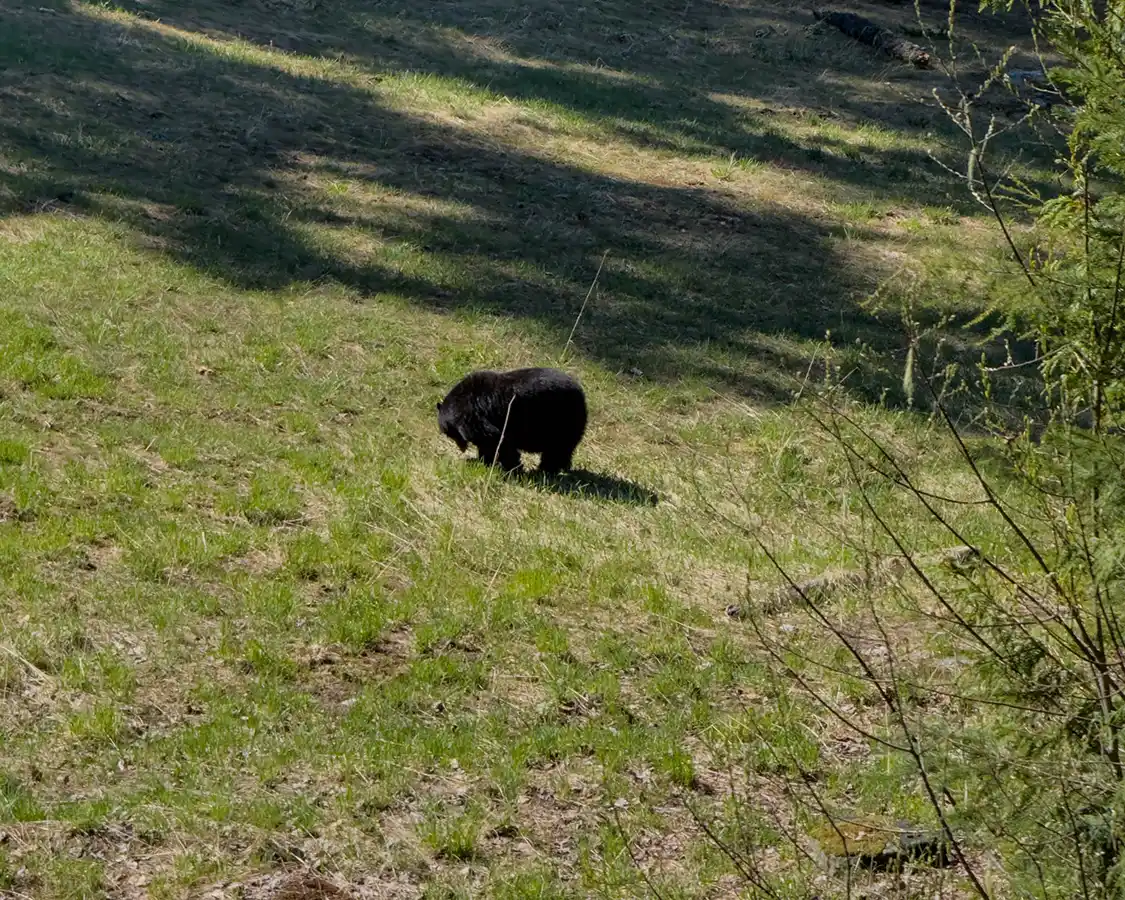
Halfway up, on a snowy run that had melted out to green grass at the bottom, a black bear was grazing on fresh greens with its head down, completely unbothered by the crowds of hikers and skiers wandering a few dozen meters away. Bears in Whistler come out of their dens around mid-April and go straight for the fresh growth under the lift lines and the skunk cabbage near the Whistler golf resort. There are more than fifty black bears in this valley alone. The official bear viewing tours did not start until May 15 that year, but ask around, and the locals will point you toward the best places to see them. I only saw one, but was lucky enough to see many on a Wildlife road trip through the Canadian Rockies a few weeks later.
The afternoon was spent at the Squamish Lil’wat Cultural Centre, and if you take one recommendation out of this article, make sure to dedicate at least an hour to this small museum.
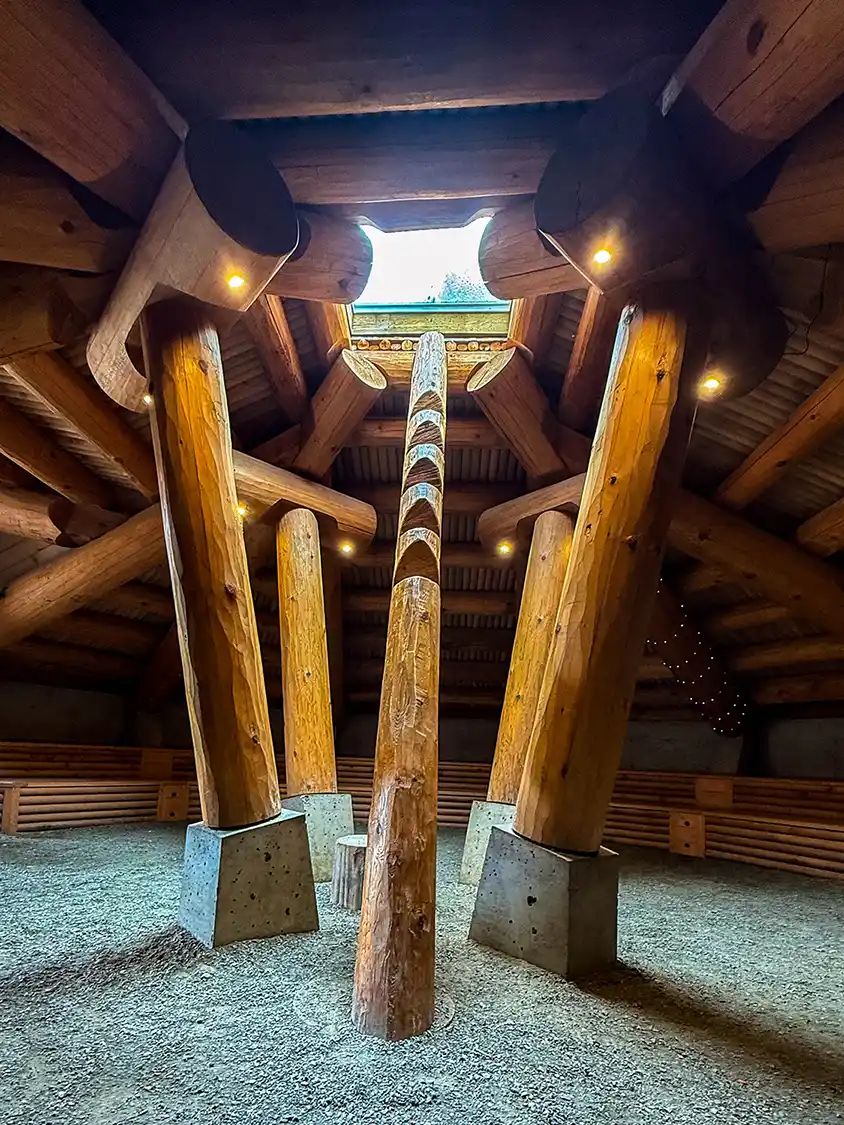
The Lil’wat Cultural Centre is the first center of its kind in Canada: two nations, the Sḵwx̱wú7mesh Úxwumixw (Squamish, Coast Salish) and the Lil̓wat7úl (Lil’wat, Interior Salish), sharing one building on shared territory. The architecture represents both nations: a Squamish longhouse form in the great hall and a Lil’wat Istken, an earthen pit dwelling, built out back. I stood inside the Istken under a cone of enormous cedar posts with a square of daylight at the apex and gravel underfoot, and it was the quietest room I entered all week, even during shoulder season.
The great hall is full of light and canoes and carved poles, and the hourly tour, called What We Treasure, is part of the Canadian Signature Experiences program. It opens with a hand drum welcome song, runs a fifteen-minute film, and then a Cultural Ambassador from one of the two Nations walks you through the exhibits. That last part is why you go. You are hearing the place described by people whose families are from it.
Lunch beforehand at the Thunderbird Cafe, the on-site restaurant: Squamish salmon chowder, Lil’wat venison chili with bannock, a hoagie built from bison salami, arctic muskox, and wild boar prosciutto. It is not a typical gift shop café.
We finished the day with a sound bathing experience in the hotel’s yoga studio, which is not something I would have booked for myself. For those who are looking for a unique wellness experience, it may be worth your time. For me, it was a good chance to have an unintended nap while being lulled in zzz’s by the humming sound emanating from crystal bowls.
Things To Do In Whistler In Spring
I’ve split this guide to help those who visit Whistler at the beginning of Spring and those who are visiting near the end. Because what you can do depends a lot on the lifts. The first group runs no matter what the mountain is doing. The second group is based on what’s open when you arrive. The third group is what you’re giving up by visiting in the shoulder season, and you should know what it is before you book.
Spring Activities in Whistler That Are Open All Season
Squamish Lil’wat Cultural Centre
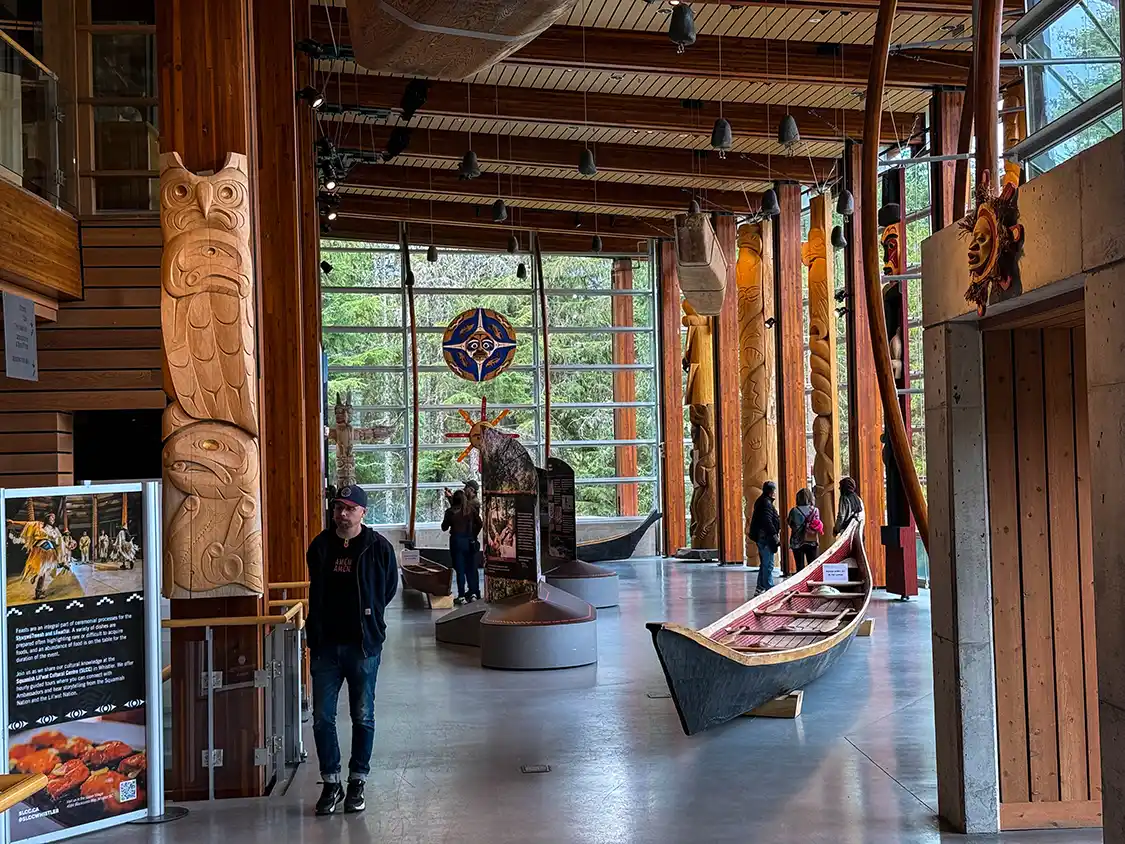
The strongest indoor hour in Whistler and the most reliable thing on this list. Hourly What We Treasure tours between 10am and 4pm, open Tuesday through Sunday, 10am to 5pm. Whistler’s largest First Nations gift shop and the Thunderbird Café are both on site. It is a ten-minute walk from the village up Blackcomb Way, next door to the Audain.
Four of the five most-read Whistler summer guides do not mention this place at all. That is a strange thing to be true, and it is true.
Audain Art Museum
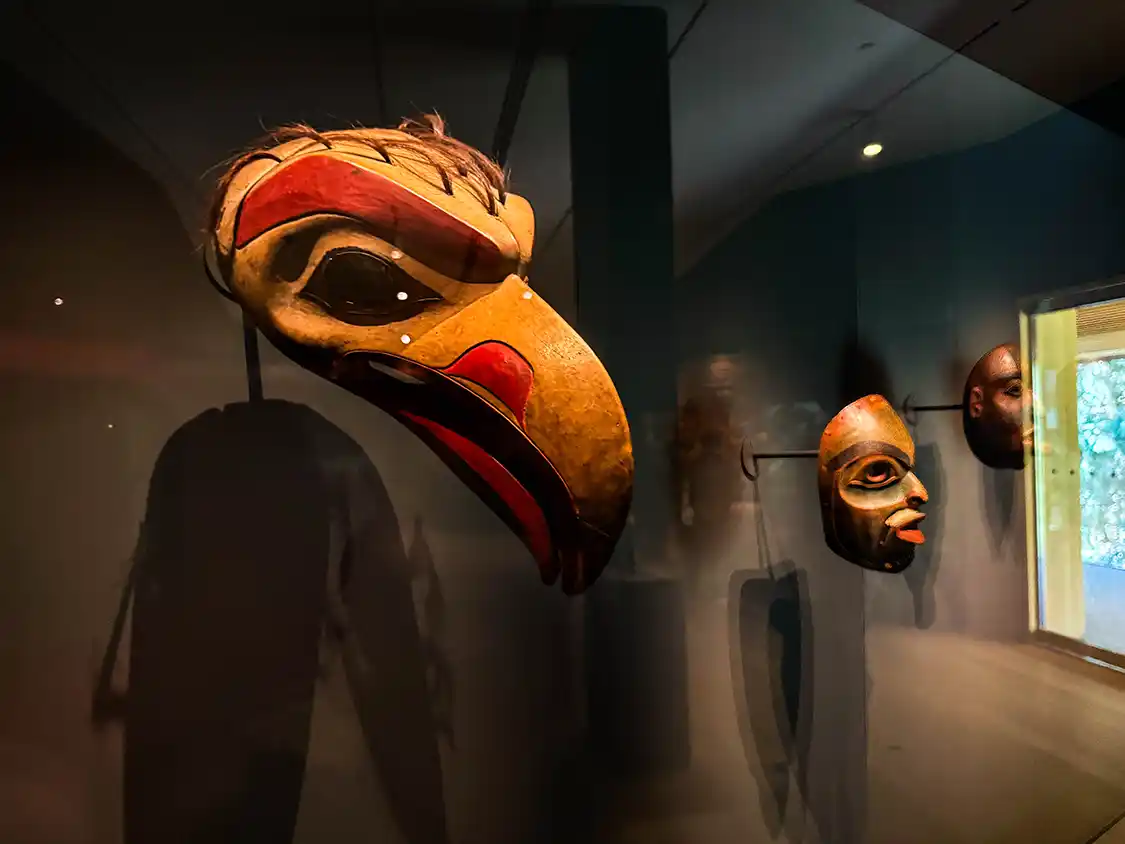
Also on Blackcomb Way, also indoors, also excellent. The permanent collection runs from historic Northwest Coast masks through Emily Carr and E.J. Hughes to Jeff Wall, Stan Douglas, Rodney Graham, Robert Davidson, Brian Jungen, and Xwalacktun Harry, with changing temporary exhibitions on top. Budget 90 minutes. Pair it with the Cultural Centre and you have a full and genuinely good day that involves no chairlift whatsoever.
Whistler Train Wreck
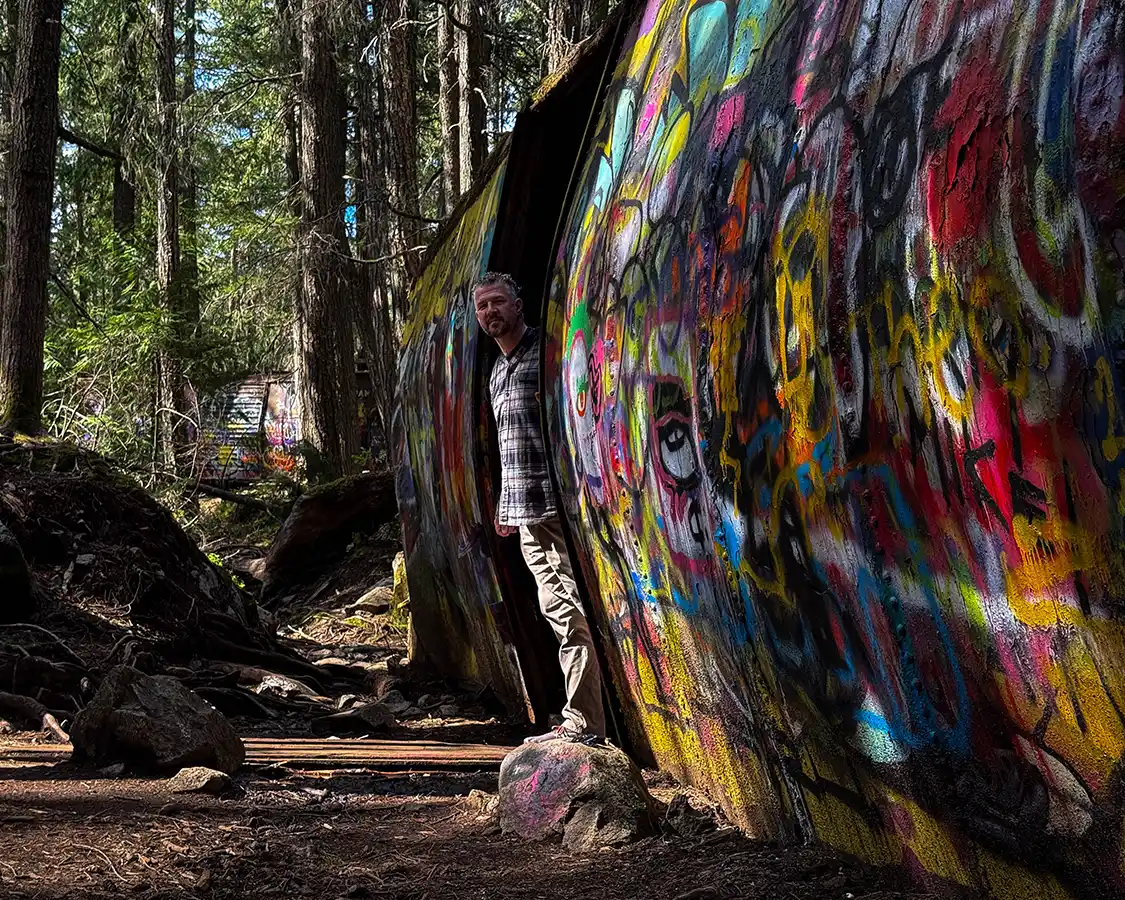
2.6 kilometers of easy gravel, a suspension bridge over the Cheakamus, and seven graffiti-covered boxcars from a 1956 derailment sitting in the forest. All seasons, all weather, free.
To get there, turn south off Highway 99 onto Cheakamus Lake Road, follow it to Legacy Way, then right onto Janes Lake Road. The main parking area is on the right. It is a short drive from the village and not walkable from it. Go early. Even in spring, it gathers people by mid-morning, and in summer the lot fills. The site sits on shared unceded Lil̓wat7úl and Sḵwx̱wú7mesh territory.
Vallea Lumina
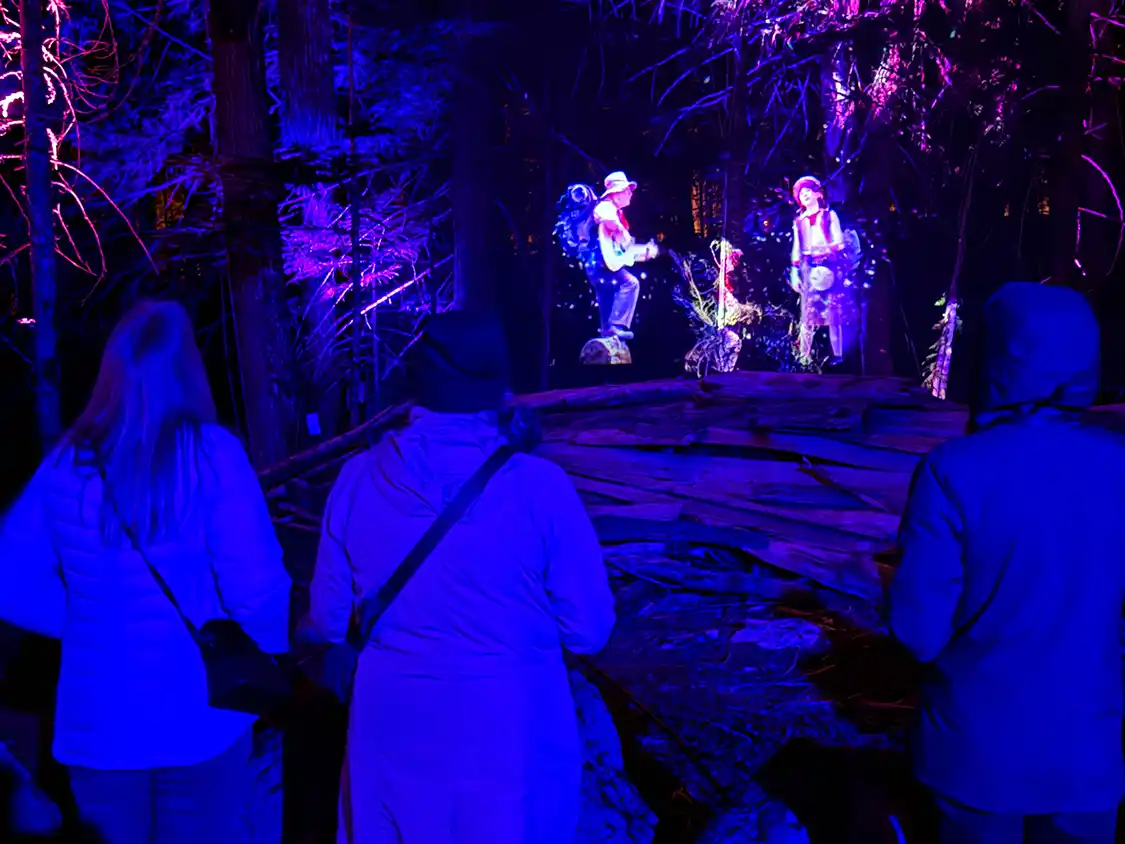
The night walk on Cougar Mountain, and my pick for the single best booking of a spring trip. 1.5 kilometers, 50 to 80 minutes walking, two hours all in, including the shuttle from the Gateway Bus Loop in the village. Runs rain or shine.
Access note that matters and that the brochures bury: the trail has several steep staircases going both up and down, and it is not recommended for people with reduced mobility. Strollers are not permitted at all, including off-road models, so bring a baby carrier if you have a small child. Umbrellas are not allowed either, so bring a rain jacket instead.
Scandinave Spa
The outdoor Nordic baths are in the forest north of the village, open daily 9am to 10pm, year-round. The Thermal Journey cycles hot, cold, and rest, and they suggest three or four rounds of about forty-five minutes each. Silence is the rule across the whole site, and phones go in a locker on arrival.
I did not get here, and it is the thing I most regret missing. In shoulder season it is close to the perfect activity: outdoors, weather-proof in the sense that sitting in a hot pool in the rain is a feature, and entirely independent of the lifts. There is a minimum age, so check before you plan a family day around it.
The Cultural Connector
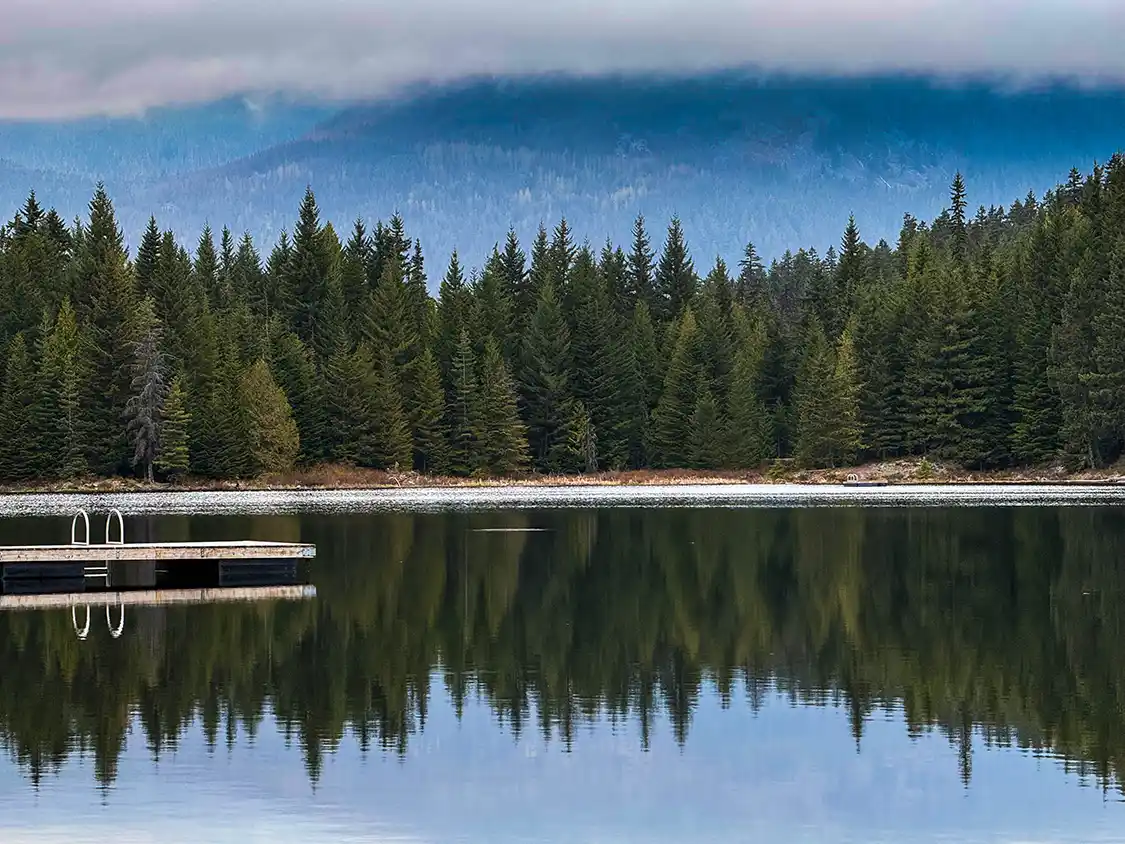
A marked walking and cycling route through the village linking six cultural institutions: the Audain, the Squamish Lil’wat Cultural Centre, the Lost Lake PassivHaus, the Maury Young Arts Centre, the Whistler Public Library, and the Whistler Museum. It is free, and it is a genuinely good way to spend a gray afternoon.
Two of those are better than they sound. The Lost Lake PassivHaus was Team Austria’s base during the 2010 Olympics, donated to the community afterward, and now runs as a four-season day lodge with a café. The Whistler Museum takes entry by donation, lets you photograph a real Olympic torch, and keeps a natural history display about the valley’s black bears, which pairs nicely with having just seen one.
Tourism Whistler also runs free self-guided audio tours through an app called Go Whistler Tours, including one on the art and storytelling of the Sḵwx̱wú7mesh and Lil̓wat7úl that visits nine culturally significant sites around the village, plus craft beer and dessert routes. Free, and a good rainy-afternoon structure. Details here.
The Valley Trail and the lakes
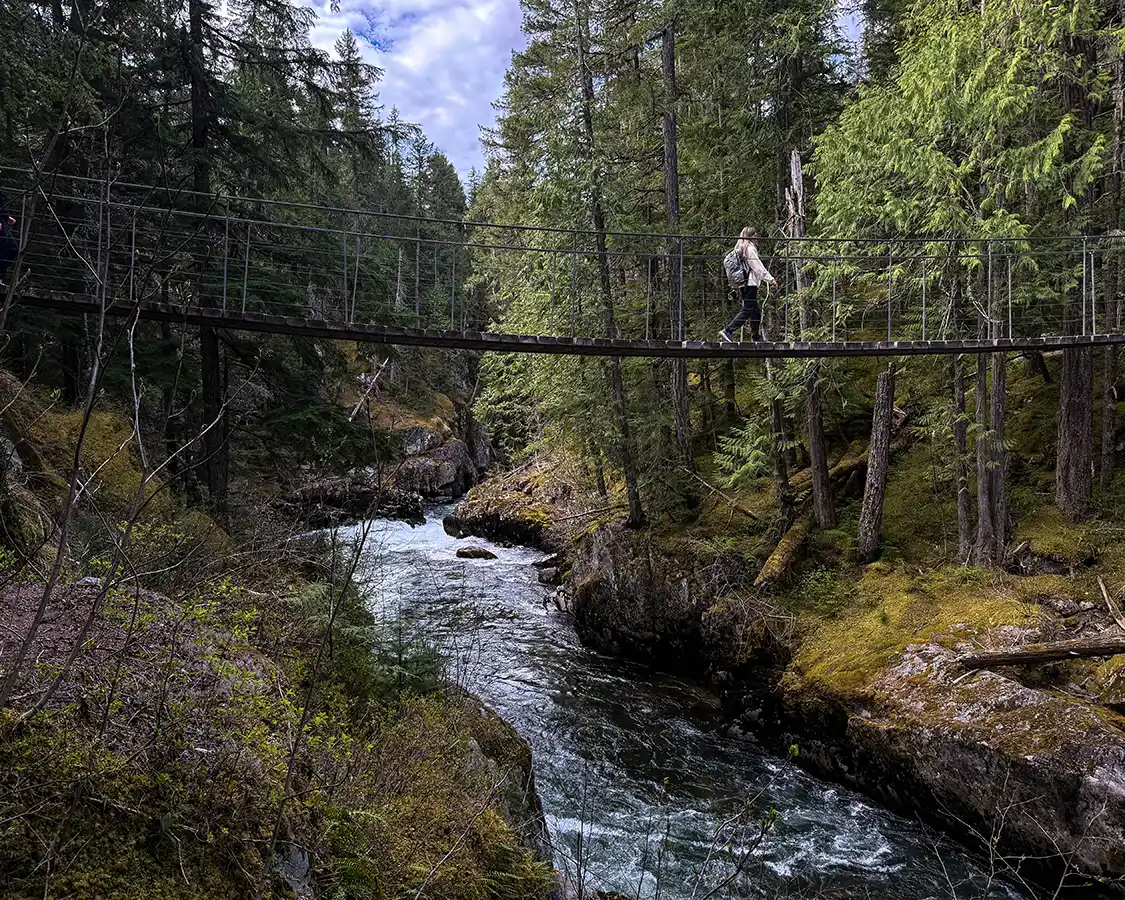
Over 40 kilometers of paved, mostly flat trail connecting the village to Lost Lake, Alta Lake, Green Lake, Rainbow Park, and Alpha Lake. In the spring, it is clear of snow long before anything in the alpine is, and it is the best way to see the valley without a lift ticket. Rent a bike in the village or walk a section of it. The swimming is best in July unless you know you can handle the cold. The walking is excellent in May.
Brandywine Falls
A 70-meter waterfall about fifteen minutes south of the village off Highway 99, reached by a flat walk of under ten minutes from the parking lot to the viewing platform. It is free, it takes almost no time, and in spring it is running hard with snowmelt, which is the best you will ever see it. If you are driving up from Vancouver, stop on the way in.
Whistler Village itself
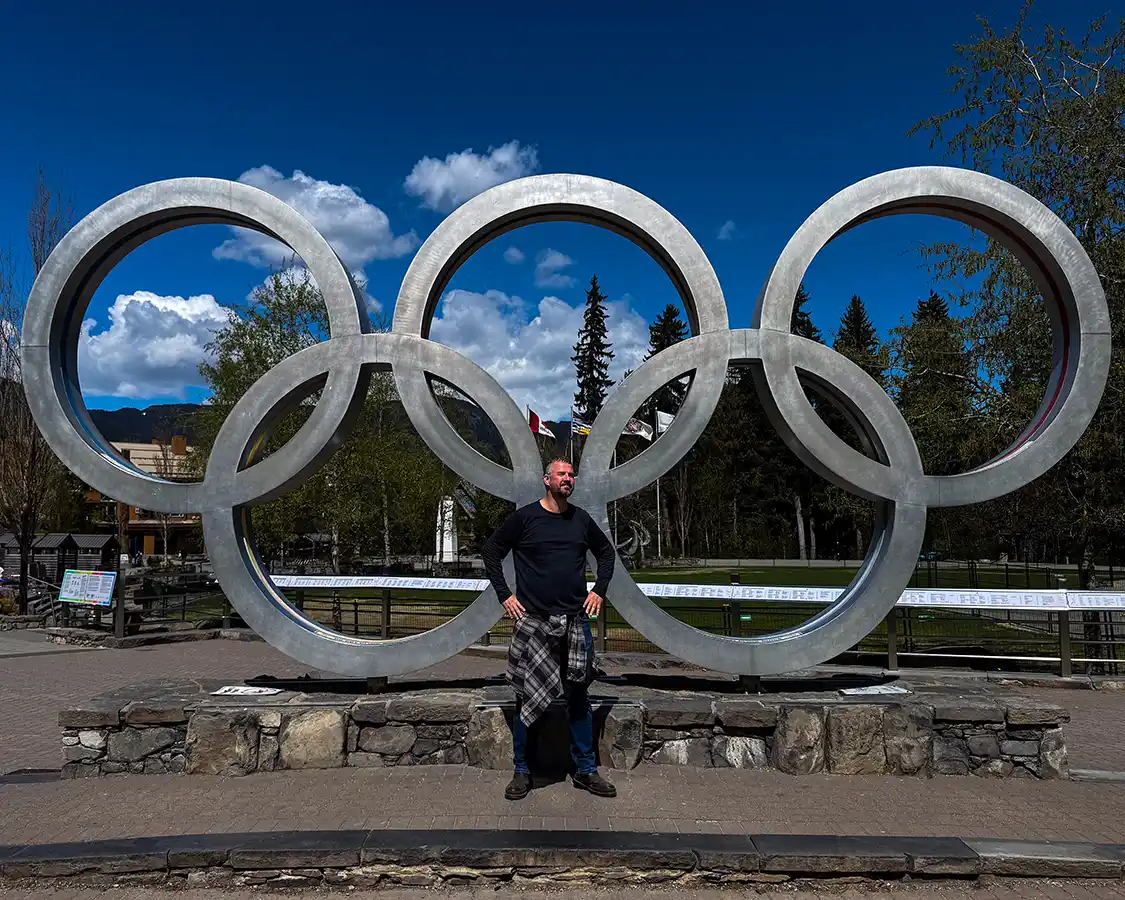
More than 200 shops, eight-plus galleries, the Olympic Plaza with the rings that everybody photographs, and a pedestrian stroll you can walk end to end. In the spring, you can get a table without much effort. That is not a small thing in this village.
Whistler Experiences That May Be Open Depending On The Date
Sightseeing gondolas
Covered in detail above, and the short version is: nothing reliable before mid-May, PEAK 2 PEAK on weekends only from mid-May to mid-June, everything daily from roughly June 13. If a gondola ride is the centerpiece of your trip, build the trip around the date rather than the other way round.
Whistler Mountain Bike Park
The Fitzsimmons Zone opens first, around May 15. Garbanzo follows in mid-June, the Creek Zone around June 20, and the Peak Zone later still. So there is downhill riding available from mid-May, but only a fraction of the mountain. Check which zones are running before you haul a bike up the highway.
Bear viewing tours
Guided tours start around May 15, once the bears are reliably out and the terrain is drivable. Before that, you are relying on luck from a gondola or a roadside, which does happen, as I found out.
Whichever way you see one: do not approach it, do not stop on the highway to photograph it, and keep dogs leashed. Over fifty bears share this valley with the town, and the ones that get habituated to people are the ones that end up dead.
Alpine hiking
The high trails need the lifts, and they need the snow gone, which means late June at the earliest for most of them and July for the high routes. In May and early June, the alpine is still winter up there regardless of what the village feels like.
What Won’t Be Open During Spring in Whistler
Every shoulder season visit to Whistler is going to come with a bit of sacrifice. Here are the top things to do in Whistler that likely won’t be open if you visit during the spring.
- The Cloudraker Skybridge, Raven’s Eye, and the Whistler Peak Inukshuk. All of these activities need the Peak Express, which usually carries a mid-June start date.
- High alpine hiking. The High Note, Harmony Lake, the Blackcomb alpine loops. These experiences are still snowbound in the spring, so they’ll be inaccessible until the summer melt.
- Joffre Lakes. The popular day trip north, and in spring it is still under snow and ice and carries a dangerous approach during the spring. It is a July and August destination.
- Lake swimming. The water is snowmelt. It’s cold. Go for it if that’s your thing.
- The full bike park. A fraction of the terrain is open before mid-June; the rest is waiting for snow to melt and mud to dry.
- Patio season in Whistler runs all year. Just dress for the weather and be prepared for chilly nights.
While some Whistler experiences are closed in the spring, there’s a big benefit to visiting during the shoulder season as well. A hotel room in one of Canada’s most expensive vacation destinations is a fraction of the July rate. You can also get a hiking trail to yourself, a restaurant that can seat you with no reservation, and a chance to see a bear on an empty ski run.
Where To Eat In Whistler
The spring season’s advantage is that you can walk into restaurants that need a reservation three weeks out in August. The disadvantage is that some kitchens take their own off-season, so check before you build an evening around one dining experience.
Wild Blue Restaurant + Bar
4005 Whistler Way, across from the Conference Centre
This was the best meal I had in Whistler and the most serious restaurant in the village. Pacific Northwest cooking with sustainable seafood, a raw bar, an open kitchen, and a large lounge and cocktail bar that is worth sitting at even if you are not eating. The team behind it is stacked: Restaurant Director Neil Henderson, Chef Alex Chen, who won Iron Chef and Vancouver Magazine’s Chef of the Year, and Jack Evrensel of Toptable Group. It has since been named to Canada’s 100 Best Restaurants and their Top 10 Best New Restaurants. My advice is to get the seafood tower.
Hunter Gather
101-4368 Main Street.
Hunter Gather is the unfussy counterweight to Wild Blue. Local food, Coast Mountain Brewing on tap, Okanagan wine, and a room that feels like a place locals actually eat rather than a themed mountain restaurant. This is a great place for lunch after a trail hike.
Thunderbird Café at the Squamish Lil’wat Cultural Centre
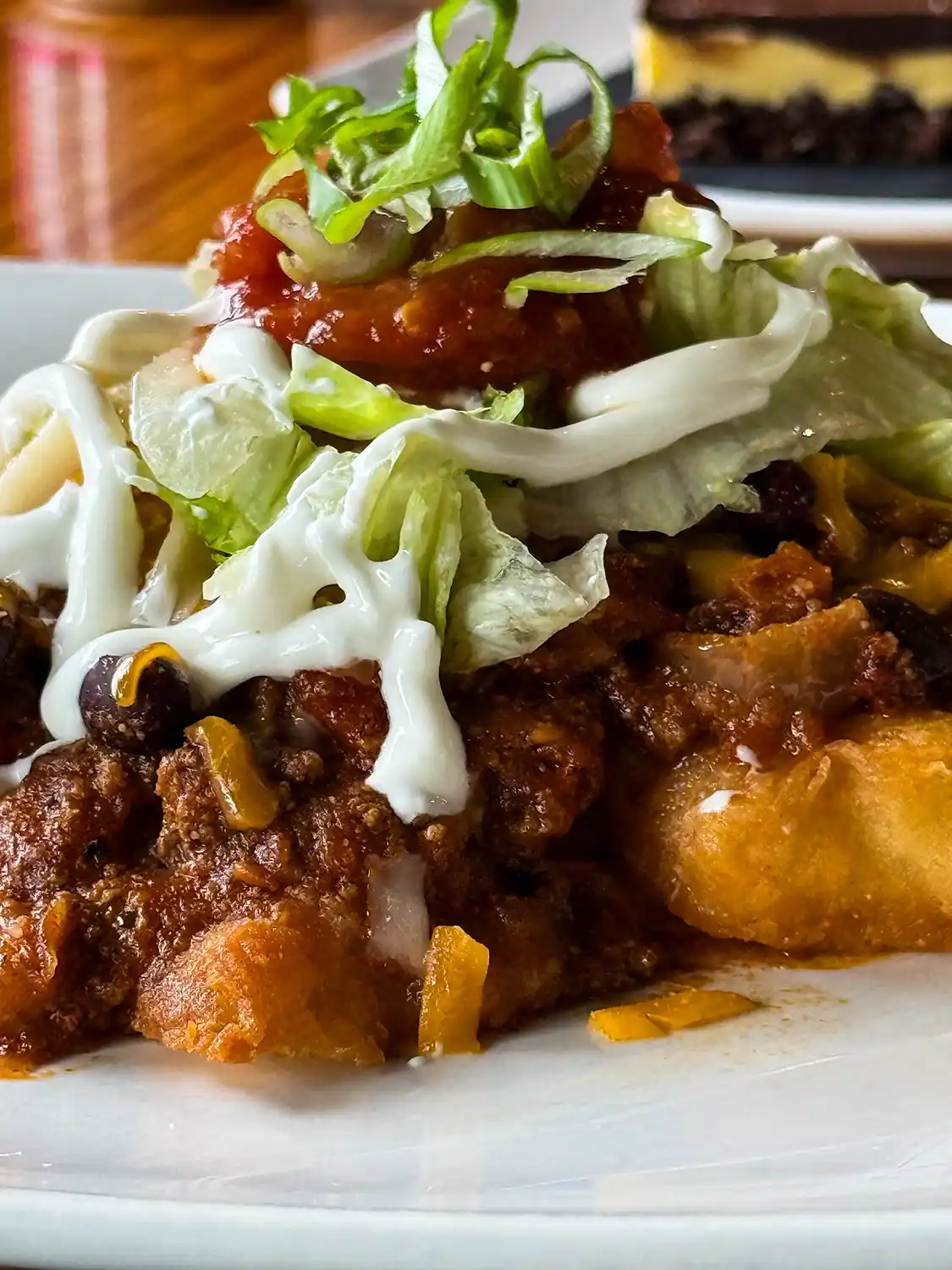
Indigenous-inspired cooking and the most interesting lunch in Whistler. Squamish salmon chowder, Lil’wat venison chili served with bannock, and a hoagie layered with bison salami, arctic muskox, and wild boar prosciutto. Maple sugar pie after. You do not need a museum ticket to eat here, though you should buy one anyway.
Restaurants At the Fairmont Chateau Whistler
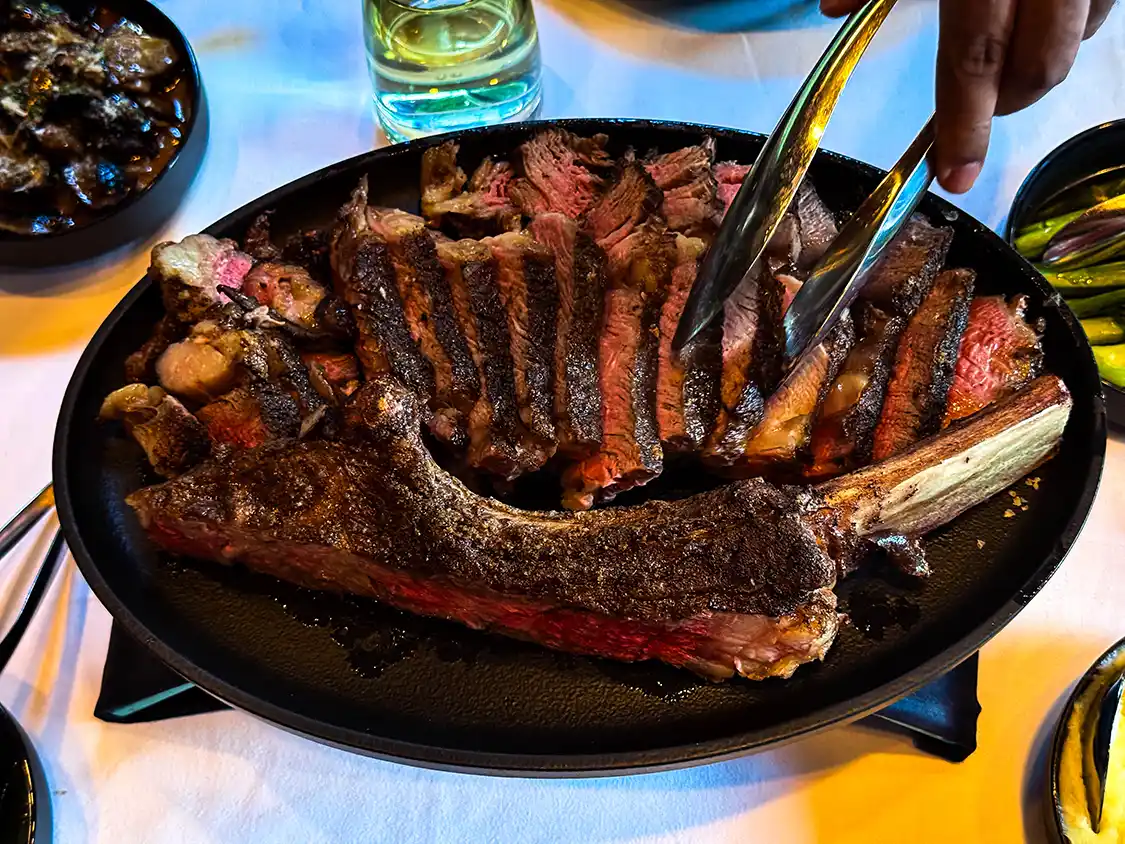
The Fairmont Chateau Whistler has three restaurants with very unique experiences. The Wildflower does the breakfast buffet and turns into a proper dining room at night, with a wine list that has won a Wine Spectator Award of Excellence. The Grill Room is the steak and seafood room with a stone fireplace and cherry wood veneer, Canadian AAA beef, and Ocean Wise seafood. Portobello on the lower lobby level is the casual one, open 6:30 am to 8:30 pm, and it is where you grab coffee, a pastry, or a sandwich without a reservation. All three are open to non-guests.
The Whistler restaurants I did not get to
Whistler’s dining scene is deeper than four days allows. Araxi, Bar Oso, Alta Bistro, and Rimrock Cafe come up repeatedly from people who know the village, and Whistler Brewing Co. and Coast Mountain Brewing cover the beer. One widely repeated warning worth passing on: a number of Whistler restaurants close Mondays and Tuesdays in the quiet months, so in spring, check the day before you set your heart on a room.
Where To Stay In Whistler
Fairmont Chateau Whistler
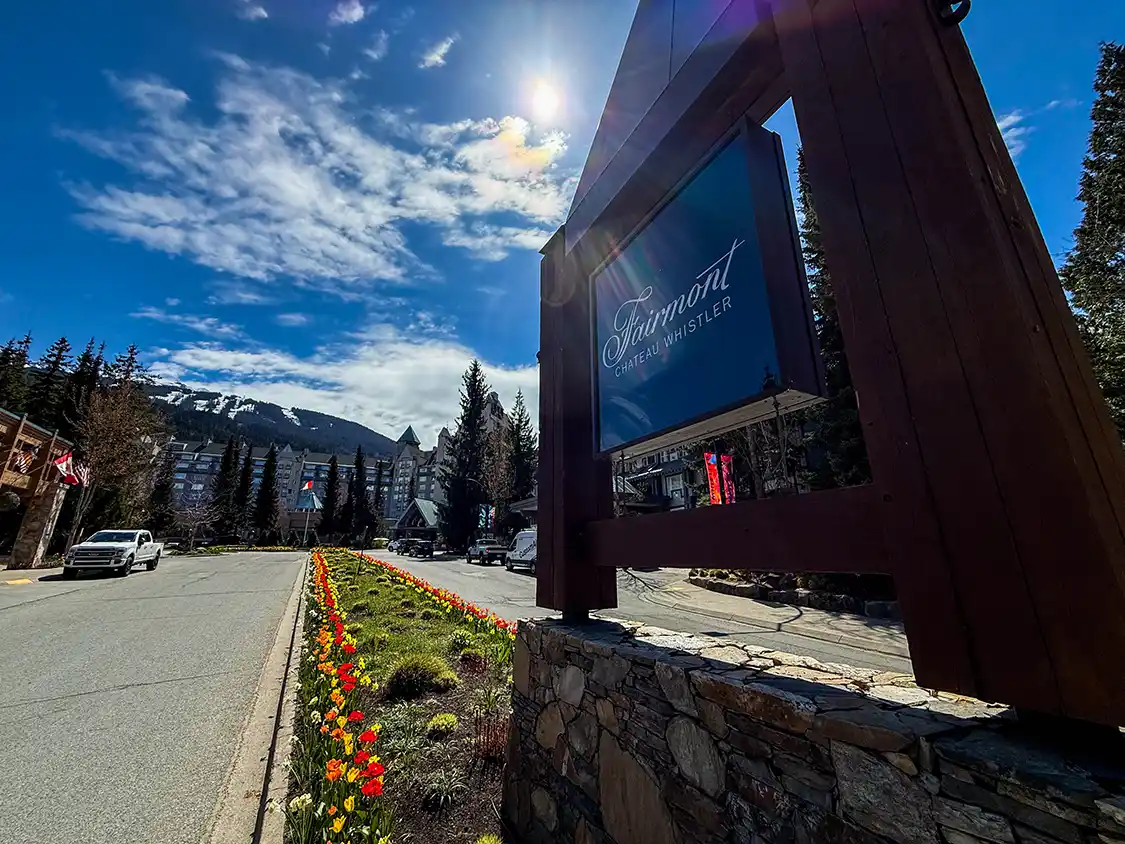
This is where I stayed while in Whistler. This iconic hotel sits at the base of Blackcomb in the Upper Village, and in spring it makes more sense than it does in winter because you are paying shoulder rates for a luxury hotel that offers more amenities than anywhere else in the village. The health club has a 60-foot heated outdoor lap pool with underwater music, an indoor-outdoor leisure pool, indoor and outdoor hot tubs, a dry sauna, and two eucalyptus steam rooms. Yoga classes are complimentary and daily. Check the current rates and availability here.
The thing that genuinely distinguishes it is the Whistler Experience Guide program, included in the resort fee. Staff guides run roughly three outings a day, confirmed 48 to 72 hours ahead, suitable for all levels, and in shoulder season when the mountain is shut, that is an unusually good deal. Ours took us to Train Wreck and ran the sound bath. Pre-registration is required, so sort it when you check in rather than the morning of the experience.
Two seasonal catches at the Fairmont. The pool deck loungers, umbrellas, and cabana rentals only run May through September, and the two winter barrel saunas and the wood fire pit only run October through April. So late April gets you the barrel saunas but not the pool deck, and late May is the reverse.
Other village options
The village is dense with hotels, and spring is when they are affordable. The Westin Resort & Spa is a reliable full-service pick, the Four Seasons Resort Whistler is the highest-rated hotel and resort in Whistler on Booking, and Pangea Pod Hotel is the budget option that offers an interesting rather than merely cheap stay.
One practical note for a spring trip: stay in the village or the Upper Village if you can. With the lifts largely down, the thing you are walking to is the village itself, and a property out along the highway turns every meal into a drive.
Frequently Asked Questions About Spring In Whistler, British Columbia
Partly, and only in the back half of the month. In 2026, the PEAK 2 PEAK closed with Whistler Mountain on April 19 and did not run again until May 16; from then until June 12, it operated on weekends and the Victoria Day holiday only. Daily operation resumed June 13. If you are visiting midweek in May, assume it is not running and confirm with the resort.
Summer alpine operations started on May 16 in both 2025 and 2026, but that is a partial opening on the Whistler Village Gondola. Full daily summer operations across all the lifts began June 13 in 2026. The practical answer for most visitors is mid-June.
Sometimes, on one mountain. Whistler and Blackcomb alternate which one stays open late in spring. In 2026, Blackcomb carried the season to May 18, while Whistler Mountain closed on April 19. In 2025, Blackcomb ran to May 19. Check which mountain is open before you plan it, because it changes.
More than you would think. The Squamish Lil’wat Cultural Centre and the Audain Art Museum are both excellent and both indoors. Train Wreck, Brandywine Falls, and the Valley Trail are all open and snow-free in the valley. Vallea Lumina runs at night, rain or shine. Scandinave Spa is open year-round. The village itself is walkable and uncrowded.
Yes, if you go in with the right expectations. You are trading the alpine for lower prices, empty trails, available restaurant tables, and a real chance of seeing bears that have just come out of their dens. If you specifically want the Cloudraker Skybridge and the high hiking, you want mid-June onward, and you should wait.
Around mid-April. They head for the new grass growing under the lift lines, which is why they are so often spotted from the gondolas in spring. There are more than fifty black bears in the Whistler Valley. Guided bear viewing tours generally start in mid-May.
About two hours north on Highway 99, the Sea to Sky Highway, traffic depending. It is one of the great drives in Canada, and it is worth leaving time for the pullouts, particularly the Tantalus Lookout.
Not for the village, which is pedestrian and compact. You do for Train Wreck, Brandywine Falls, Scandinave Spa, and anything down the highway. There is no Uber in Whistler. Local transit covers the valley, and coach services run from Vancouver Airport.
Pack for two seasons. A waterproof shell, a warm mid-layer, and footwear you do not mind getting wet. The valley can be T-shirt weather while the mountain above it is still in full snow, and you may well experience both in an afternoon.
Is Spring A Good Time To Visit Whistler?
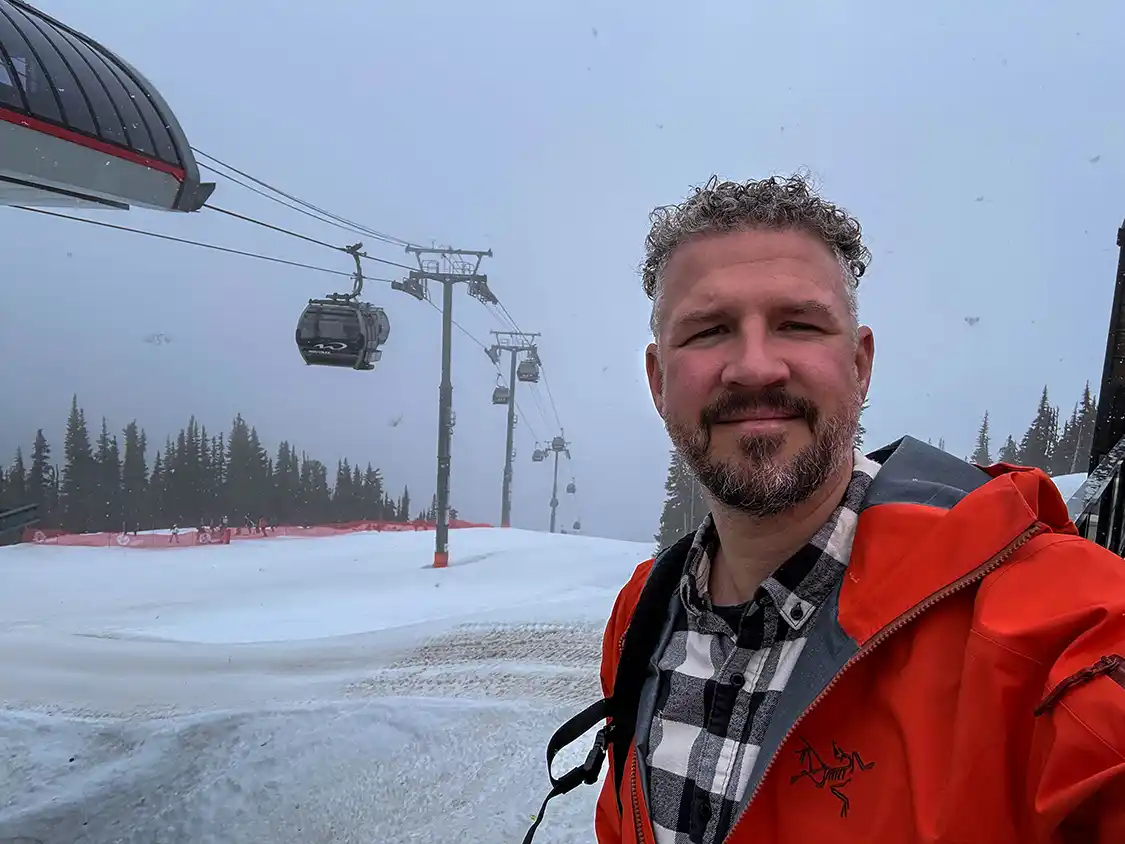
Whistler in spring is a resort with its guard down. The machinery that defines this place for most of the year- the lifts, the lines, the whole choreography of getting thousands of people up a mountain and back- is switched off and being serviced. What’s left is the valley, and the valley is quietly wonderful. A rainforest with a train wreck in it. Two of the best cultural institutions in British Columbia, side by side, ten minutes from a ski lift. A bear eating grass on a run steps from the crowds. I’ve written before about the Canadian destinations worth building a trip around, and Whistler earns its place on that list in a season nobody associates it with.
Go knowing what’s shut. Check the dates, because they move. Book Vallea Lumina and the Cultural Centre, walk Train Wreck early, and keep your eyes on the ski runs.
And then come back in July for everything you missed. I intend to.
You May Also Like To Read:
Disclosure: I visited Whistler as part of a hosted media trip organized by Tourism Whistler and Destination B.C. All opinions remain my own. This article may contain affiliate links: if you book accommodation through one of them, Wandering Wagars may earn a small commission at no extra cost to you.