These tips for visiting the Great Pyramids of Giza with kids will help make your journey to the last remaining ancient wonder unforgettable, with everything you need to know about the new 2026 entrance system, ticket prices, and how to handle the vendors.
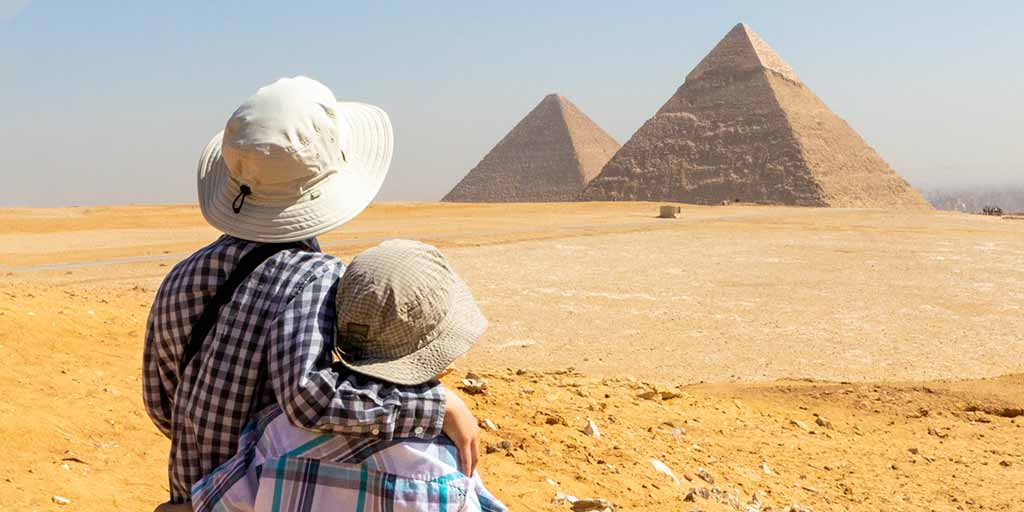
The realization that we were in one of the cradles of human culture hit us hard when we woke up to the view of the Great Pyramids outside of our hotel window. It was seeing images of the Pyramids of Giza with kids that inspired our children to choose Egypt as our spring travel destination. The boys, Dylan and Cohen, were fascinated by the stories of the pharaohs, along with the history and the mythology of the country.
Our Egypt itinerary started in Cairo and brought us to famous destinations such as Abu Simbel and Luxor, as well as to off-the-beaten-track places such as the Siwa Oasis. Our very first stop was in the capital of Cairo. The first thing we wanted to do was visit the Great Pyramids of Giza with the kids. And it was as awe-inspiring as we had hoped. We were jet-lagged and bleary-eyed, but we couldn’t wait to spend the morning exploring the Great Pyramid Complex in Giza, Egypt.
There were many tips for visiting the Great Pyramids of Giza that we read before we left. Stories from our friends from around the world ran the gamut from awe-inspiring messages to complex warnings about what you need to know about visiting the Great Pyramid with children. And I’ll be completely honest, the reality of the experience probably lies somewhere between all of them.
The Great Pyramids are majestic, and the history and architecture behind them alone are enough to make visiting them with kids a bucket list experience. But the site has also changed enormously in the last couple of years. A sweeping 2026 overhaul moved the main entrance, banned private cars from the plateau in favor of free electric shuttles, pushed ticketing online, and opened the colossal Grand Egyptian Museum next door, so a lot of the advice floating around online is now out of date.
This is our honest, boots-on-the-ground guide to visiting the Pyramids of Giza with children. I’ll lay out how to plan your visit, what’s new for 2026, how to keep your kids safe and happy around the site’s famously persistent vendors, which scams to watch for, and how to make the most of a day that should blow away your expectations. For the bigger picture of a family trip through the country, pair this with our complete Egypt travel guide.
Quick Planner: Visiting The Pyramids Of Giza With Kids
Getting in: The main entrance is now the visitor center on the Fayoum Highway, on the south side of the plateau. Buy tickets online in advance.
Getting around: Private cars are banned on the plateau. Free electric shuttle buses loop between the main viewpoints and pyramids.
General ticket (2026): Roughly 700 EGP for adults and 350 EGP for students, with young children free. Entering the Great Pyramid of Khufu costs extra (around 1,500 EGP).
Best time: October to April, on a weekday, arriving right at opening (7 am).
Where to stay: The Marriott Mena House for the once-in-a-lifetime view, or a budget guesthouse near the Sphinx gate.
Be careful: Beware of aggressive vendors and camel and horse touts, especially in how they approach kids. Learn to say “La, shukran.”
Don’t miss: The Grand Egyptian Museum next door, now home to Khufu’s restored solar boat.
What’s New At The Pyramids Of Giza
Table of Contents
If you visited the pyramids years ago, or read a guide written before 2025, the Pyramid site you’ll arrive at today looks and works differently than what you may have expected. The Egyptian government handed management of the plateau to a private operator and rolled out a long list of changes aimed at taming the chaos that the site was once known for. Here’s what you need to know before a family visit.
- The main entrance has moved. The primary entrance is now a modern visitor center on the Fayoum Highway, on the south side of the plateau. The old entrance up by the Marriott Mena House is no longer the main gate. The Sphinx gate near the village still exists, but it no longer has a staffed ticket office, so if you want to enter there, you’ll need to have booked online first.
- Private cars and tour buses are banned on the plateau. This is the single biggest change, and it’s a good one for families. Instead of dodging traffic and haggling with drivers, you park at the visitor center and hop on a free, air-conditioned electric shuttle bus that loops between the key stops (the panorama viewpoint, Khafre, Menkaure, and the Sphinx area). The buses run on a hop-on, hop-off basis and are included with your admission. For tired little legs, being able to ride between viewpoints rather than trudging miles across hot sand is a genuine gift.
- Tickets are now sold online. You can buy through the official ticketing portal and app before you arrive, and there are also machines and windows at the main visitor center. Booking ahead saves you from standing in line with restless kids, but be warned: the online portal can be glitchy, so save your confirmation and screenshot it in case the payment system hiccups.
- The Grand Egyptian Museum is open next door. After years of delays, the Grand Egyptian Museum (GEM) is now fully open, a short distance from the plateau and connected by a walkway. It houses the complete Tutankhamun collection and, of most interest here, Khufu’s restored solar boat, which has been moved from the plateau into the museum. Which brings us to the next point.
- The old Solar Boat Museum on the plateau has closed. The little museum that used to house Khufu’s boat right beside the Great Pyramid is gone. The boat now lives in the GEM, so if seeing it is on your list, budget time for the museum. It’s honestly one of the best things you can do with kids in Egypt right now, and it pairs beautifully with a morning at the pyramids.
- The vendor free-for-all has been reined in (mostly). Under the new operator, a lot of the hawkers and touts have been cleared off the plateau itself, and the remaining stalls are concentrated near the entrances and the Sphinx. It is calmer than it used to be. But calmer is not the same as gone, and the pressure your family will feel, especially aimed at your children, is still very real. That deserves its own section, so let’s talk about it properly. Something to note is that a lot of the hawkers have now moved just outside the entrance, so accessing the entrance can be more chaotic than it used to be.
How We Planned Our Visit To The Great Pyramids of Giza With Kids
Since we were coming off an epic flight from Toronto through Frankfurt, Germany, and into Cairo the day before, we knew our bodies would be a mess when we woke up to explore the pyramids. To give ourselves the best possible start, we booked a room at the beautiful Marriott Mena House. This is not a budget hotel; it’s one of the best hotels for families visiting the pyramids of Giza. The Mena House is the only hotel that sits within the Giza Pyramid Complex, and while you’re fighting a six-hour time change after 24 hours of transit on almost no sleep, eating breakfast with a view of the Great Pyramid is exactly what the doctor ordered.
It also helped that we were a short, five-minute drive door to door from the hotel to the complex, so we could have a relaxed breakfast and still be among the pyramids in no time, without wrestling with the city’s legendary traffic. (One 2026 note: with cars now banned on the plateau, everyone enters through the new Fayoum Highway visitor center and rides the shuttle in, so the Mena House’s old proximity advantage is smaller than it was, though waking up to that view is still worth every penny.)
What Was Visiting The Pyramid Complex With Kids Like?
Arriving at the Great Pyramids is a crash course in Egypt’s gloriously complicated ticketing. During our first visit, you paid at the gate, with separate adult and child prices and extra fees to bring in a camera or a tripod. We opted for the general area ticket and paid a little more for our camera gear.
As we walked in, we were hit at once with the dramatic sweep of the Great Pyramid of Khufu, and the sheer scale of the place landed. While Khufu gets all the attention, there are literally hundreds of pyramids, tombs, temples, and mastabas scattered across the complex. We had just one day, so we had to choose carefully.
The Great Pyramid of Khufu
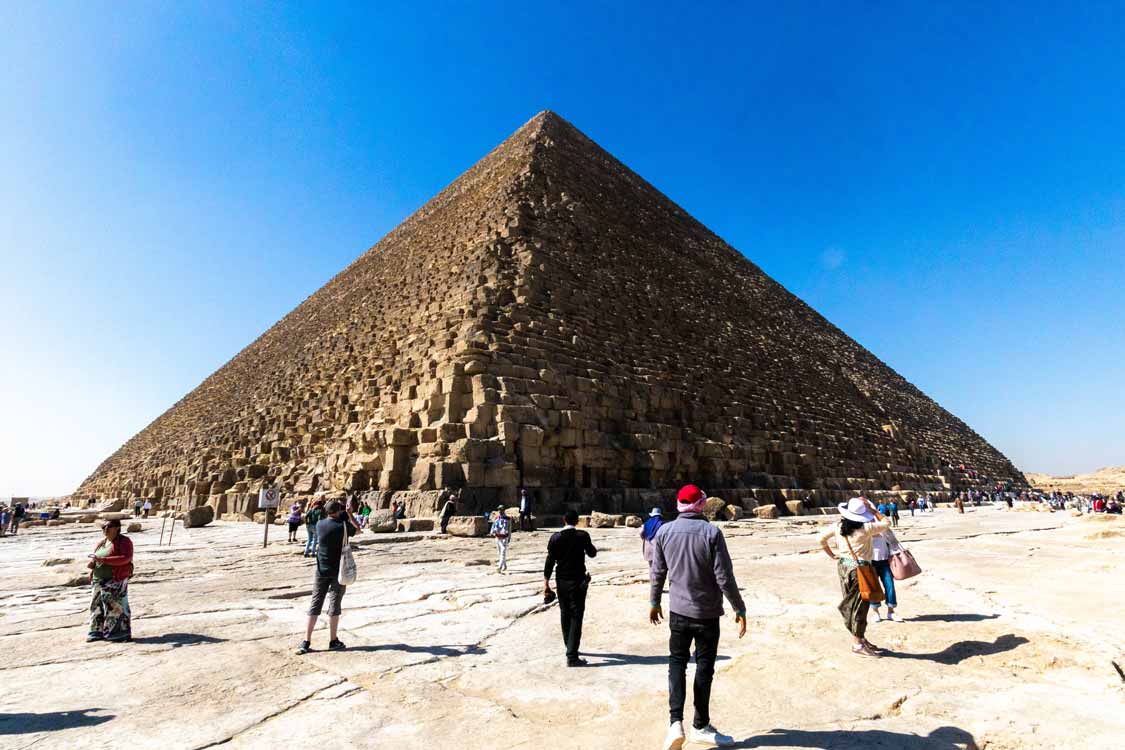
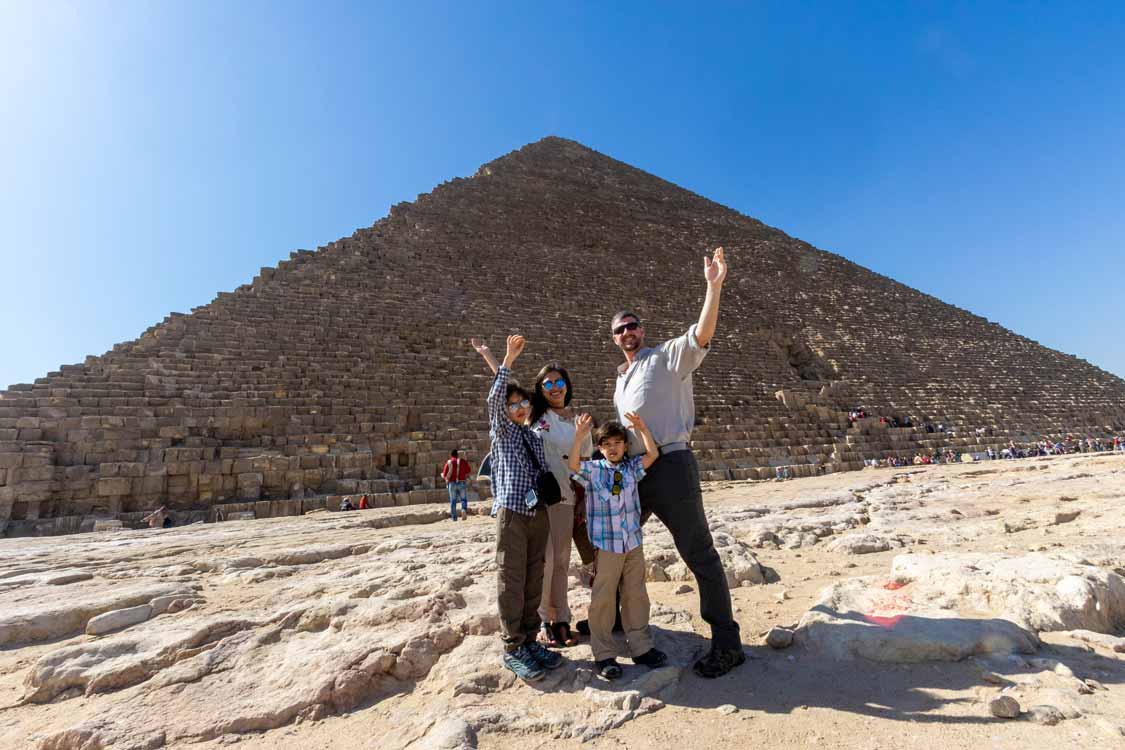
Our first glimpse of Egyptian history was an epic one. The 479-foot (146 m) Khufu Pyramid is the tallest and oldest in the complex, and we spent our first stretch dodging vendors as we craned our necks up at it. You can go inside Khufu (and the other pyramids) for an extra fee, but the interiors were stripped of their antiquities millennia ago, and there’s really nothing left in the cramped, airless hallways to see. If anyone in your group is claustrophobic, stay outside. The thrill is real, but if you only want to spend on one interior, I’d honestly save it for the Step Pyramid of Djoser at Saqqara.
The Giza Plateau
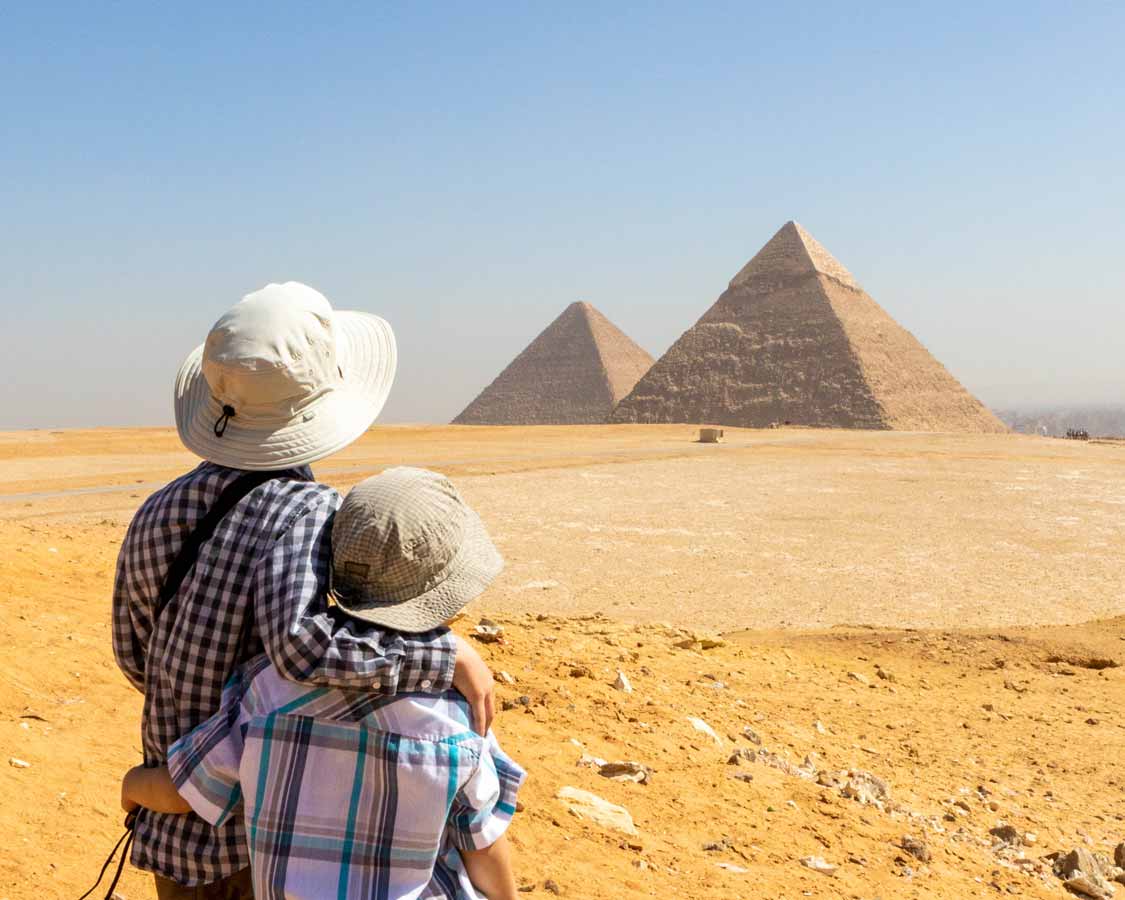
After Khufu, we joined our guide for the ride up to the Giza Plateau, and that’s when it clicked for me that the pyramids are best appreciated from a distance. The view across the open plateau pulled an audible reaction out of Cohen: “This is more like it.” Seeing the pyramids up close is awesome, but there’s something else entirely about taking them in across the empty desert, with nothing between you and the Great Pyramids but sand and a few camels.
The handful of little shops up here sold cheap souvenirs, scarves, and T-shirts, but unlike the lower complex, these vendors were much more hands-off, and they sat back from the viewpoint so nothing obstructed the moment. (This viewpoint is now one of the free shuttle stops, which makes it far easier to reach with kids than the old scramble.)
The Great Pyramid Camel Ride
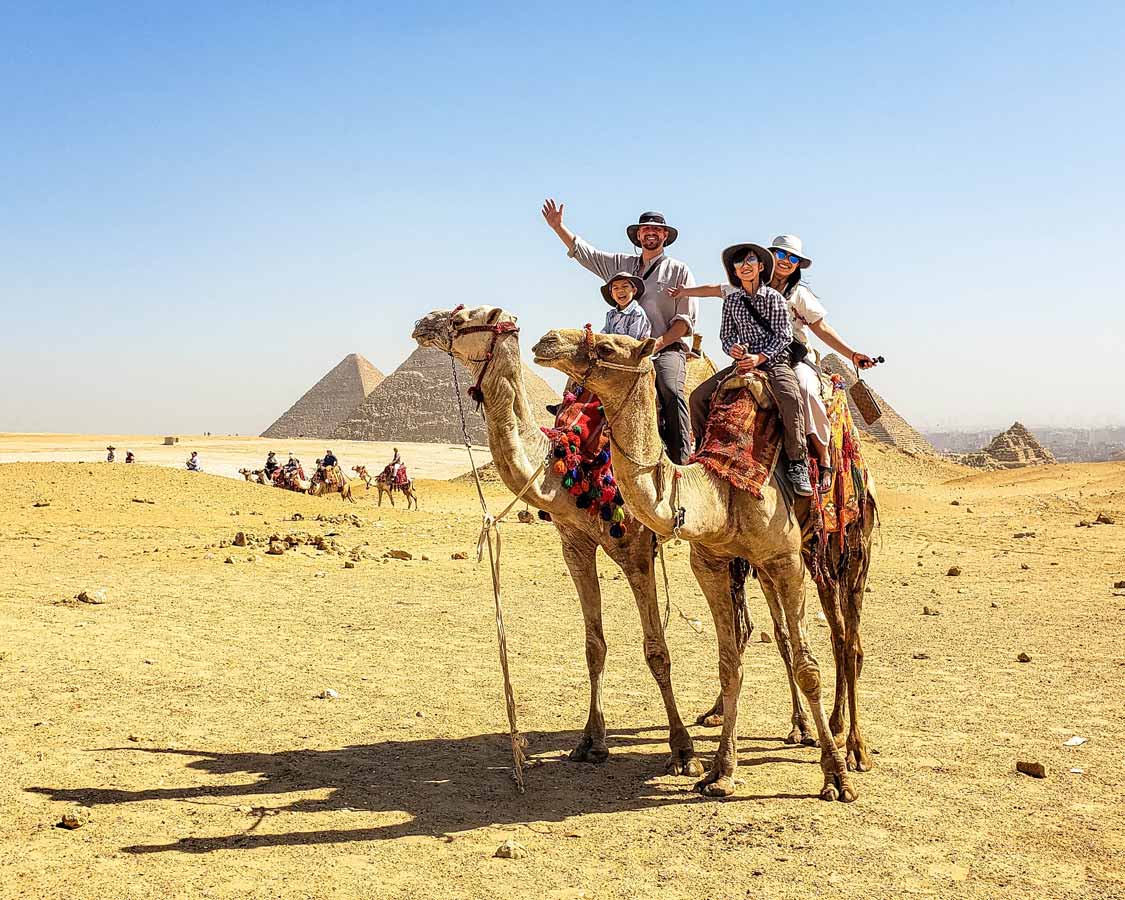
We knew nothing would top our two-hour camel ride through the Wadi Rum desert in Jordan, but we couldn’t resist a quick, silly photo op on some camels in front of the pyramids. We opted for a short 20-minute jaunt rather than a longer tour, since we still had a full day in Cairo ahead. Our Giza camel ride was a very different beast from Jordan’s. Instead of a quiet guide who wanted us to sit back and soak it in, we got an ambitious young man armed with every cheesy photo pose imaginable. I was hoping for gorgeous shots of the family with the pyramids behind us. What I got was… different. And honestly, as dorky as the pictures are, they sum up a lot of our goofy, happy time in Giza with the boys.
We paid about 10 US dollars (roughly 160 EGP) for the 20 minutes, tip included, after agreeing on the price up front. (See the scams section below, because pinning down that number before anyone climbs on a camel is important.)
The Solar Boat (Then And Now)
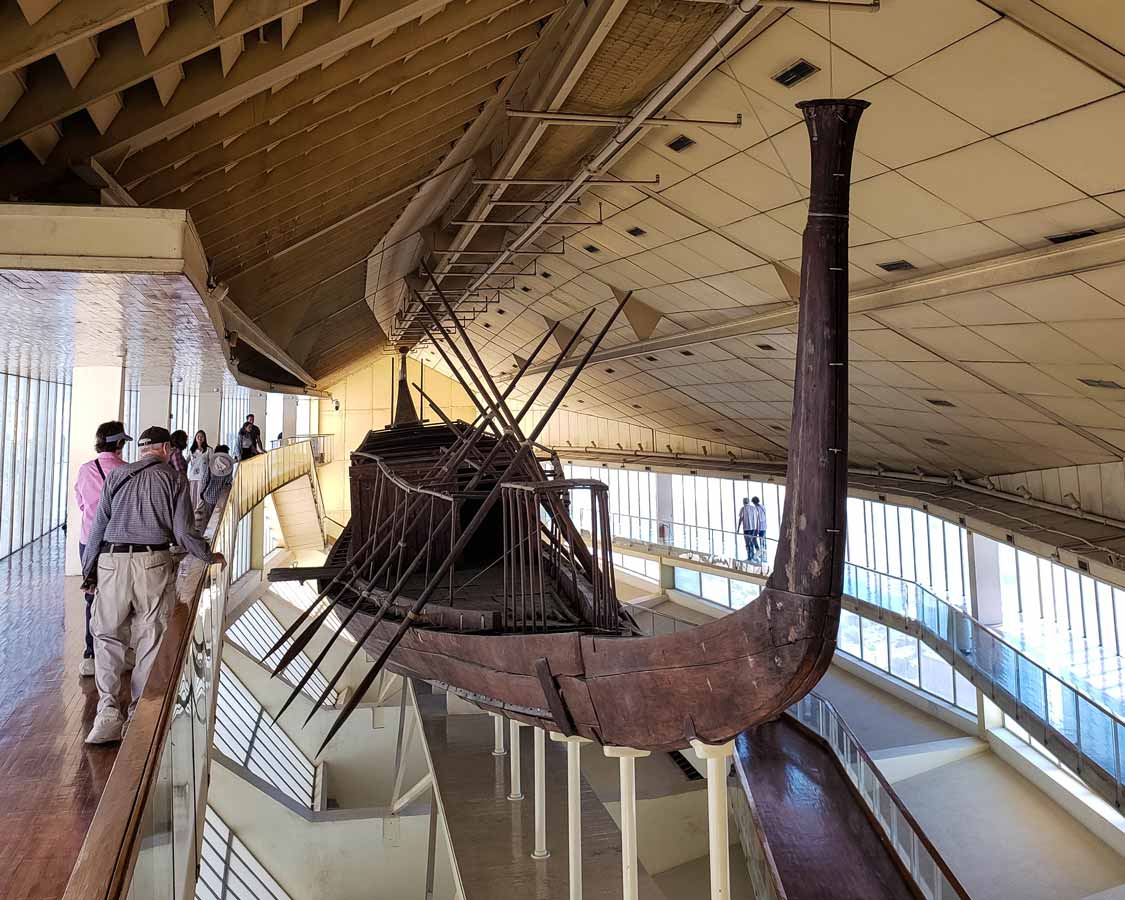
One of the most unexpected treats of our day was the old Solar Boat Museum, tucked right beside the Great Pyramid. Before visiting, I had no idea the pharaohs commissioned these enormous wooden boats to carry them into the afterlife, and Khufu’s was one of the best-preserved of them all.
As we went in, we were made to pull soft smocks over our shoes to keep dust and sand from damaging the 4,600-year-old timber. The boat was jaw-dropping, both for its condition after more than four millennia and for its size. The pharaohs were famous for their egos, and let me tell you, the ego that boat could float was immense.
As of 2025, that plateau museum has since closed, and Khufu’s restored solar boat now lives in the Grand Egyptian Museum next door, where it’s displayed better than ever. If your kids are boat-obsessed like ours were, make time for the GEM.
The Great Sphinx
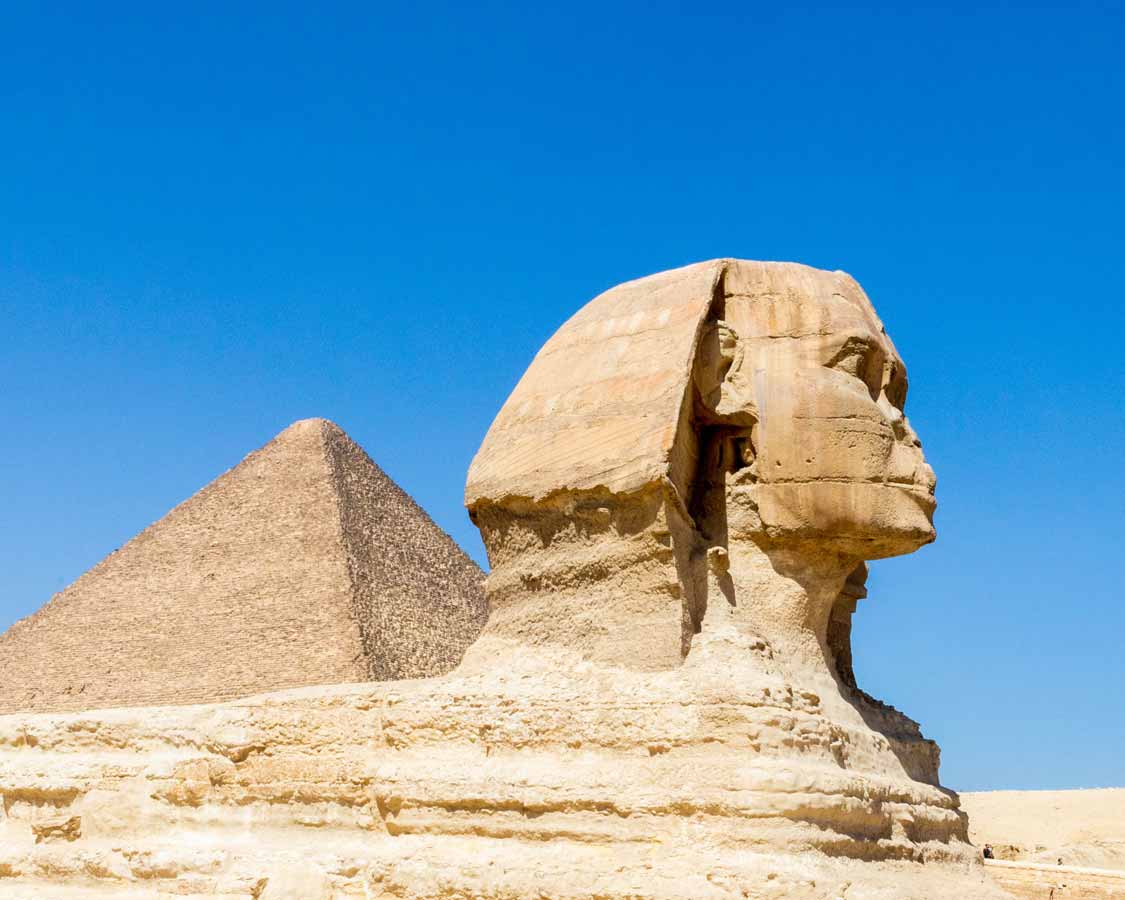
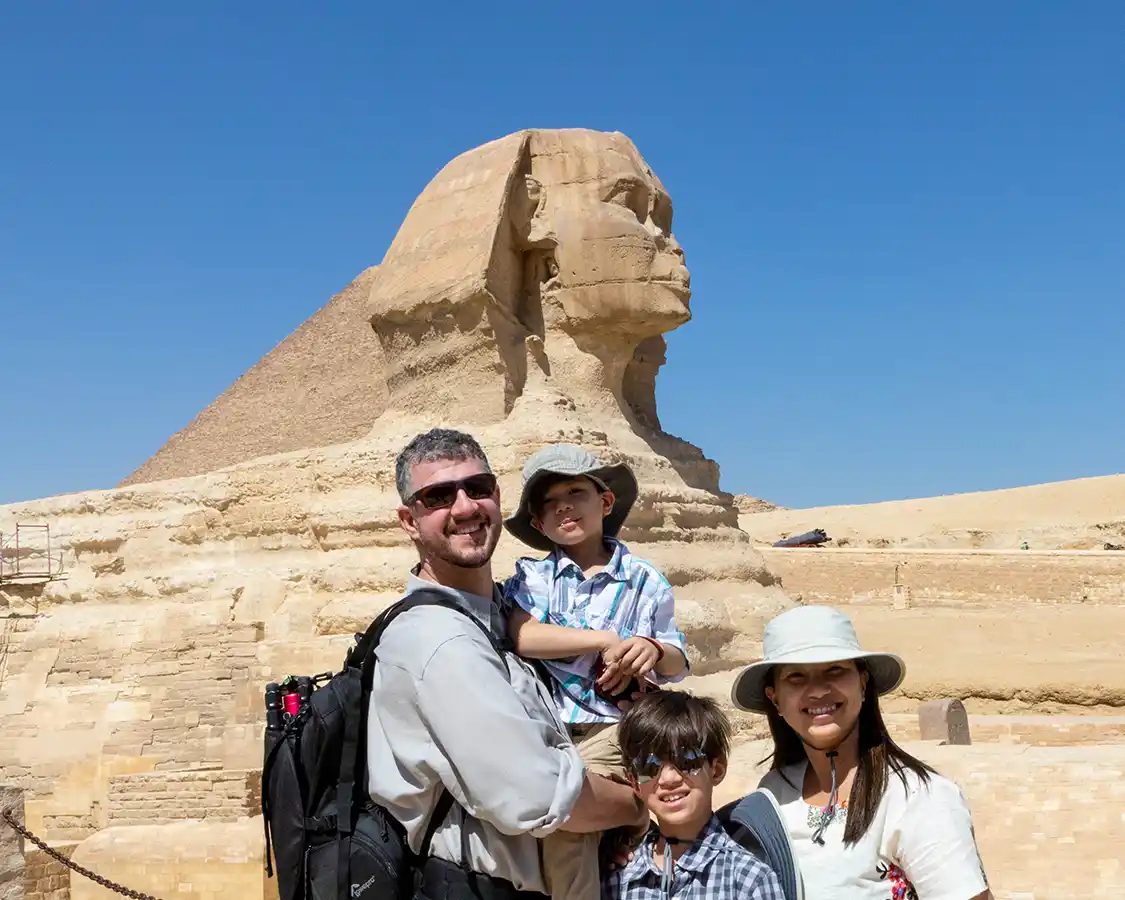
The Temple of the Great Sphinx connects to the Funerary Temple of Khafre by a causeway, but the Sphinx is treated as its own attraction with a separate entrance. Arriving here felt much less formal than the rest of the complex, and a line of stalls funneled us toward the temple, with vendors trying to press every kind of cheap trinket into the boys’ hands as we passed. Truthfully, the boys were less wowed by the Sphinx than I expected. I think the majesty of it got a little worn down by everything we’d already seen that morning. A short circular path along the edge of the Sphinx set our route. If I went back, I’d linger longer beside the temple itself, where the photo angles are much better.
That was our day: tired, dusty, a little punch-drunk from jet lag, and completely won over. Now, here’s everything we learned that will make yours smoother, starting with the question we get asked most.
Is It Safe To Visit The Pyramids Of Giza With Kids?
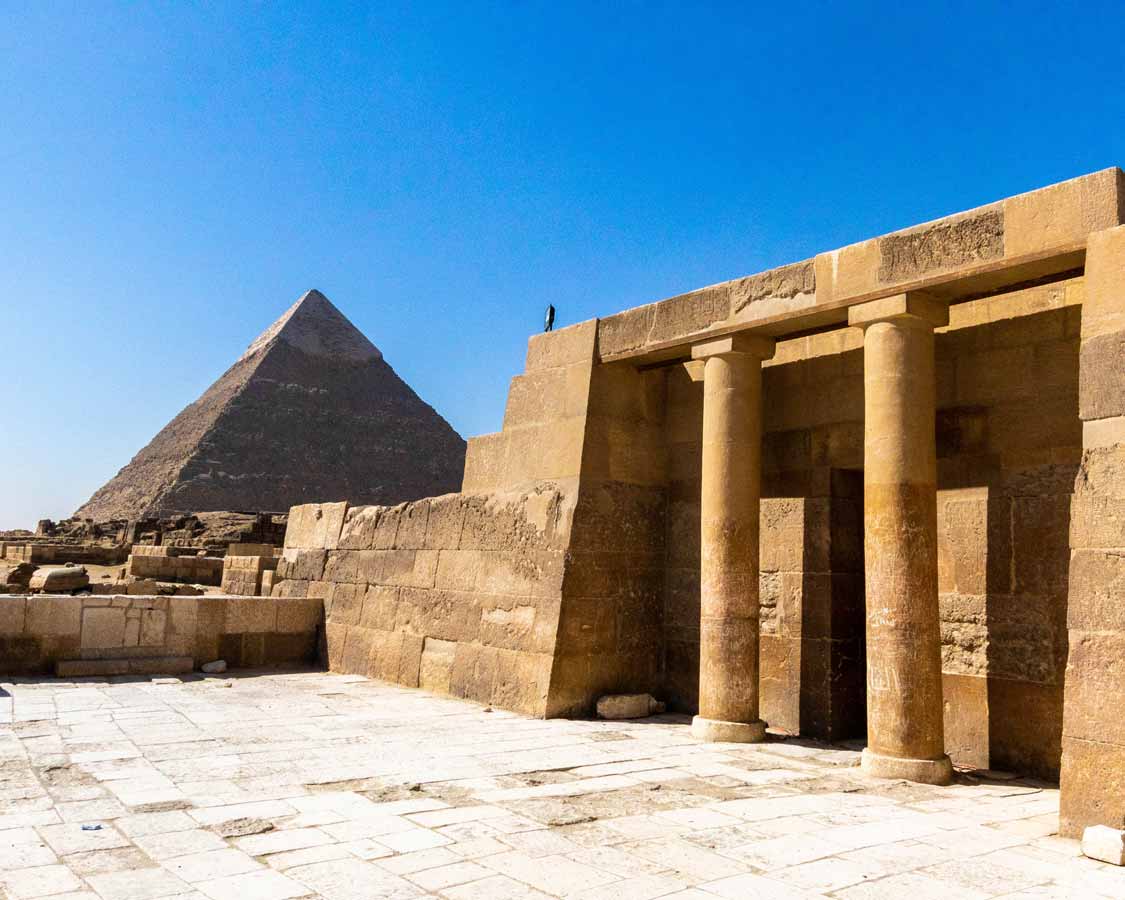
One of the biggest questions we’re asked about traveling to Egypt with kids is whether it’s safe. The short answer is yes. Giza is one of the most visited places on earth; the plateau is heavily policed and touristy, and violent crime against visitors is rare. Millions of families pass through every year without incident, and the 2026 management changes have made the whole experience noticeably smoother and less frantic than it was when we visited.
That said, “safe” and “hassle-free” are two different things, and it’s worth setting expectations honestly. The political and socio-economic situation in Egypt can change quickly, as it did when we were forced to leave the country on very little notice at the start of the 2020 pandemic. Check your government’s current travel advisories before you go, keep to the main tourist areas around Giza, Cairo, Luxor, and the Nile, and you’ll be in good shape.
The thing that catches most families off guard at Giza isn’t danger. It’s the intensity of the sales pressure, and specifically the way vendors target children. This is the part nobody warns you about clearly enough, so here’s the real talk.
Egyptian vendors are, frankly, some of the most persistent salespeople you’ll encounter anywhere. Most are just trying to make a living in a tough economy, and many are perfectly friendly. But their tactics can feel relentless, and a subset of them have learned that the fastest way to a parent’s wallet is through a parent’s kids. They will single out children because children don’t know how to say no, because a child holding a trinket creates instant leverage, and because most parents will pay almost anything to avoid a scene or to make their kid happy.
Here’s what that looks like in practice, and how we handled it:
- They give “gifts” to your children. A vendor will press a small souvenir- a headscarf, a toy camel, a bracelet- into your child’s hands with a big smile, saying it’s a gift, a present, no charge. Your kid lights up. Then, moments later, the vendor asks you for money, and if you try to hand the item back, they’ll refuse to take it or act wounded. The fix is simple, but you have to brief your kids before you arrive: tell them not to accept anything from anyone, no matter how friendly, and that if someone hands them something, they should give it right back and find you. If an item ends up in your child’s hands anyway, hand it back firmly, say “La, shukran,” and keep walking. Do not hold it, examine it, or let your child carry it off.
- They use your kids to start a conversation. A friendly “Where are you from? Canada? I have a cousin in Toronto!” aimed at your child is often the opening move of a sales pitch. It’s not sinister, but it’s designed to make you feel rude for walking away. You don’t have to engage. A polite smile and a steady pace are all you owe anyone.
- They crowd and follow. With kids in tow, you move slowly, and vendors know it. The best defense is to keep your family moving with purpose, keep your children close (hold hands in the busy zones near the entrances and the Sphinx), and avoid stopping in the middle of a knot of stalls unless you actually intend to buy.
None of these scams should scare you off. They are annoying, but manageable, and the new shuttle system means you’ll spend far less time running the vendor gauntlet than families did a few years ago. But go in prepared, brief your kids in the hotel that morning, and you’ll all have a much better day. The magic words, said calmly and with a smile but real firmness, are “La, shukran.” La means no. Shukran means thank you. Deliver it like you mean it, and most vendors will move on to the next mark.
Common Scams At The Pyramids (And How To Handle Them)
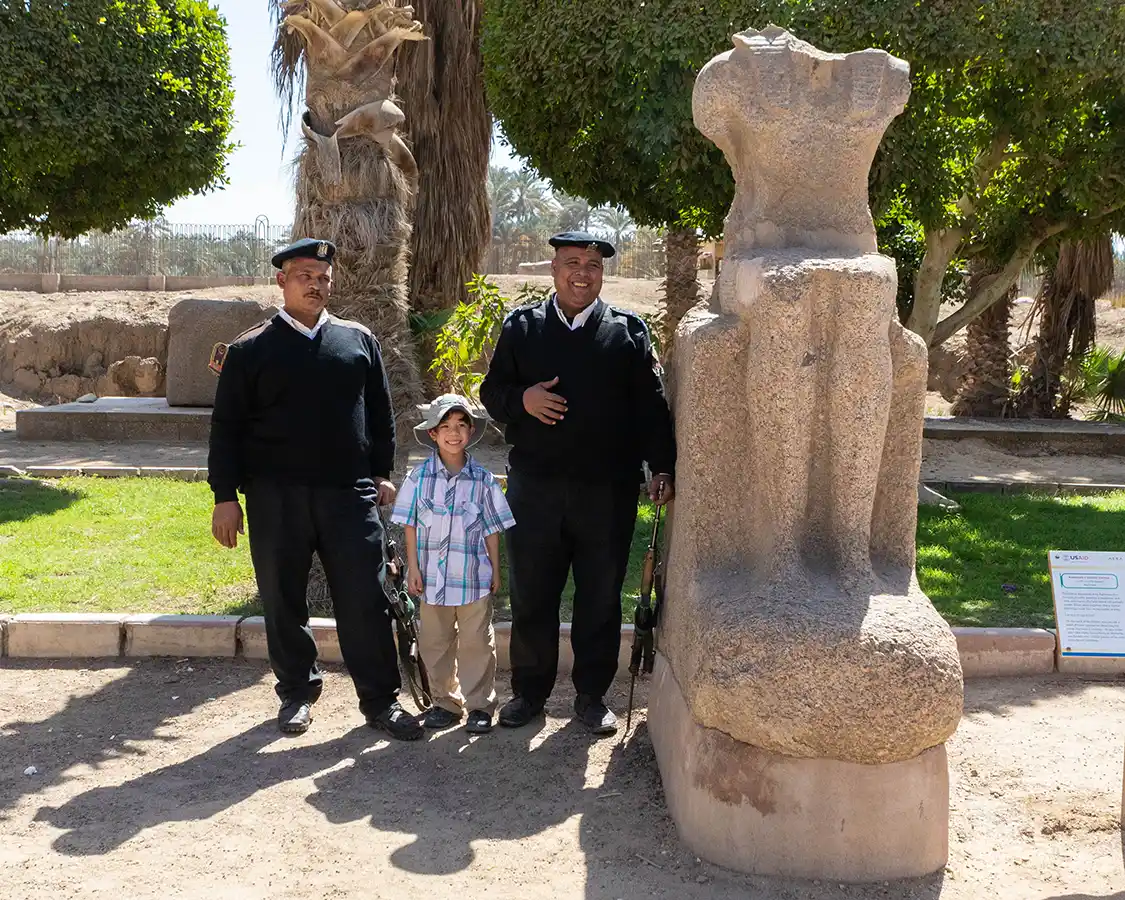
Beyond the general sales pressure, there’s a handful of specific, well-worn scams that come up again and again at Giza. None of them are dangerous, and all of them are easy to sidestep once you know the playbook. Forewarned is forearmed.
- The camel or horse ride squeeze. This is the classic, and it’s the one to watch most carefully with kids. A handler offers a camel or horse ride for a cheap, almost suspiciously low price, say 100 EGP. Your children, understandably, are thrilled. Once everyone is up on the animal and out across the sand, the price suddenly changes: now it’s per person, or per camel, or the quoted price was only one way, and getting down and back costs more. With your kids stranded on a camel, you’re in a weak negotiating position, which is exactly the point. If you want a camel ride (and it can be a genuinely fun photo op), agree on the total price out loud and in full before anyone gets on, confirm it covers everyone, both directions, and the return, and ideally take a photo of the agreed number or have it written down. Pay at the end, not before. We paid about the equivalent of 10 US dollars for a short, silly 20-minute ride, tip included, and knew the number before we started.
- The “free” photo. A vendor offers to take a great family photo with your camera or phone, or hands your child a headdress or a prop “just for a picture.” The photo is not free, and neither is the prop. Either politely decline, or agree a small tip up front if you actually want the help.
- The gift-for-kids move. Covered above, but it belongs on the scam list too: anything pressed into a child’s hands as a “gift” will come with a price attached. Hand it straight back.
- The fake or freelance guide. Someone official-looking may attach themselves to your family, start “explaining” the site, point you toward a viewpoint, or open a gate for you, and then demand a guiding fee. Real guides are booked in advance through your hotel or a reputable operator. If you didn’t hire them, you don’t owe them. A firm “La, shukran, we’re fine” works. We toured with a licensed guide through Traveline Egypt, which meant we always knew who was actually with our family.
- The baksheesh nudge. Baksheesh (tipping) is a normal and expected part of Egyptian life, and small tips for genuine service (a bathroom attendant, a helpful shuttle driver) are fair and appreciated. But it can also be used as a pressure tactic: someone opens a rope, points at a “special” spot, or offers to let your kid climb somewhere they shouldn’t, then expects payment. Carry a stash of small notes for legitimate tips, and don’t feel obligated to reward manufactured “help.”
- The redirect. Occasionally a driver or a tout will insist the pyramids are “closed,” “closed for lunch,” or “only open from the other entrance,” and offer to take you somewhere else instead (a perfume shop, a papyrus “institute,” a relative’s stable). The pyramids are not closed. Check the official hours, head to the real entrance, and ignore anyone telling you otherwise.
The common thread through all of it: agree on prices before, not after; don’t let anything land in your kids’ hands; and don’t be afraid to deliver a friendly but confident “no.” Do that, and the scams, as annoying as they are, become a footnote to an unforgettable experience.
What Age Is The Right Age To Visit The Pyramids With Kids?
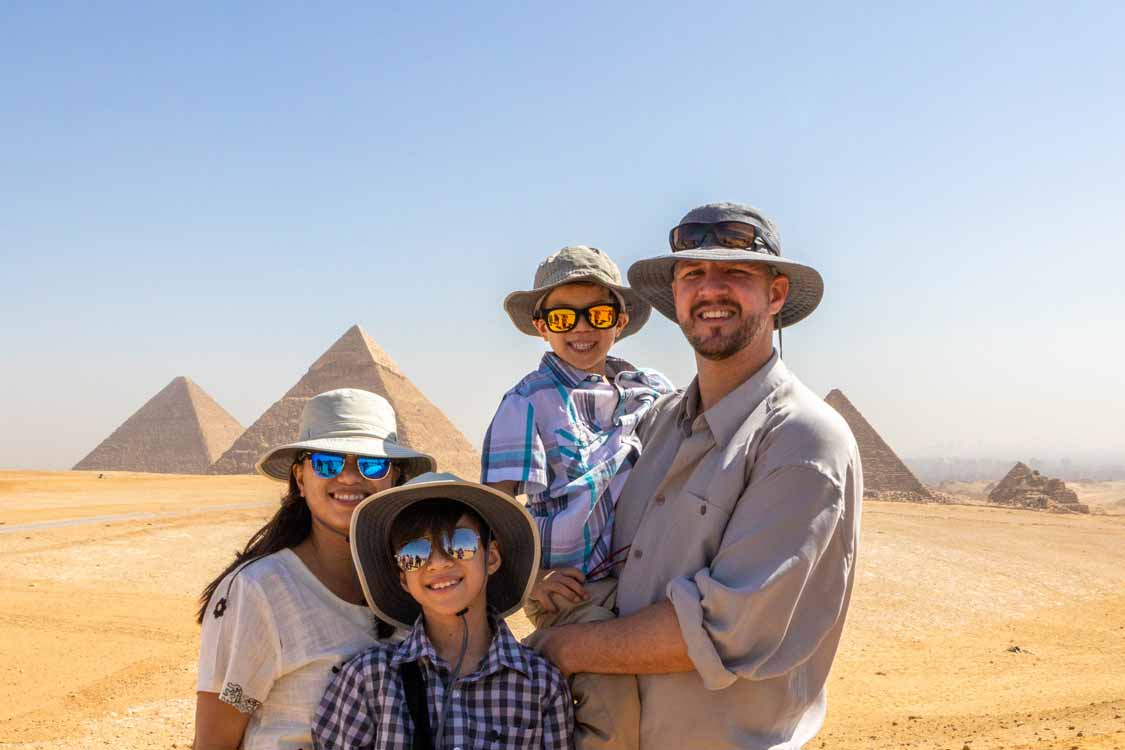
There’s no wrong age to stand in the shadow of a 4,500-year-old wonder, but what your kids get out of it changes a lot with age, and it helps to set your own expectations accordingly.
- Toddlers and preschoolers (under 5): They won’t remember it, and the heat, the crowds, and the long open distances can be tough. But it’s very doable with a carrier, plenty of water, and a shuttle-hop strategy rather than long walks. Manage your own expectations: this visit is for you as much as them, and that’s fine.
- Ages 5 to 8: This is a sweet spot for wonder. Kids this age have usually soaked up enough about mummies, pharaohs, and “how did they build it?” to be genuinely wide-eyed. They’ll love the camels, the scale, and the sand. Keep the visit to a focused morning before they melt.
- Ages 9 to 12: The best age, in our experience. Older kids can handle the walking, engage with a guide, ask the endless brilliant questions our boys did, and even (if they’re up for it) tackle the cramped interior of a pyramid. This is the age where the history really lands.
- Teens: Teens tend to either find it profoundly cool or play it cool, sometimes both in the same hour. Give them a bit of ownership (let them plan which pyramids to prioritize, or lead the way to the Sphinx) and lean into the photo opportunities.
Whatever the age of your kids, a morning visit to the pyramids beats an afternoon one. Energy is higher, temperatures are lower, and you’ll beat the worst of the crowds and the heat.
Can You Go Inside The Great Pyramids With Kids?
All three major pyramids of the Great Pyramid Complex allow entry for an additional fee. Here’s my take on the experience: the tombs and hallways have been stripped bare by tomb raiders over the past four millennia and are essentially empty inside. They’re a far cry from the vivid, painted chambers of the Valley of the Kings in Luxor. The passages are steep, low (in places, if you’re tall like me, you’ll be bent nearly double, with headroom of only around 1.2 meters), narrow, hot, and stuffy, with little airflow.
If anyone in your group is claustrophobic, skip it, no question. Very young children may find the dark, cramped climb frightening rather than thrilling. But for confident kids who love a bit of adventure, ducking into the Great Pyramid of Khufu is a bragging-rights experience they’ll talk about for years, even if there’s “nothing” to see at the end. Just know what you’re signing up for: it’s about the visceral thrill of being inside, not about artifacts. Cameras, video, and tripods are not permitted inside the pyramids.
If your budget only stretches to one interior visit, Khufu is the iconic choice, though the smaller Khafre and Menkaure pyramids are cheaper and often less crowded.
How Much Does It Cost To Visit The Great Pyramids With Kids In 2026?
Like most attractions in Egypt, pricing at Giza is layered, and it changes often. Egypt’s currency has moved a lot in recent years, so treat every figure below as an approximate guide and confirm current prices when you book. Children’s tickets typically run at roughly half the adult price, and young children (generally under 6) usually enter free.
As a rough guide to pricing for the Pyramids of Egypt:
- General plateau admission: around 700 EGP for adults and 350 EGP for students, which covers entry, the plateau, the viewpoints, and the free shuttle buses.
- Inside the Great Pyramid of Khufu: a separate ticket of roughly 1,500 EGP.
- Inside the Khafre or Menkaure pyramids: cheaper separate tickets, useful if you want the interior experience without the Khufu price tag.
- Grand Egyptian Museum: a separate ticket, bought for the museum itself, and well worth budgeting for.
Unlike the old days, you no longer pay separate camera fees for phones or standard cameras on the plateau, and the messy à la carte ticket windows have largely given way to online booking. Buy your general admission and any interior-pyramid tickets online in advance, keep your confirmation handy, and you’ll skip most of the queuing.
How Do You Get To The Great Pyramids From Cairo?
The Great Pyramids sit in Giza, a suburb on the western edge of greater Cairo, a 30 to 60 minute drive from most of the city depending on the city’s notorious traffic. Uber and Careem both operate in Cairo and are, in my view, the easiest and least stressful way for families to get to the pyramid plateau: the fare is agreed in the app, so there’s no haggling, no “the meter is broken,” and no scenic detour to a cousin’s souvenir store. Regular taxis work too, but be sure to agree on the fare before you get in.
Whichever way you go, most cars have seatbelts but not car seats, so if you’re traveling with little ones, we recommend packing a lightweight, foldable travel car seat or booster. Have your driver drop you at the main visitor center on the Fayoum Highway, which is now the primary entrance to the pyramids.
What Is The Best Time Of Year (And Day) To Visit The Pyramids With Kids?
The plateau is open year-round, but the sweet spot to visit is October to April, when temperatures are manageable. In the summer months, the heat can be brutal, and there’s very little shade out on the open sand, which is as hard on kids as it is on adults. If you must visit in summer, go the moment the gates open and be off the plateau by late morning.
Aim for a weekday if you can. On weekends and Egyptian public holidays, local families flood the site when kids are out of school, and it gets very crowded. And regardless of season, arrive at opening. The site opens at 7 am (the shuttle buses start running at 8 am, and hours shift slightly during Ramadan). Early morning gives you cooler air, softer light for photos, thinner crowds, and fresher, more patient children.
Where To Stay Near The Great Pyramids With Kids
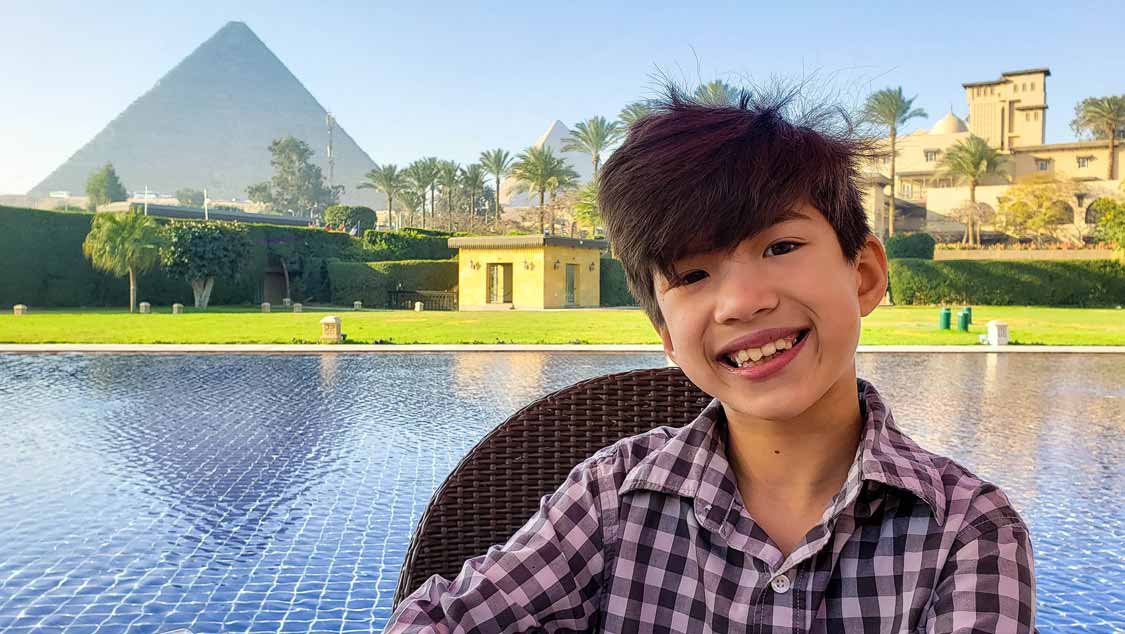
If you’re making the trip all the way to Egypt, waking up to a view of this ancient wonder is worth splurging on for at least a night. There are loads of family-friendly hotels in Giza, from landmark luxury to simple guesthouses. These are the ones I’d point families toward.
The Marriott Mena House
This is where we chose to stay on our first visit, and it’s magic. The Marriott Mena House is the only hotel that sits within the Great Pyramid complex, with rooms and a restaurant terrace that look straight up at the Great Pyramid. It is not a budget hotel, but as a Marriott property, you get comfortable beds, pools, cafes, and one of the best breakfast buffets in Egypt with a view that makes 24 hours of jet-lagged travel with kids melt away. You can check prices and availability for the Marriott Mena House here.
Steigenberger Pyramids Cairo
A strong upper-mid-range option for families who want resort comforts (multiple pools, several restaurants, big rooms) with pyramid views, at a gentler price than the Mena House. It’s a comfortable, kid-friendly base with room to spread out after a hot morning on the plateau. You can find their current rates and availability here.
Giza Pyramids View Inn
A well-loved budget-friendly choice just a short distance from the Great Sphinx. The rooftop terrace serves up beautiful sunset views of the complex, and there’s an à la carte breakfast and free WiFi. You can check prices and availability for the Giza Pyramids View Inn here
Great Pyramid Inn
If you’re looking for a budget place to stay near the pyramids, this spot, right across from the Sphinx, is where my family stayed on our 2025 visit to Egypt that had us out exploring the Western Desert (you can check out my video from that trip here). The rooms don’t have a great view; in fact, ours looked out onto a mess of bricks and wires.
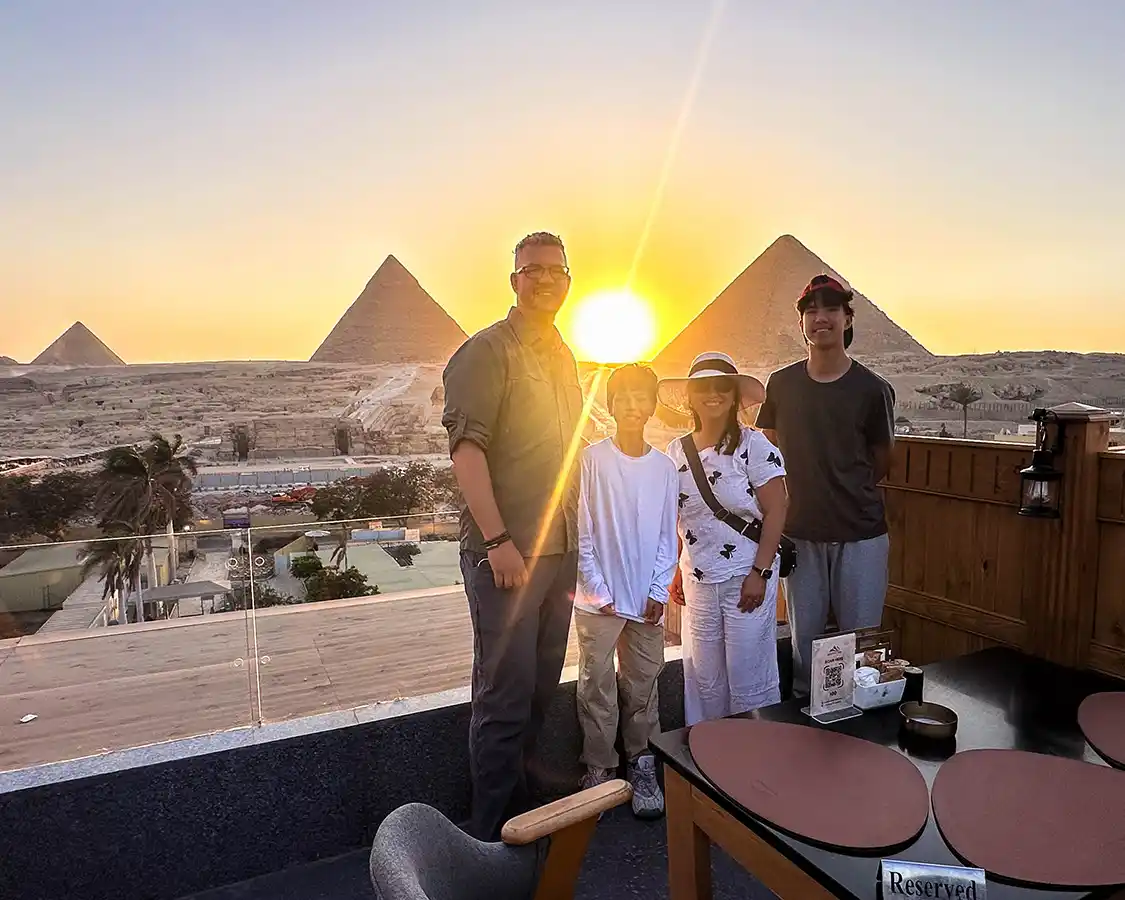
The trade-off is that the view from the rooftop restaurant was incredible, and it is one of the best places to see the sun set right between the Giza pyramids. It’s also a great place to watch the new sound and light show that takes place daily. You can check out their rates and availability here.
Great Pyramid Complex Hours Of Operation
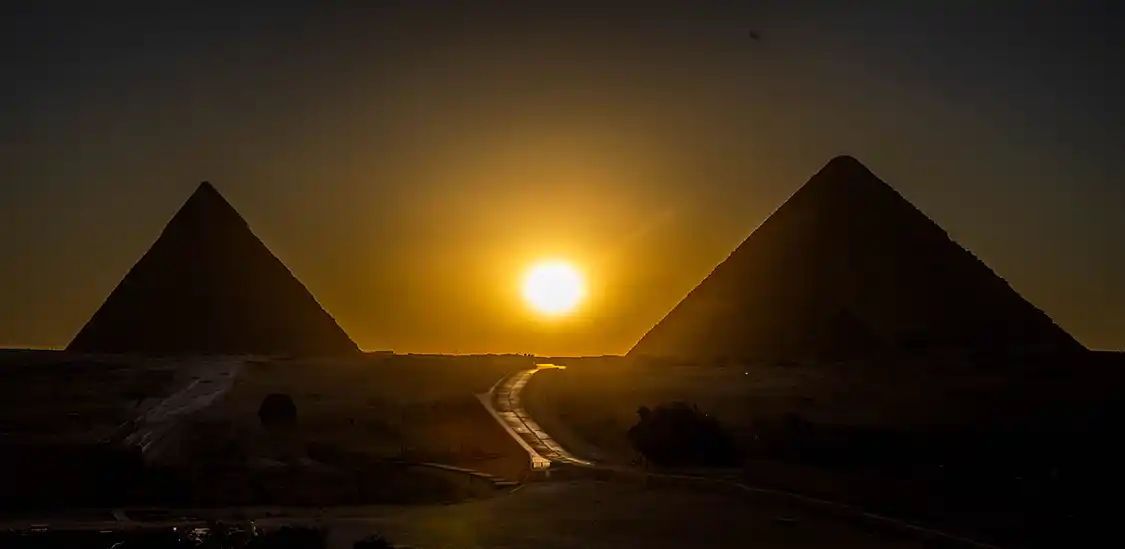
The Giza Plateau is open daily from 7:00 am to 4:00 pm. A few things worth knowing on top of that:
- The free electric shuttle buses don’t start running until 8:00 am, so if you arrive right at opening, you may be walking the first stretch.
- Hours shift during Ramadan, when the site typically opens later (around 8:00 am) and can close earlier.
- Interior pyramid access sometimes runs on tighter windows than the plateau itself, and individual pyramids rotate closed for maintenance and restoration.
Since hours in Egypt do change seasonally and around holidays, it’s worth confirming on the official ticketing portal close to your visit.
Practical Tips For A Day At The Pyramids With Kids
Are There Bathrooms At The Great Pyramids?
Yes, there are bathrooms at the visitor center and at points around the plateau. As is customary in Egypt, attendants may request a small tip for access to toilet paper. Sometimes, you may find that toilet paper may not be supplied, so carry tissues and a stash of small notes (a couple of Egyptian pounds per person is standard). Have everyone go before you head out onto the plateau, where facilities are more spread out.
Is There Food And Drink Available?
Bring water, and lots of it. Dehydration is the fastest way to end a visit to the pyramids with kids early. There are cafes and restaurants at and around the new visitor center, and the Grand Egyptian Museum, and the classic Panorama-style restaurants near the plateau serve buffets and drinks. But it’s smart to pack snacks and refillable water bottles so you’re not at the mercy of hanger meltdowns between stops.
Should You Hire A Guide?
For families, a good licensed guide is worth the investment. They bring the history alive for kids, handle the logistics, and act as a natural buffer against touts and fake guides. Book through your hotel or a reputable operator (we used Traveline Egypt) rather than accepting an offer from someone who approaches you at the gate.
The Sound And Light Show
If you’re staying nearby, the evening Sound and Light Show at the pyramids projects the site’s history onto the monuments and the Sphinx. It’s cheesy in the best way, and younger kids often love the spectacle. It runs after dark, so weigh it against bedtimes, but it’s a memorable way to see the pyramids lit up.
Frequently Asked Questions About Visiting The Pyramids With Kids
Yes. Giza is heavily touristed and policed, and serious safety issues are rare. The main challenge for families is persistent vendors and touts rather than danger, and the 2026 management overhaul has made the site calmer than it used to be. Check current travel advisories, stick to the main tourist areas, and brief your kids on the vendor tactics described above.
Kids from about 5 to 12 tend to get the most out of it, with 9 to 12 the sweet spot for engaging with the history and even braving a pyramid interior. Younger children and toddlers can absolutely come, but the visit is more about the experience and long-term learning rather than something they’ll remember forever.
Yes, for an extra fee, but the passages are steep, low, hot, and cramped, with headroom around 1.2 meters in places, and there’s nothing to see inside beyond the thrill of being there. It suits adventurous kids roughly 9 and up, and anyone claustrophobic should skip it.
General admission runs roughly 700 EGP for adults and about half that for students and children, with young children often free. Going inside the Great Pyramid of Khufu costs extra (around 1,500 EGP), and the Grand Egyptian Museum is a separate ticket. Prices change frequently, so confirm when you book online.
Agree on every price out loud and in full before you commit (especially for camel and horse rides), never let vendors hand souvenirs to your kids, book guides in advance, and keep a calm, firm “La, shukran” ready. See the safety and scams sections above for the full playbook.
Uber or Careem is the easiest, lowest-hassle option for families, a 30 to 60 minute ride depending on traffic. Have your driver drop you at the main visitor center on the Fayoum Highway.
Very much so. It’s home to the full Tutankhamun collection and Khufu’s restored solar boat, and it pairs perfectly with a morning at the pyramids. It’s one of the best family activities in Egypt right now.
Final Thoughts On Visiting The Great Pyramids With Kids
Our energy level was rock bottom when we visited the Great Pyramids of Giza with the kids, and it was still one of the most incredible mornings of our travels. The sheer weight of history behind these ancient wonders makes the journey worth it on its own. The views from the plateau drew an audible “This is more like it” out of Cohen. We had a goofy, cheesy camel ride we’ll laugh about forever. And tired or not, the boys never ran out of questions for our guide.
The pyramids weren’t even the single most jaw-dropping thing we did in Egypt with the kids, but they were unforgettable, and the 2026 changes (the shuttles, the online tickets, the calmer plateau, and that spectacular new museum next door) have genuinely made them easier and more pleasant to visit as a family. Go in prepared for the vendors, keep your kids close and your “La, shukran” handy, and you’ll come away with the kind of memories that last a lifetime.
For more on planning your family adventure through the country, don’t miss our complete Egypt travel guide, our guide to the Siwa Oasis, and our tips for things to do in Luxor.
Disclosure: We partnered with Traveline Egypt to make the most of our travels in Egypt. All opinions remain our own. Wandering Wagars is a participant in the Amazon Services LLC Associates Program, an affiliate advertising program designed to provide a means for sites to earn advertising fees by advertising and linking to amazon.com, amazon.co.uk, amazon.ca. Amazon and the Amazon logo are trademarks of Amazon.com, Inc. or its affiliates.
You May Also Like To Read:

Pin This For Later:
Jacob
Sunday 31st of August 2025
Loved this post! Visiting the Great Pyramids with kids can feel overwhelming, but your tips make it sound so much more manageable. When we were planning our Egypt trip, I found a lot of useful travel resources with advice like yours really helped us feel prepared. Can’t wait to take the little ones there one day!
Ryan K Biddulph
Sunday 19th of April 2020
What a fun time guys. Loving those camels too. We saw quite a few during trips to Qatar and Oman. I love that part of the world.
Kevin Wagar
Monday 20th of April 2020
It was awesome Ryan. Definitely not as relaxing as our long ride in Jordan, but almost as beautiful! We are dying to get to Qatar and Oman. Hopefully, once travel opens up again we can make our way over there.