Morocco family travel tips for families: visas, safety, getting around, medinas, the Sahara, and everything we learned traveling Morocco with kids
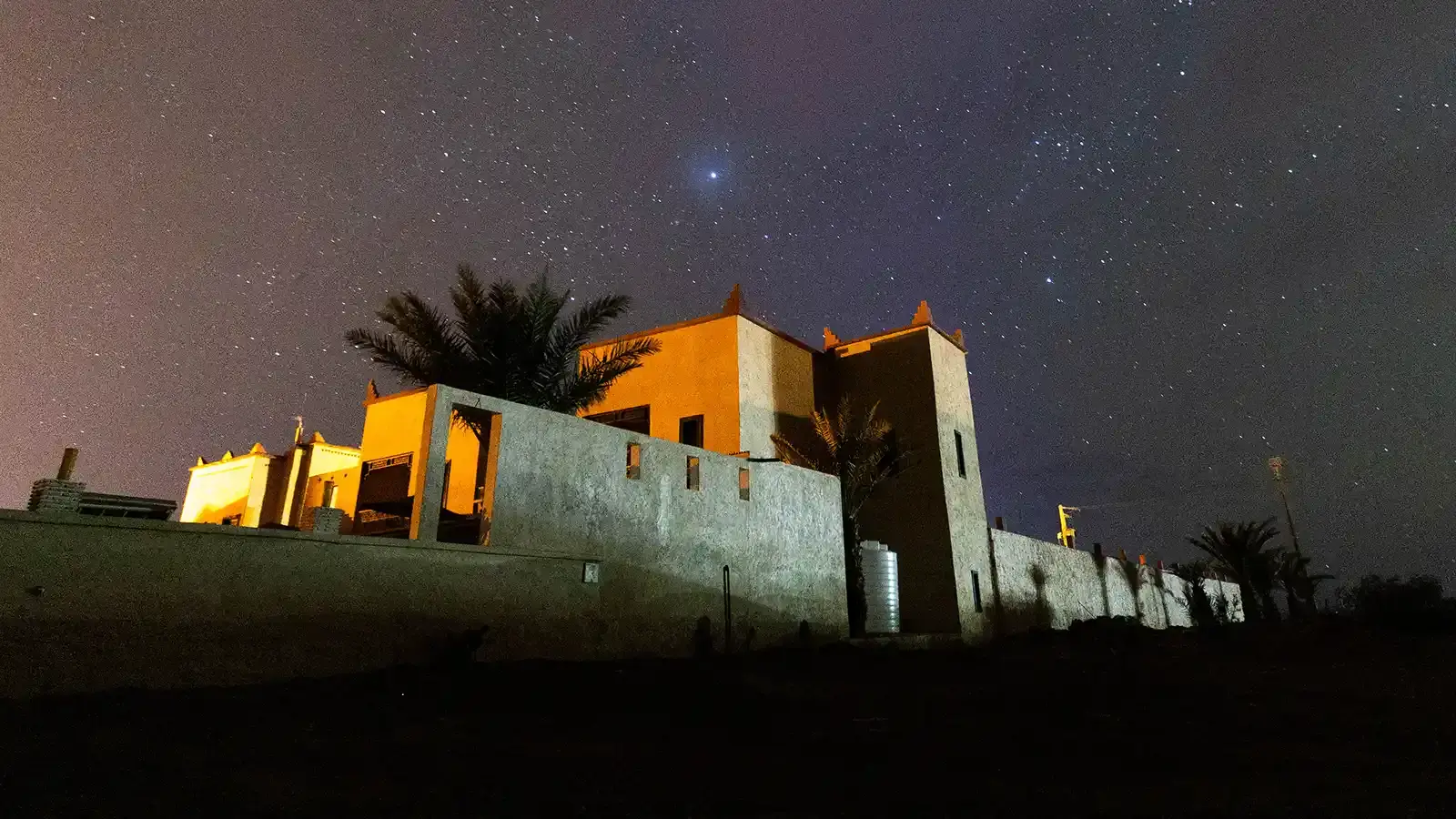
There is no country in the world quite like Morocco.
Sitting just 9 miles (14 kilometers) from the southern tip of Spain, close enough to see across the Strait of Gibraltar on a clear day. But in that short distance, Europe disappears entirely. What replaces it is something older, louder, more fragrant, and utterly unforgettable.
Ancient medinas where the streets narrow until your shoulders touch both walls. The Sahara is a desert with dunes so vast that they swallow the horizon in every direction. Winding mountain passes that still carry snow in spring, while the valley below is dressed in a myriad of greens, reds, and yellows. And everywhere, an intensity of daily life that invites visitors to experience food, art, culture, and history.
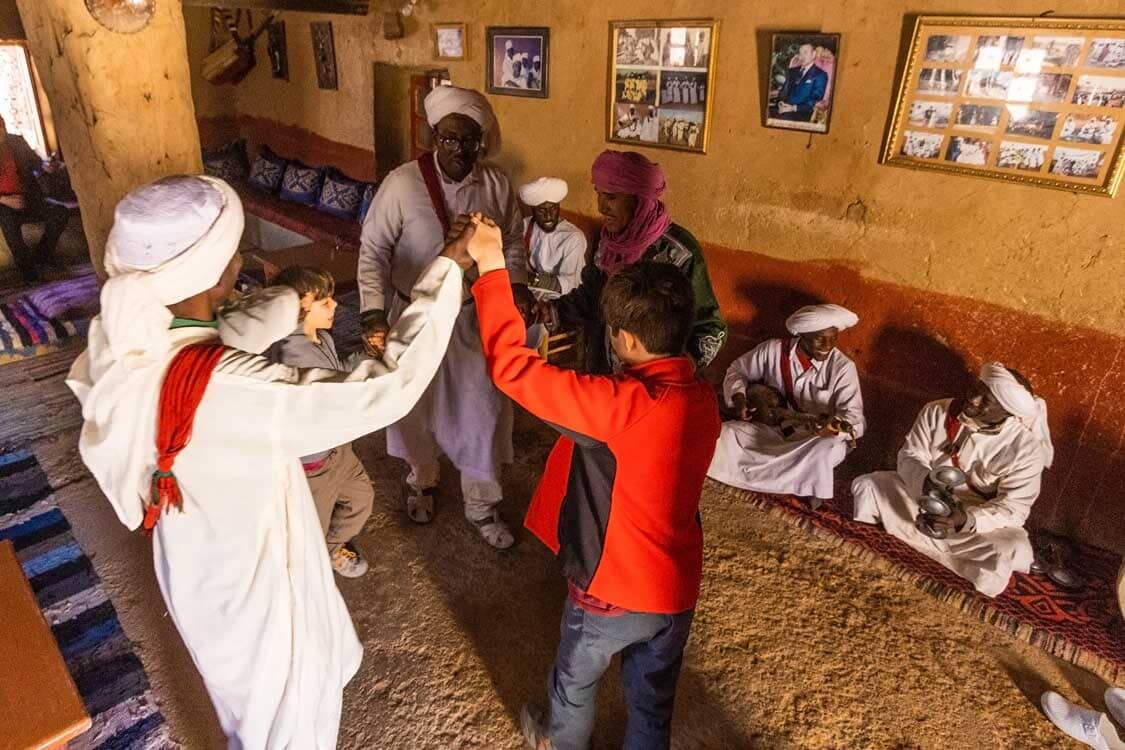
My family was sitting on cushions in a small home in the village of Khamlia, just outside Merzouga, on the edge of the Sahara. In front of us, a group of Gnawa musicians – descendants of sub-Saharan Africans brought to Morocco centuries ago – were playing with an energy that filled every corner of the room. Guembri bass lines, iron castanets clicking in fast patterns, call-and-response vocals that built until the music wasn’t something we were listening to but something we felt in our chests.
Our guide, Daoud, watched the boys for about thirty seconds before he stood up, pulled Cohen and Dylan to their feet, and started teaching them to dance. They were terrible at it. They did not care. Neither did anyone in that room.
That is Morocco. And that is why families who go there stop comparing it to anywhere else they have traveled to.
I have traveled through Morocco with my family. We drove the southern circuit from Marrakech to the Sahara and back, spent days inside the medinas of Fes and Marrakech, stood in Roman ruins at Volubilis outside Meknes, walked the canyon floor of the Todra Gorge, and fell asleep in a Berber desert camp while the boys tried to count stars they had never seen that many of. Here is what you actually need to know before you travel to Morocco with kids. These tips come from real, lived experience.
At a Glance: Quick Facts for Family Travel in Morocco
🗣 Language: Spanish, Arabic, and French. Darija (Moroccan Arabic) is the everyday dialect. English is growing in tourist areas, but is rarely spoken outside them.
💰 Currency: Moroccan Dirham (MAD). Not exportable – exchange on arrival. Cards work in city hotels and restaurants; cash is essential everywhere else. (USD). Cards work in cities; carry cash for markets, rural areas, and smaller towns.
🔌 Power Adapter: Type C and E (European standard). 220V. North American and UK travelers need an adapter.
🚗 Driving: Right-hand side. Highways are excellent. Cities can be congested and challenging. Medinas are car-free. The rule of predictability matters more than the rules of the road.
🆘 Emergency: Police: 19 | Ambulance: 15 | Gendarmerie: 177 | Tourist Police: 0537-72-42-22
💧 Tap Water: Not safe to drink water from the tap anywhere. Bottled water is cheap and everywhere. Bring a filtered bottle for remote and desert areas.
🛂 Visas: Canada, US, UK, and most EU nationalities receive 90-day visa-free entry. No advance application required.
🕌 Culture Note: Predominantly Muslim. Ramadan changes daily rhythms significantly. Dress modestly in medinas and at religious sites.
Do You Need a Visa to Visit Morocco? Entry Requirements
Table of Contents
Getting your family into Morocco is straightforward for most people from Western nations. Citizens of the United States, Canada, the United Kingdom, and most EU countries can enter visa-free for stays of up to 90 days. No paperwork, no pre-arrival registration. You arrive, you get a stamp.
Your passport must be valid for at least six months from your date of entry and have at least one blank page for stamps. Check every family member’s document well before booking – children’s passports often expire faster than adults’, and renewing one under time pressure is exactly as stressful as it sounds.
Solo parents and non-biological guardians: Carry notarized proof of guardianship and copies of birth certificates for all children. Moroccan border officers take family documentation seriously. The ones who ask for it are not interested in hearing that you didn’t bring it.
Overstays carry daily fines and can create friction on future visits. Know your entry date. Plan your departure accordingly.
💡 PRO TIP: Check Before You Book
Visa policies in Morocco can change with very little notice. The 90-day exemption is current, but confirm the requirements with the Moroccan Embassy for your country before booking. Nothing in travel ages faster than visa information.
Getting Connected: Mobile and Data in Morocco
Getting a local SIM or activating an eSIM before or immediately after arrival is one of the most practical things you can do for family travel in Morocco. Navigating a Marrakech medina without reliable maps is the fastest way to become genuinely lost.
Morocco’s three main carriers – Maroc Telecom, Orange, and Inwi – all offer prepaid SIM cards available at airports and city shops. A data plan covering a standard family visit currently runs around 100-200 Dirham. If your phone supports eSIM, I use the Airalo app and recommend it consistently. Purchase and activate a Morocco data plan before you leave home so you step off the plane already connected.
Coverage is solid in Marrakech, Fes, Casablanca, Rabat, and all main highway corridors. In the south and the Atlas Mountains, gaps appear but aren’t too big. In the Sahara itself, near Merzouga, expect no signal, even with some of the local carriers. At our desert camp, we had no connectivity and no WiFi. That was the point.
👀 HEADS UP: The Medinas Are Where You Need Maps Most
The medinas of Marrakech and Fes are genuinely disorienting, even with a GPS running. Download offline maps for both cities through Google Maps or something similar before you enter. Do this while connected to WiFi, not while standing in a souk alley trying to figure out which way leads out.
Getting Around Morocco With Kids
How you move through Morocco shapes the entire travel experience. This is a large country with dramatically different regions, and the distances between them require real planning.
Driving
Driving in Morocco is essential for families undertaking the southern circuit – Marrakech through the Atlas Mountains, Ouarzazate, Todra Gorge, and Merzouga. Regional trains don’t reach the south. Buses work, but add hours and complexity with children in tow. A rental car gives you the freedom to stop wherever the landscape demands it, and Morocco’s landscape will demand it constantly.
The honest take: Morocco’s highways are genuinely excellent by international standards. The intercity roads in the south are well-maintained and offer spectacular views. Cities are another matter entirely. Marrakech and Fes are dense, fast-moving, and full of motorcycles that treat traffic signals as optional. Do not try to drive into the Marrakech medina. Park at the edges and walk in.
The rule that matters more than any traffic law: be predictable. Signal your intentions early, move steadily, and make your path clear to the vehicles around you before you act on it. Morocco’s accident rate is driven by unpredictability, not aggression.
Private Driver vs. Rental Car
For the southern circuit, a private driver for the full route is worth serious consideration. It costs more than a rental car and eliminates the stress of mountain road navigation while giving you a local who knows where to stop, what to skip, and how to negotiate in places that require negotiation.
We drove ourselves and are glad we did – there is something irreplaceable about a family road trip through that landscape in your own vehicle. But the private driver option is an excellent choice for families less comfortable with assertive driving conditions. You can book one through Tours by Locals.
Trains
Morocco’s ONCF rail network is reliable, comfortable, and well-suited to families visiting the northern cities. The main corridor – Casablanca, Rabat, Meknes, Fes, Tangier, and Marrakech – is well-served.
Book in advance to secure seats together as a family. First-class tickets are not expensive by Western standards and are worth the upgrade on longer routes.
Grands Taxis and Petits Taxis
Petits taxis operate within cities on a metered basis. Be sure to let the driver know that you want the meter running before the car moves – every time, without exception. Grands taxis connect towns on fixed routes, often shared with other passengers. Renting one exclusively for a shorter intercity hop is a cheap and practical way for families to travel with luggage. Negotiate the price before you get in.
💡 PRO TIP: Use Grab or InDrive
InDrive is a car booking app that operates in Marrakech and other major Moroccan cities. It is safer and more transparent than hailing a street taxi, and removes the meter dispute problem entirely. Uber exists in Marrakech and Casablanca, but rarely outside of those cities. Download it before arrival.
Language in Morocco
Morocco has a layered language situation that surprises most first-time visitors. The two official languages are Arabic and Tamazight (Berber). French is effectively a third official language – used in government, business, and education. Darija, the Moroccan Arabic dialect, is what most people actually speak day-to-day, and it differs enough from Modern Standard Arabic that even fluent Arabic speakers sometimes find it unfamiliar.
In the major tourist areas, enough English is commonly spoken in hotels, tour agencies, and upscale restaurants, and English speakers will find it relatively easy to get by. Step outside those corridors and French becomes your most useful fallback. In the south and in smaller Berber communities, French and Darija together cover almost everything.
Download Google Translate with the Arabic and French language packs for offline use before you leave. Make the effort to use a few local words. Locals in Morocco respond to the attempt in a way that shifts the entire interaction.
Phrase | Darija (Moroccan Arabic) | French | Pronounciation |
|---|---|---|---|
Hello | Salam | Bonjour | SAH-lam / bon-ZHOOR |
Thank you | Shukran | Merci | SHOO-kran / MAIR-see |
Please | Afak | S’il vous plait | AH-fak / seel voo PLAY |
Where is…? | Fayn kayn…? | Ou est…? | FAYN kayn / oo AY |
How much? | Bchhal? | Combien? | bsh-HAL / kom-BYAN |
My child is sick | Wlidi mrid | Mon enfant est malade | wlee-DEE m-REED |
Help! | Awenni! | Au secours! | ah-WEN-nee / oh seh-KOOR |
Bathroom | Toilette / Hammam | Toilette | twah-LET |
Yes | Ah | Oui | Ah / ooh-WEE |
No | La | Non | l-AH / NO-ohn |
What Power Adapter Do You Need for Travel in Morocco?
Morocco uses Type C and Type E sockets, the European standard, running at 220V and 50Hz. If you are traveling from North America, you will need both a plug adapter and to verify that your devices are dual-voltage before plugging anything in.
Most modern smartphones, laptops, tablets, and camera chargers are dual-voltage – the label on the charger brick will say something like 100-240V. If it does, you need only a plug adapter, not a voltage converter. If your device is single-voltage at 110V, a converter is essential.
UK travelers need a Type C/E adapter, but no voltage converter – British devices run at 230V and are compatible.
💡 PRO TIP: Bring a Multi-Port USB Hub
A multi-port USB charging hub with a single Type C/E adapter like this one is the most practical solution for a family trip. One adapter, multiple devices charging simultaneously. We never travel without one.
Is Morocco Safe for Family Travel? An Honest Answer
Morocco is, by the measures that matter for family travel, quite a safe country. The crime rate is relatively low. Political stability is stronger than that of many neighboring nations. The vast majority of families who visit – including ours – complete their trip without any security incident. That is the accurate baseline.
The 2018 murder of two Scandinavian hikers in the Atlas Mountains was a real and horrifying event. It was also an isolated act with no broader organizational support, and the Moroccan government’s response was immediate. It should not define your risk assessment of Morocco any more than a single violent crime in any Western city should define how you think about that city.
Medina Harassment and Tout Culture
This is the more consistent reality families need to prepare for. In Marrakech and, to a lesser extent, Fes, you will encounter persistent touts – individuals who offer directions, guide services, shop invitations, or conversation that eventually leads to a sales pitch. Some are aggressive. Almost none have any interest in causing harm. If you have ever traveled to Egypt, the vendors in Morocco are not even remotely as aggressive.
The preparation: walk with purpose, make eye contact, and say ‘la shukran’ (no thank you) clearly and calmly, and do not follow strangers into unfamiliar lanes even if the offer sounds useful. A reputable local guide for your first day in each major medina is money extremely well spent – it removes the vulnerability that touts target and teaches you the layout before you navigate independently.
Children change this dynamic in two directions. Moroccans love children genuinely and openly, and a family moving through a medina receives far more warmth than a solo traveler. But children can also make parents distracted, which touts often notice. Keep your group together, keep moving, and brief your kids before entering the medina on what to expect.
Traffic
Morocco’s road fatality rate is high by international standards, driven by motorcycle density and fast intercity driving. The rule that matters: be predictable. Whether you are driving, crossing a street, or walking through a narrow alley, move in ways that vehicles around you can anticipate. Decisive, steady movement prevents accidents more reliably than caution does.
🚫 DON’T OVERLOOK: Travel Insurance
Travel insurance that covers emergency medical evacuation is not optional for Morocco, particularly if your itinerary includes the remote south, the Atlas Mountains, or the desert. Medical care in major cities is good. In rural areas, getting there is what insurance is for. Buy it before you need it. We typically use Safetywing or World Nomads.
Health and Vaccination Recommendations for Family Travel in Morocco
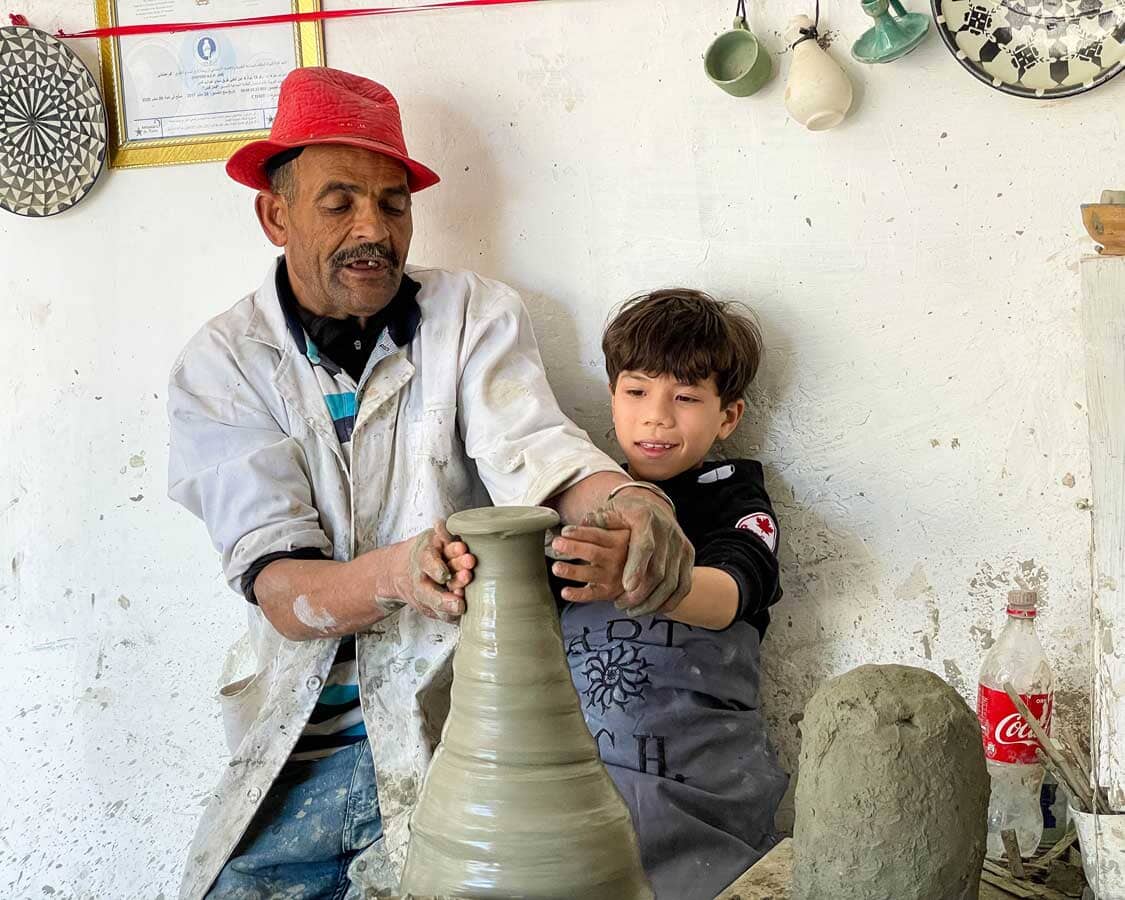
No vaccinations are required for entry into Morocco, but travel health clinics recommend several. Book an appointment at least six weeks before departure to allow time for any multi-dose series to complete.
- Routine vaccinations (MMR, DTaP, polio) should be fully current for every family member before any international travel.
- Hepatitis A is strongly recommended. Morocco’s street food and market culture is one of the great pleasures of the trip – make sure your family is protected before they start enjoying it.
- Hepatitis B is recommended for longer stays or any trip where medical care might be required in-country.
- Typhoid is worth discussing with your travel doctor, particularly if your itinerary includes rural areas, markets, or adventurous eating. Ours did.
Malaria is not a risk in Morocco’s primary tourist regions. Dengue risk is low. Standard mosquito precautions – DEET repellent, covering arms and legs at dusk – are sensible in the south and near standing water.
👀 HEADS UP: Traveler’s Diarrhea Is Real
The tap water in Morocco is not safe to drink anywhere. Bottled water is cheap and available everywhere. For remote and desert areas, bring a filtered water bottle.
Traveler’s diarrhea is a genuine risk. Pack oral rehydration salts and children’s antidiarrheal medication. Moroccan pharmacies are excellent, and pharmacists typically speak French if not English – they are your best resource for minor illnesses on the road.
Morocco’s private hospitals in major cities are well-equipped. Medical facilities become progressively more limited as you move into the mountains and the desert. Pack a solid family medical kit: children’s pain relief, antihistamines, rehydration salts, high-SPF sunscreen, insect repellent with DEET, and any prescription medications in quantities generous enough to cover unexpected delays.
The Regions of Morocco: What Families Need to Know
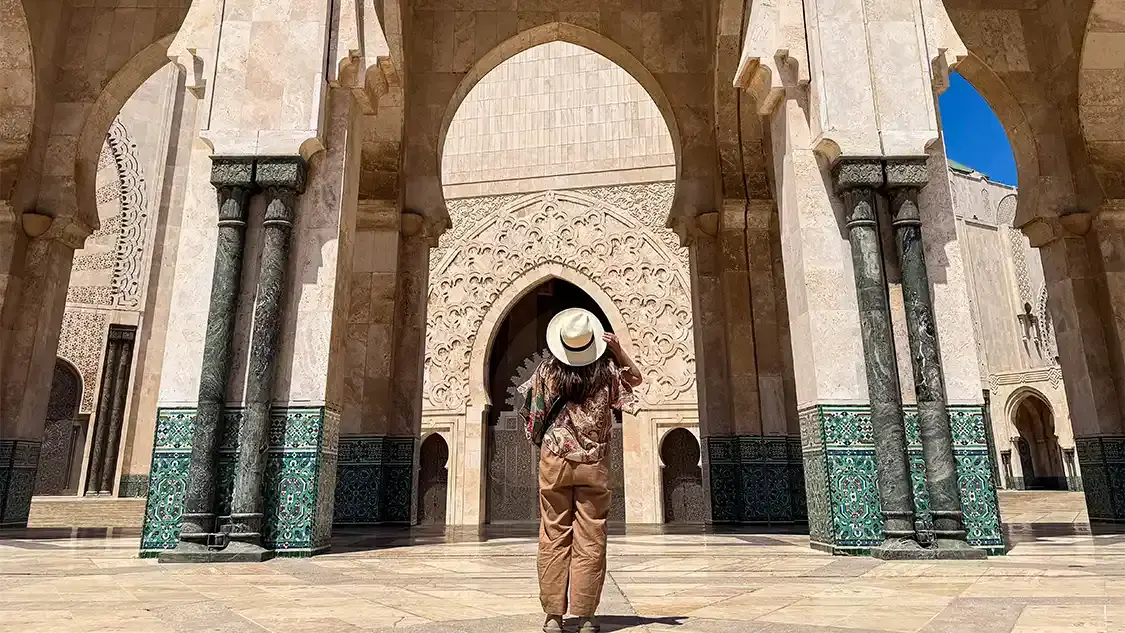
Morocco rewards selective planning far more than it rewards bucket list box-ticking. The families who have the best travel experiences here are the ones who choose fewer places and stay longer. Choose regions based on what your family actually wants – history, adventure, desert, culture – and give each place enough time to become familiar.
For a full destination-by-destination breakdown, see our guide to the best places to visit in Morocco for families. What follows is the practical orientation for each region.
Marrakech
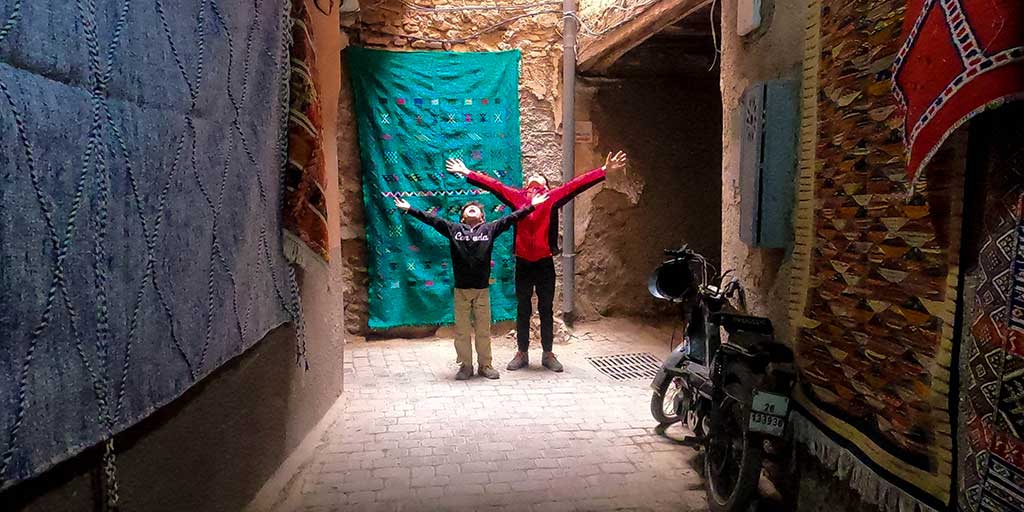
Marrakech is Morocco’s most visited city for good reason. Excellent international connections, strong tourist infrastructure, and a medina that is genuinely overwhelming in the best possible way. The Djemaa el-Fna square alone – snake charmers, storytellers, food stalls, acrobats, all operating simultaneously – is an hour your family will not forget. Give Marrakech at least two full days. Use a local guide for day one.
Fes
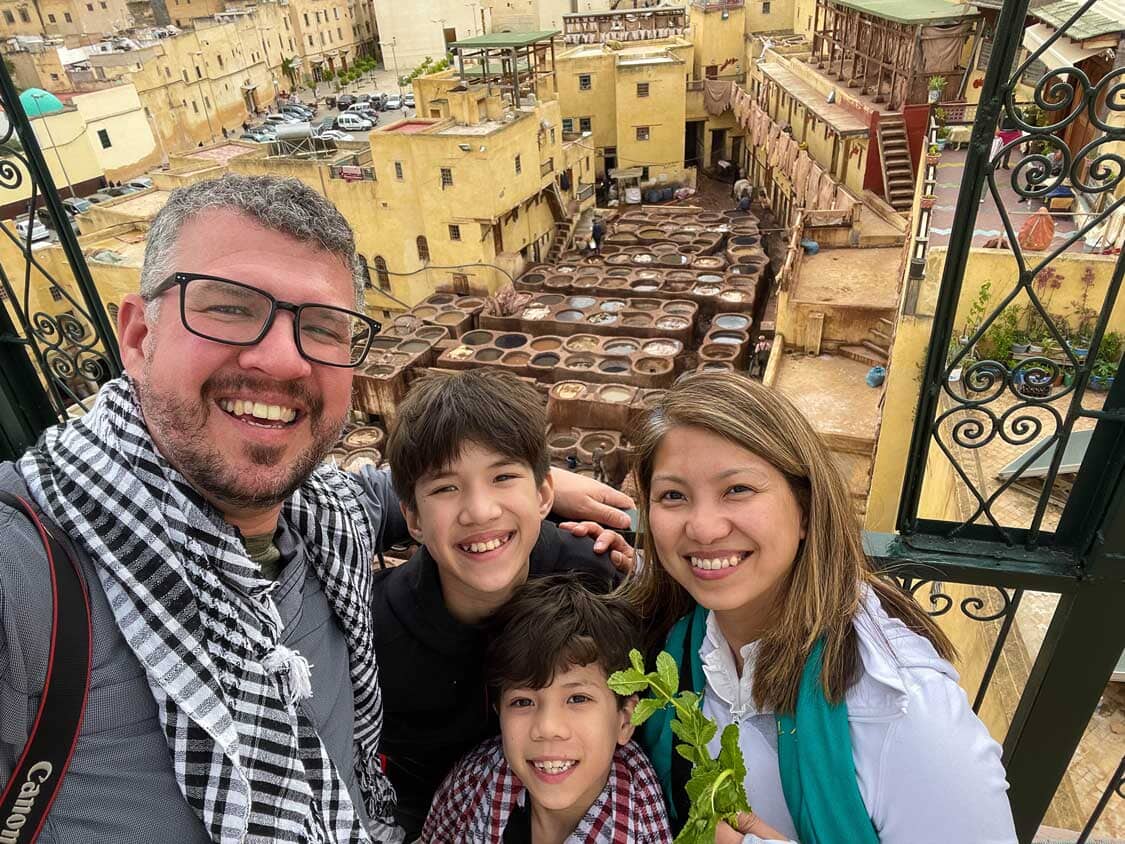
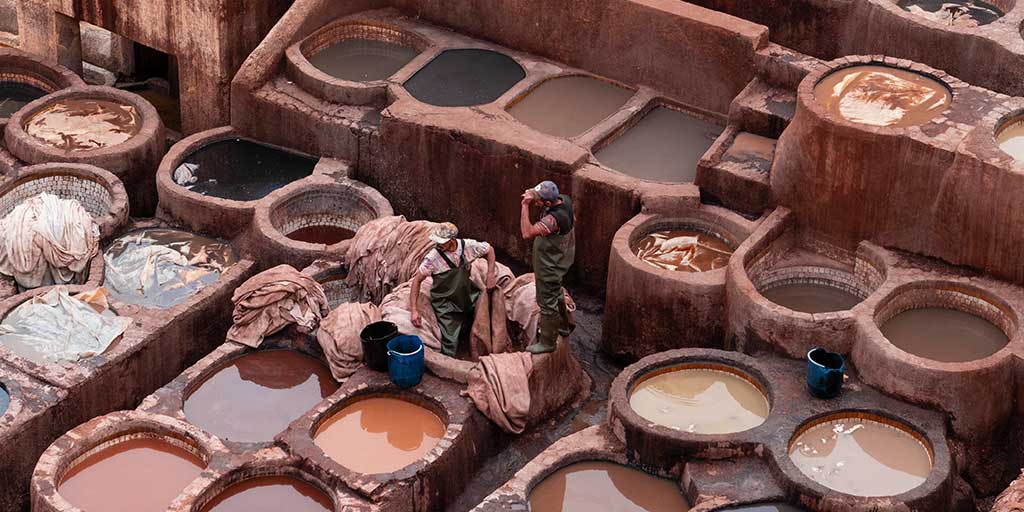
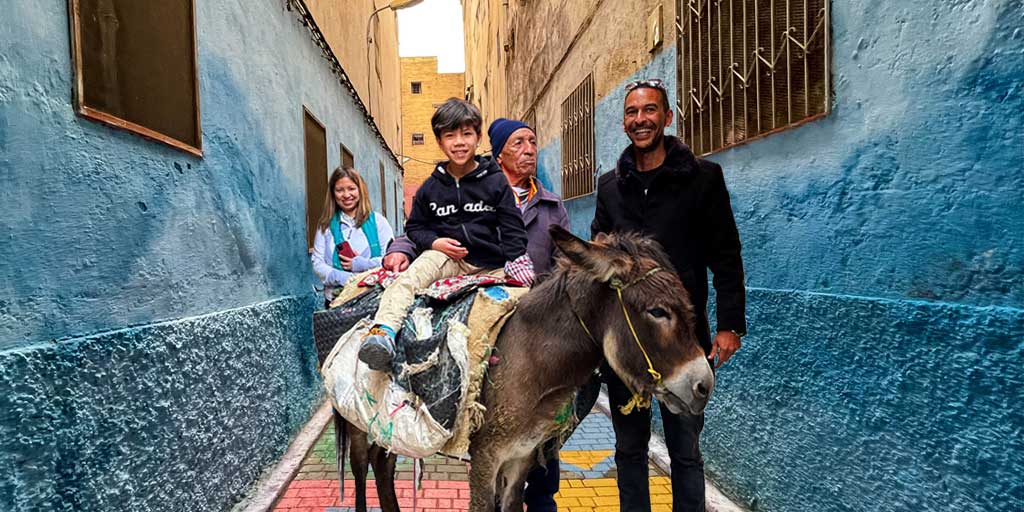
The Fes el-Bali medina is the largest car-free urban area in the world, and navigating it on foot is one of the greatest disorienting pleasures in travel. The tanneries are extraordinary. The craft traditions – copper, leather, ceramics, textiles – are visible in the workshops that line the lanes.
Fes demands more patience than Marrakech and delivers a far more immersive experience. A guide for your first day is not optional here; it is the difference between the experience and the survival exercise.
Merzouga and the Sahara
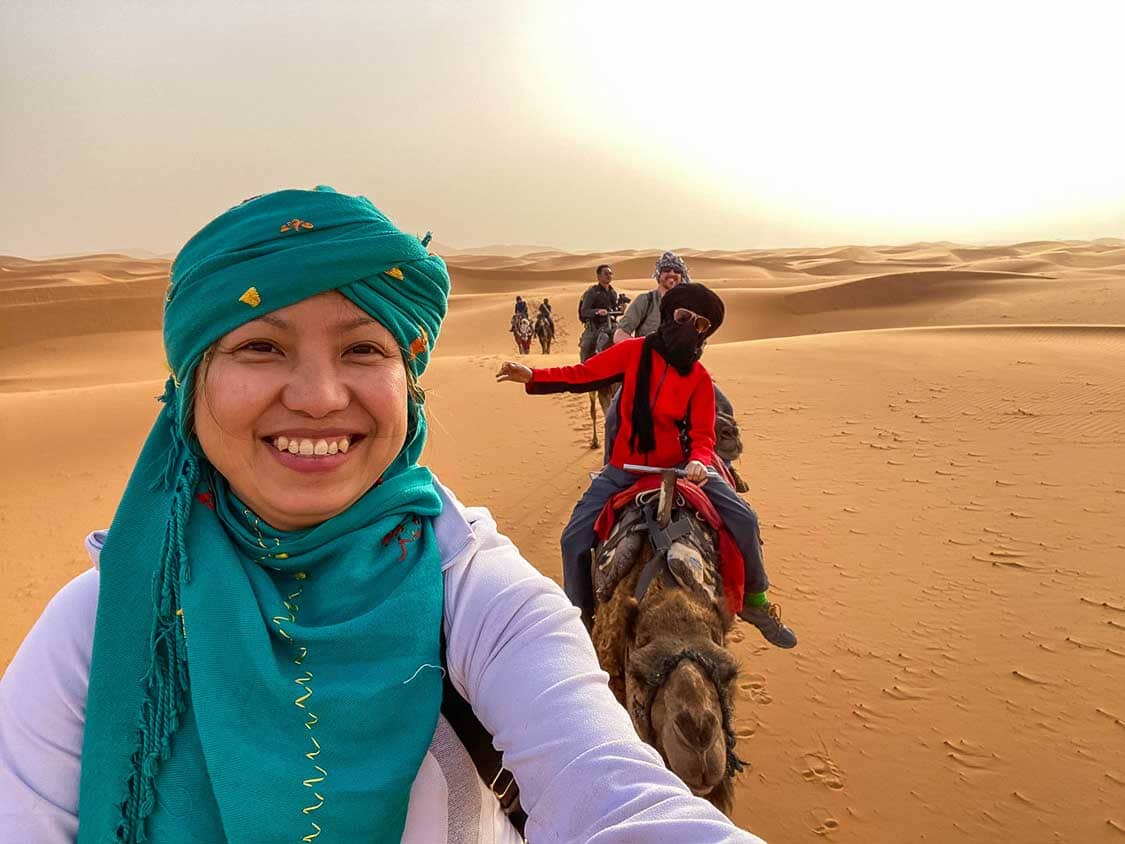
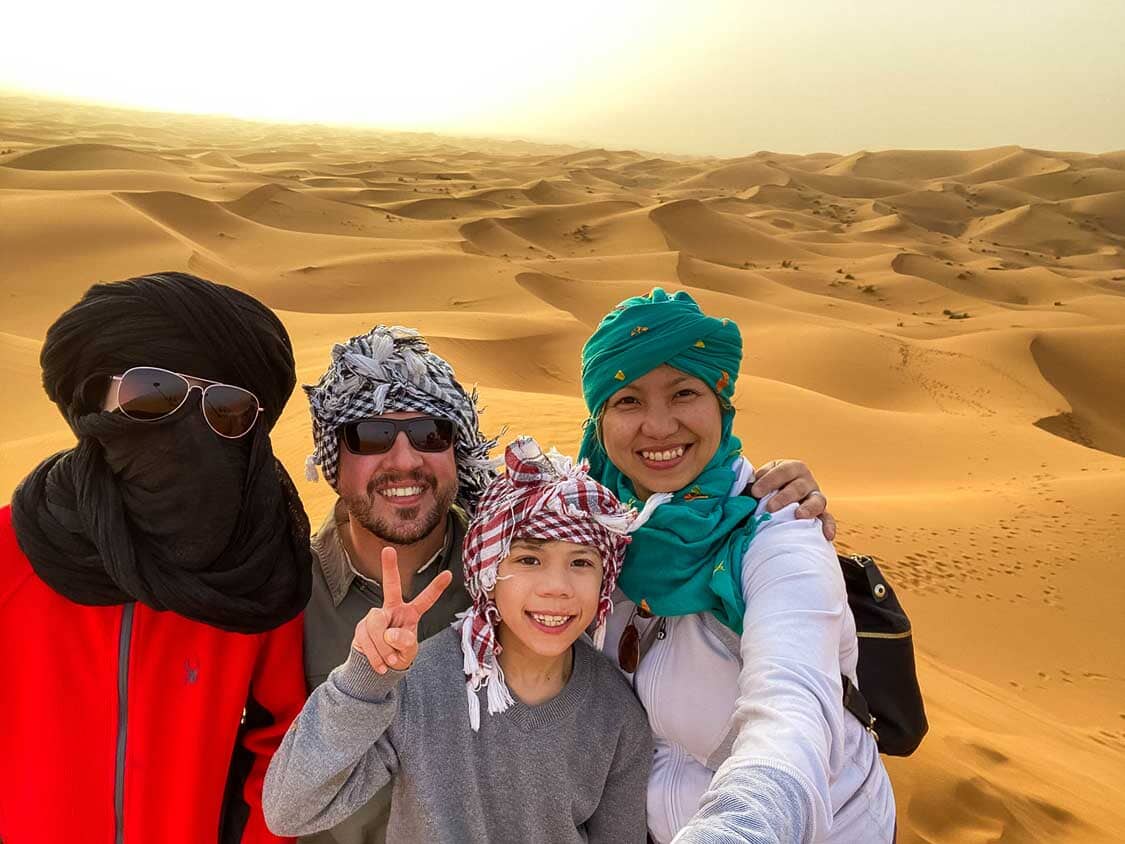
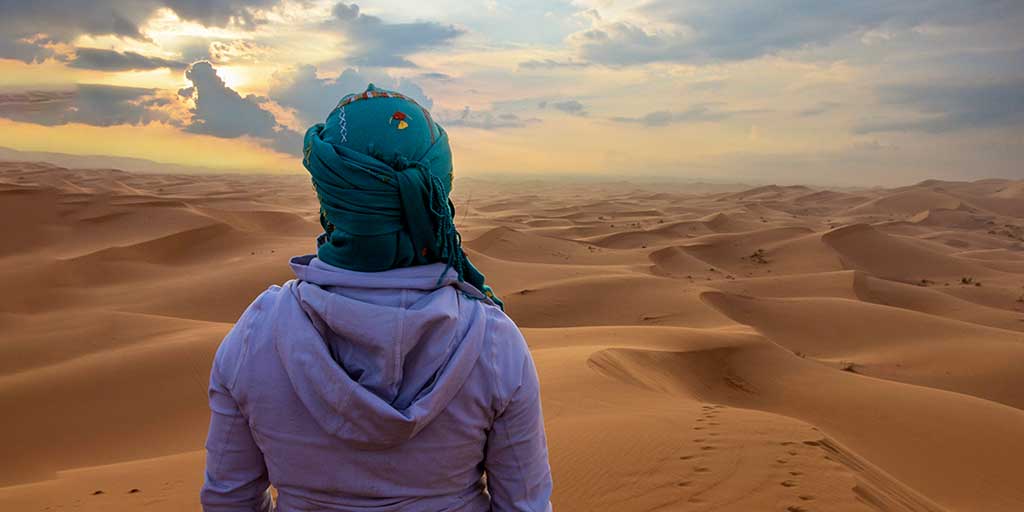
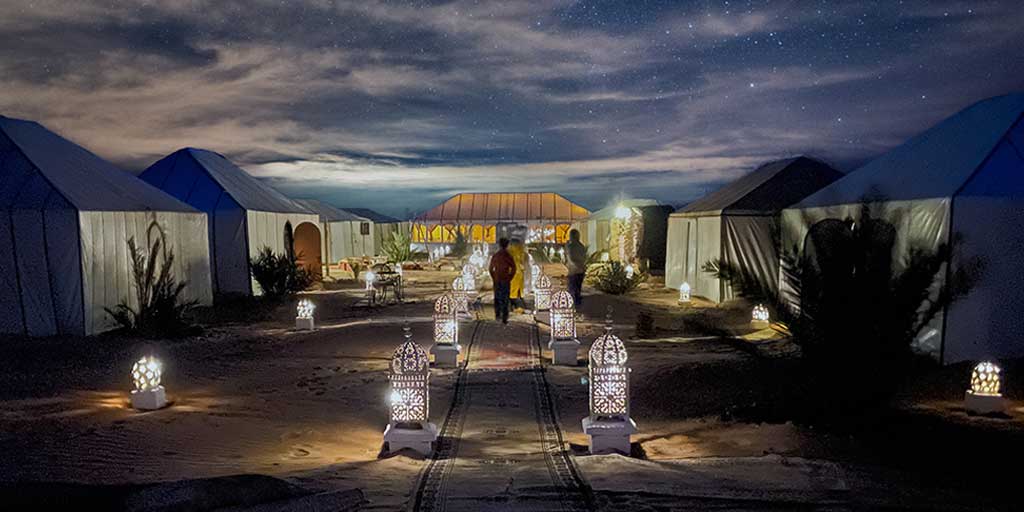
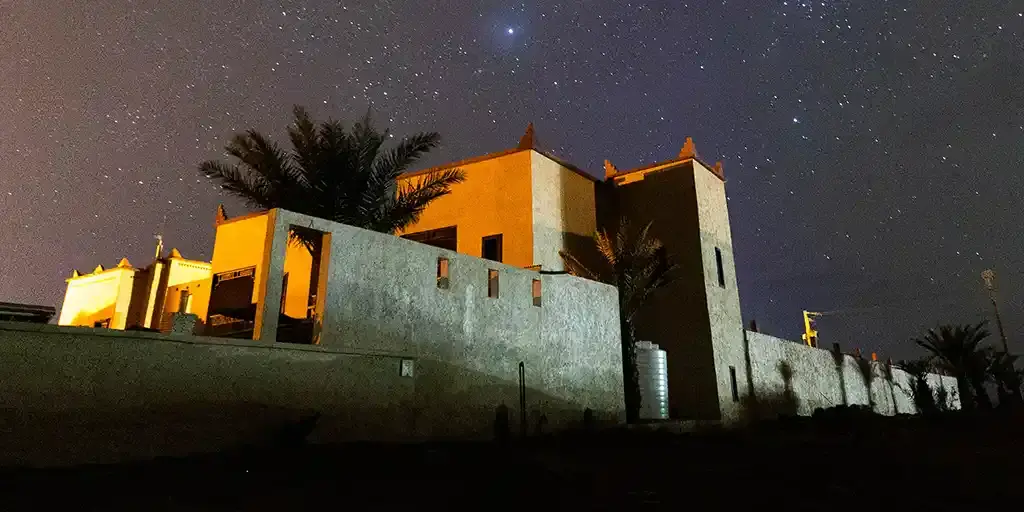
Merzouga is the emotional center of a Moroccan family trip. The Erg Chebbi dunes outside Merzouga rise 150 meters from the flat desert floor, shifting color from pale gold to deep amber at sunset. The overnight desert camp – arriving by camel, eating tagine in a tent, lying on your back watching stars that don’t exist at home – is one of those travel nights that becomes a permanent family reference point. The village of Khamlia, three miles from town, is home to the Gnawa community whose music stopped us completely. No booking required. No entrance fee. Just arrive.
The Southern Circuit: Volubilis, Ouarzazate, and Todra Gorge
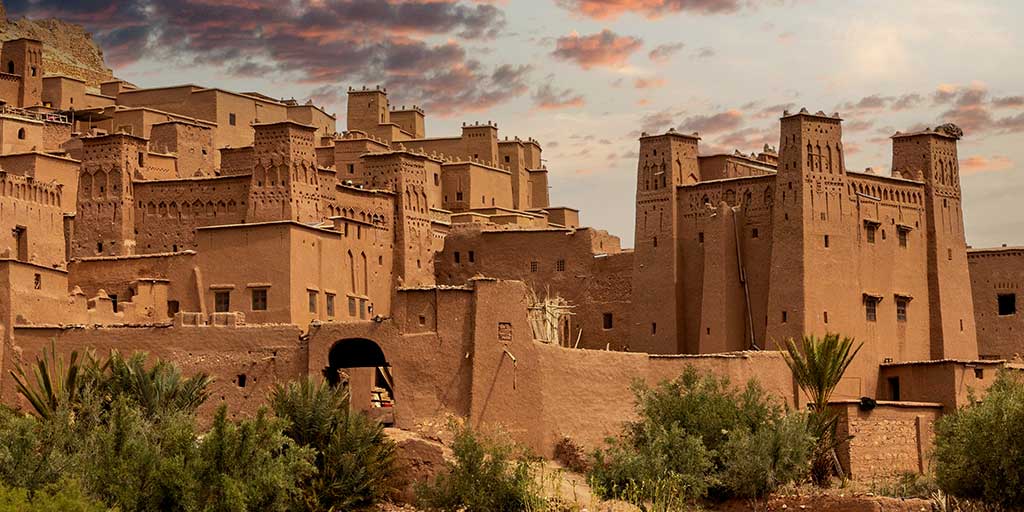
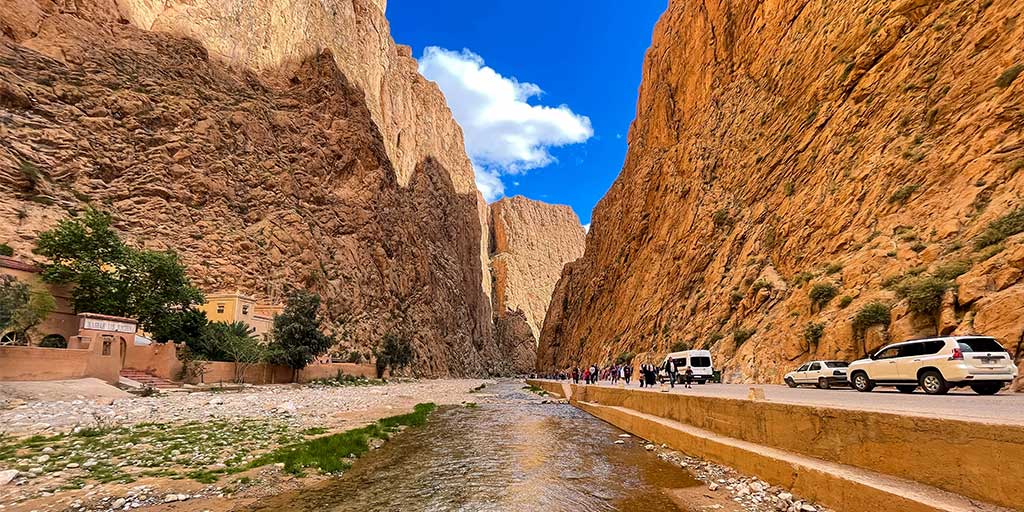
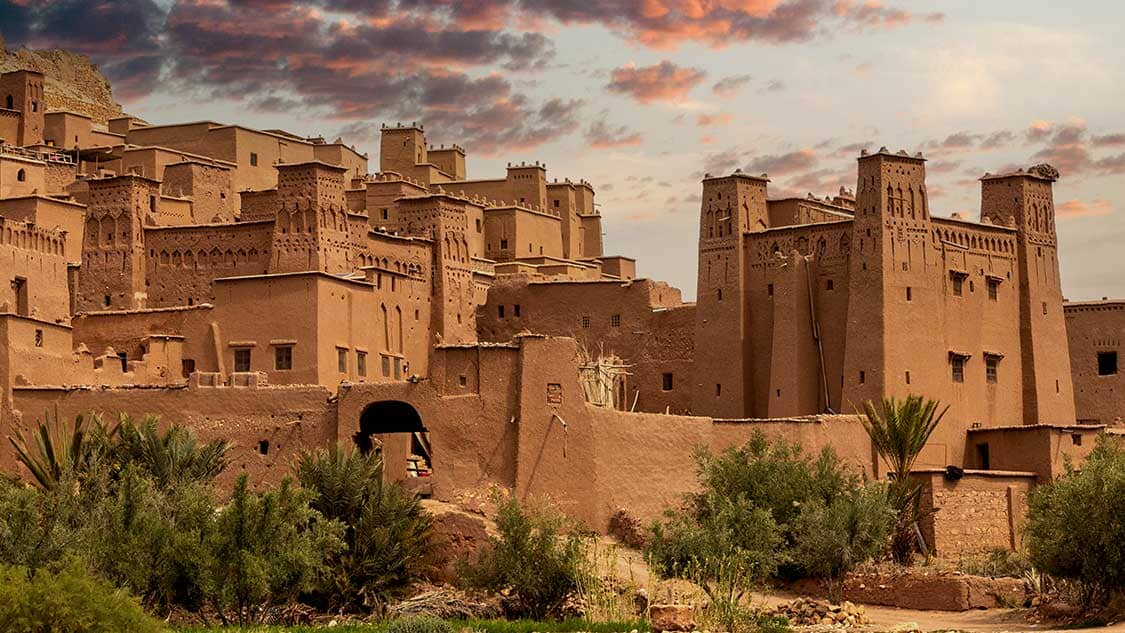
The drive from Marrakech south through the Atlas Mountains is one of the great family road trips in Africa. Ait Ben Haddou – the fortified ksar that has served as the backdrop for more film productions than any other location in Morocco – sits on this route, as does Ouarzazate (gateway to Africa’s “Hollywood”) and the Todra Gorge, where canyon walls rise 300 meters on both sides of a shallow river. Walking the gorge floor with children is viscerally dramatic. The scale makes adults feel small. It makes children feel like they’re inside something ancient.
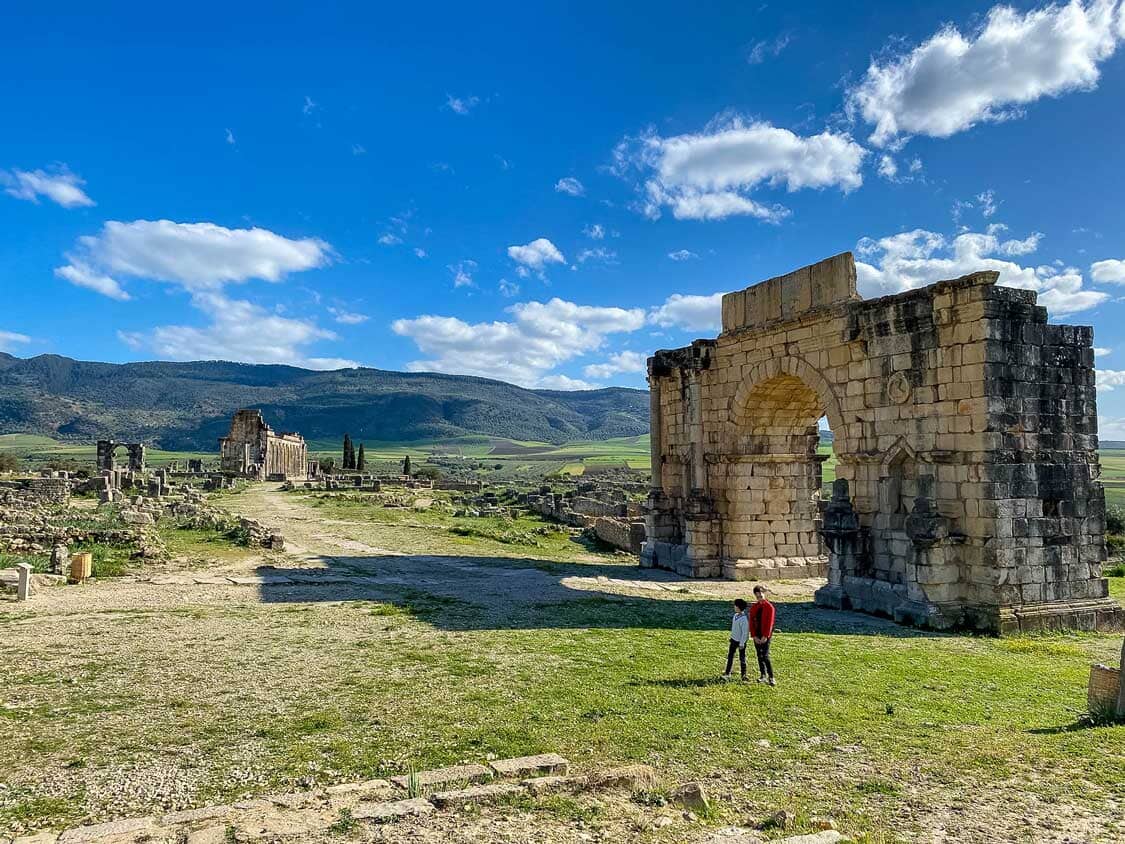
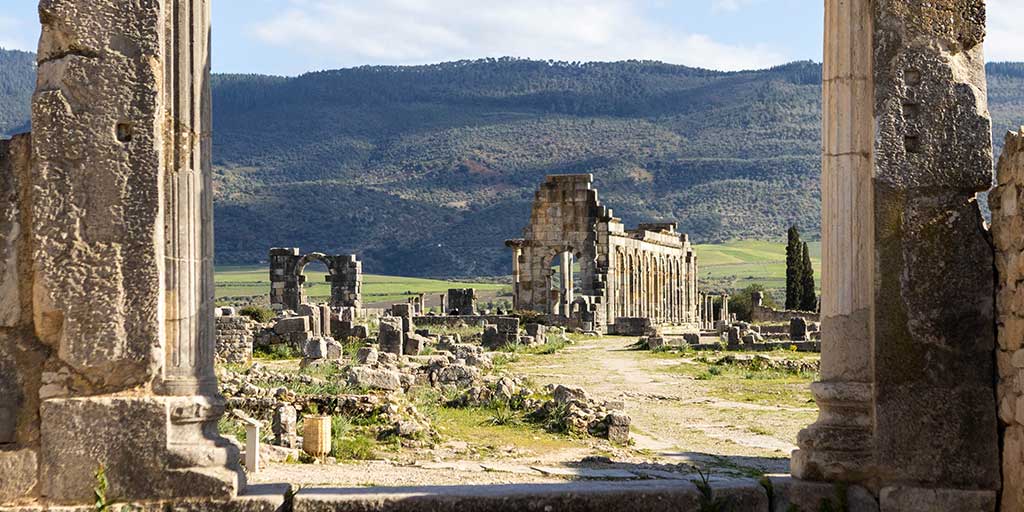
Most families on the southern circuit miss Volubilis, outside Meknes in the north. That is a mistake. Rome’s westernmost frontier, this remarkably preserved site has mosaics still covering villa floors, triumphal arches standing at near-original height, and a scale that lands with real force on children old enough to understand what they’re standing inside. It is not Pompeii, but it belongs in that category of experience.
Casablanca and Rabat
Casablanca is Morocco’s economic engine and largest city. Rabat is the administrative and cultural capital. We visited Casablanca after traveling to Tanzania and Rabat on our first visit to the country. These cities have a very different energy from the imperial cities – more cosmopolitan, more contemporary – and the Hassan II Mosque, one of the largest in the world and open to non-Muslim visitors on guided tours, is among the most architecturally extraordinary buildings on the continent.
Chefchaouen and Essaouira (What We Haven’t Seen)
We have not personally visited Chefchaouen or Essaouira, and we will not pretend otherwise. What families consistently report from Chefchaouen – the famous blue-painted city in the Rif Mountains – is a manageable, photogenic medina at a pace that feels like relief after Marrakech.
Essaouira on the Atlantic coast offers sea air, open space, and a walled medina that is small enough to navigate without a guide. For families wanting to end a Morocco trip with something slower and more coastal, Essaouira is the consistent recommendation
Money and Budgeting for Family Travel in Morocco
The Moroccan Dirham (MAD) is a closed currency, meaning you cannot purchase it outside Morocco. Exchange money on arrival at the airport or at banks in cities – rates are regulated and consistent. Do not change money with individuals on the street, regardless of the rate offered.
Most major credit cards are accepted at established hotels, upscale restaurants, and larger shops in major cities. Outside those contexts – market stalls, smaller restaurants, rural accommodations, desert camps, taxis – assume cash only. Carry more cash than you think you’ll need before heading south or into the Atlas.
ATMs are widely available in cities and most towns. Most charge a transaction fee; withdraw larger amounts less frequently to minimize it. Notify your bank before departure to prevent your card from being flagged on first use abroad.
Bargaining
Bargaining is the mechanism in Moroccan markets. It is not optional, and it is not rude – it is how commerce works here. A rough starting point: open at roughly half the asking price, expect to settle somewhere between. Do not begin bargaining if you have no genuine intention of buying. Do not let children engage with vendors unless you are prepared to complete the transaction.
The bargaining dynamic is one of the genuinely educational experiences of Morocco for older children. It teaches them that price is not fixed, that transactions involve relationships, and that commerce can be completed with everyone feeling respected. Let them watch. Let them participate when they’re ready.
💡 PRO TIP: Morocco Is Affordable
Street food is extraordinarily cheap. Mid-range riads cost a fraction of equivalent hotels in Europe. The desert camp experience – one of the great travel nights available anywhere – is surprisingly accessible financially. Budget meaningfully for the experiences that matter, and you will find Morocco delivers extraordinary value.
What to Pack for Morocco
Morocco presents a specific set of packing challenges that most general travel guides miss: extreme climate variation across a single itinerary, cultural dress requirements in medinas and at religious sites, desert conditions that demand different preparation than any city environment, and terrain that ranges from cobblestoned medina lanes to canyon floors to Saharan dunes.
- Light layers that cover shoulders and knees for medinas and religious sites. For women, a scarf or wrap in your day bag solves nearly every dress code situation.
- Comfortable walking shoes that can handle cobblestones, uneven surfaces, and hours of daily use. The medinas are walking destinations.
- DEET-based insect repellent. Relevant in the south and near any standing water. For children, this non-DEET alternative is a great option.
- High-SPF sunscreen. The desert sun in the south is serious.
- A filtered water bottle. Essential for remote areas, useful everywhere.
- A family medical kit: rehydration salts, children’s antidiarrheal, antihistamine, fever reducer, and a solid first aid kit.
- Warm layers for the desert at night and the Atlas Mountains. Merzouga in the evening is cold. People are consistently surprised by this.
- Download offline maps for Marrakech, Fes, and your driving route before you leave your hotel.
For the complete breakdown, see our Morocco Family Packing List.
Travel Resources for Families Visiting Morocco
For practical planning, safety considerations, and logistics, these dedicated guides provide deeper support for families interested in travel to Morocco.
A Few Things Morocco Will Teach Your Family
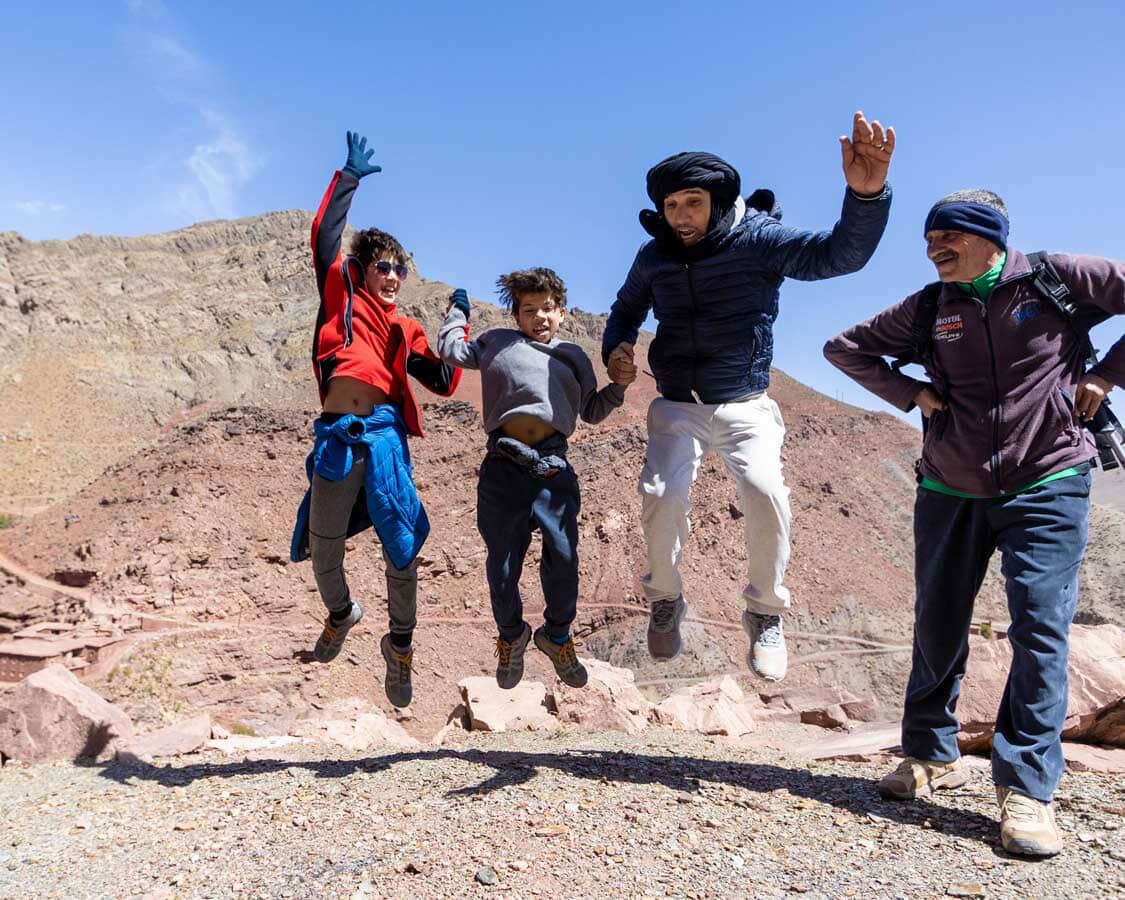
Morocco is one of those countries that leaves something behind in the people who visit it. Not just photographs. Something harder to articulate.
- Pace is a choice. Morocco does not hurry. Meals stretch long after the plates are empty. Negotiations unfold over tea. The families who fight this leave frustrated. The ones who surrender to it leave changed. Your children will learn more about patience in a Moroccan souk than in any classroom.
- Commerce is personal. Every transaction in the medina is a small relationship. The bargaining is not adversarial – it is a form of conversation. Watching your children figure this out and participate in it is one of the unexpected joys of bringing them here.
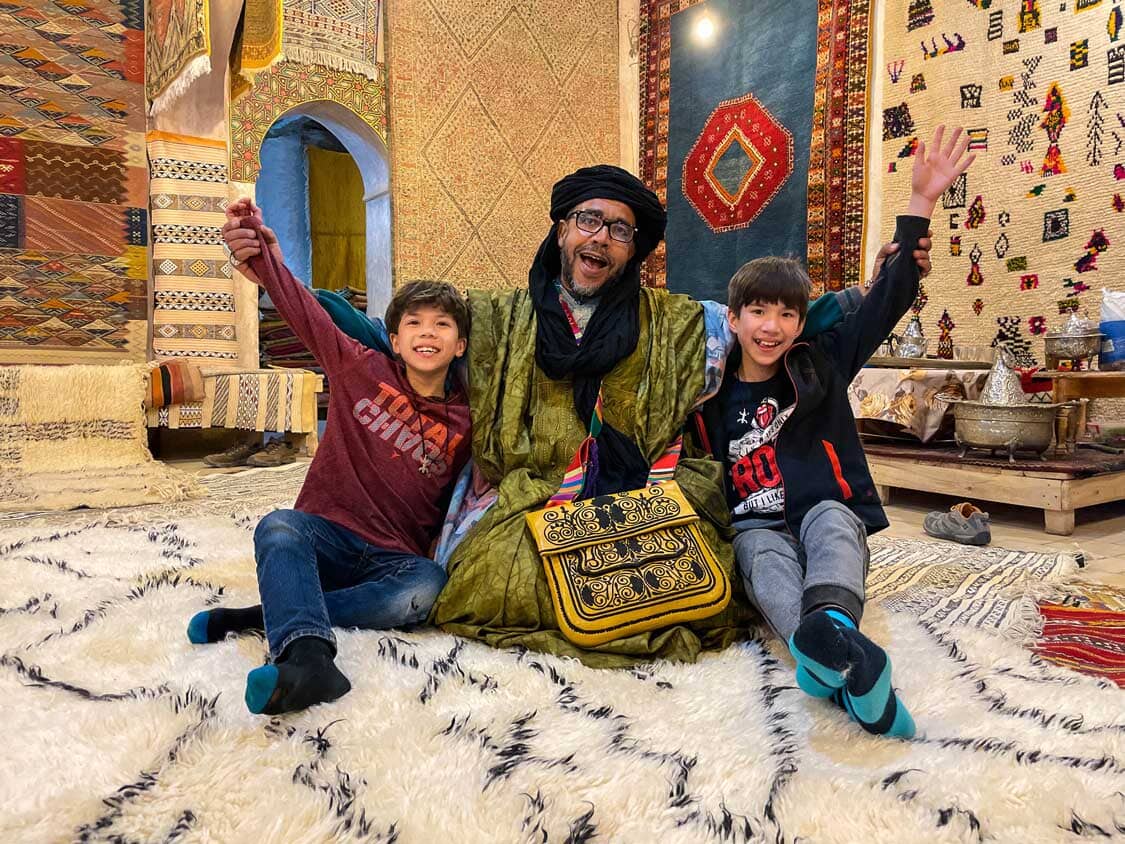
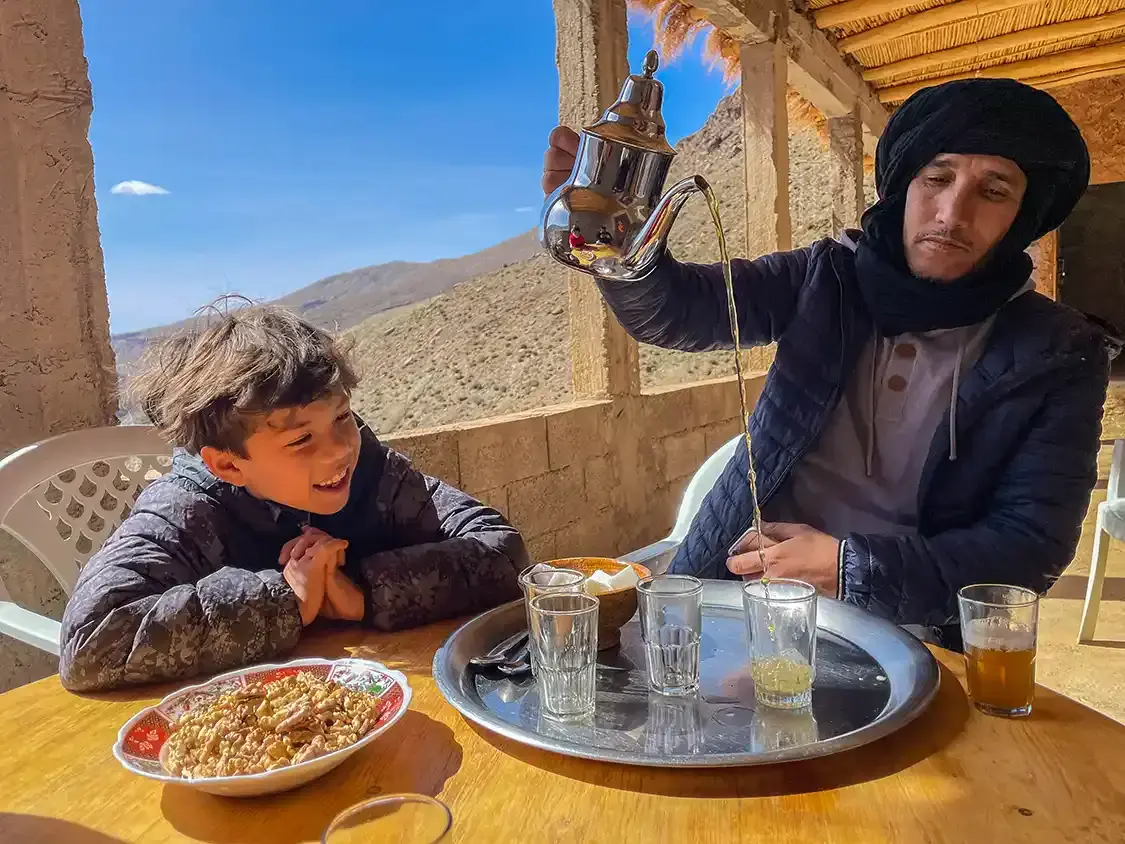
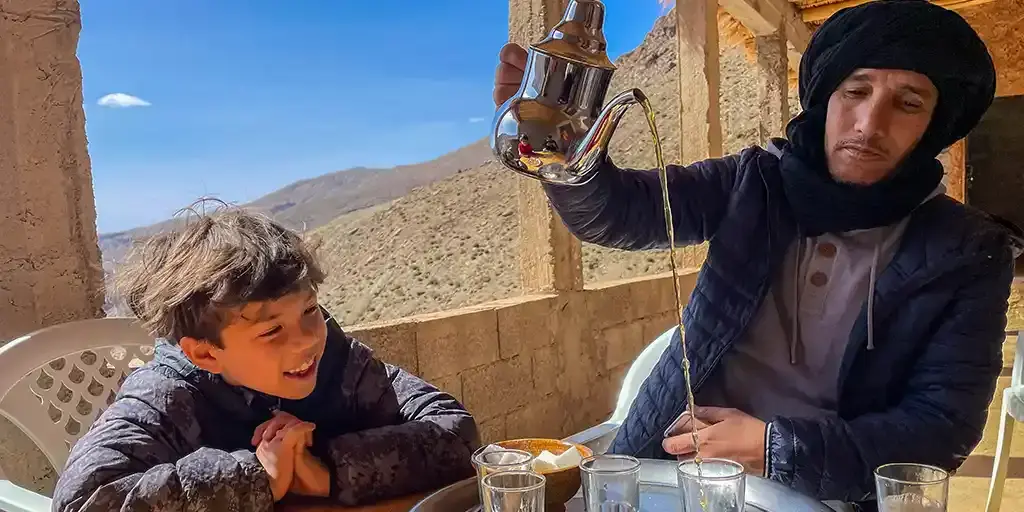
- Generosity runs deeper than you expect. A stranger will press mint tea into your hand. A shopkeeper will pull out a chair for your child without being asked. An elder in the desert will share food you didn’t know was being prepared. The warmth of Morocco toward children is not a performance. It is simply how things are.
- History is not always in museums. The medinas are still lived in. The Roman ruins at Volubilis are still mostly standing. The Saharan trade routes are still traceable across the landscape. Morocco makes history feel immediate in a way that teaches children something no textbook can replicate.
Final Thoughts on Family Travel in Morocco
Morocco is a country that asks something of you from the moment you arrive. Patience. Attention. A willingness to be wrong about what you expected and to embrace what you find instead. It is not always comfortable. It is never forgettable.
What it gives back – to your children most of all – is a travel experience that few other destinations produce as reliably. History that exists outside of museums and is still lived in. A culture practiced daily rather than performed for tourists. A landscape that shifts from mountain to desert to ancient city in a single day’s drive. And people who, when a Gnawa musician takes your son’s hand and pulls him to his feet to dance, are not demonstrating hospitality. They are simply living it.
Go. Take your family. Let Morocco be exactly what it is.
This guide is updated as new regional articles and planning resources are published. Looking beyond Morocco? Explore the International Family Travel Guide.